
Hanwha XNF-9013RV vs Pelco SRXF3-12360-I: Specification Comparison
Both the Hanwha XNF-9013RV and the Pelco SRXF3-12360-I are 12MP fixed fisheye IP cameras targeting full-panoramic coverage from a single mount point. They occupy the same resolution class and share the fisheye form factor, making them genuine cross-shop candidates for integrators evaluating wide-area surveillance. The comparison covers imaging performance, installation environment suitability, and VMS/analytics integration — drawing exclusively from the published specifications provided for each unit.
In This Guide
How do the imaging specs compare?
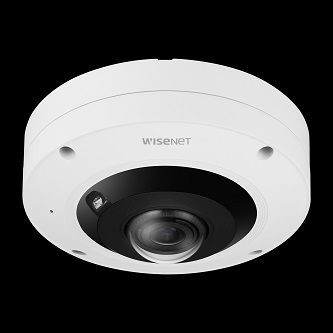
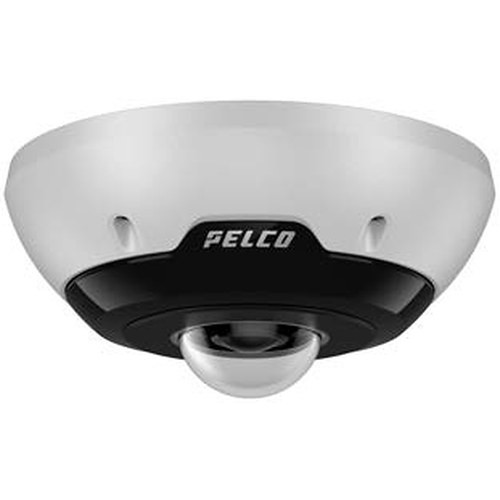
The Hanwha XNF-9013RV uses a 1/2.3" 12MP CMOS sensor producing a native 3008×3008 circular fisheye output at up to 30fps, paired with a 1.08mm f/2.2 fixed lens and a 187° horizontal, vertical, and diagonal field of view. Minimum illumination is rated at 0.39 lux in color mode and 0 lux with its built-in Wise IR active (PoE: 8m range; PoE+: 13m range). Dynamic range is specified at 120dB via Hanwha's extremeWDR. The Pelco SRXF3-12360-I delivers 3840×2160 (4K UHD) output — a rectangular remap rather than a native square — at a maximum of 12.5fps full resolution, through a 2.7mm f/2.5 lens (the spec sheet also lists a 1.4mm focal length, which is internally inconsistent; both values are reproduced here as provided). Minimum illumination for the Pelco is listed as 0.10 lux; no IR illuminator is specified, so the camera depends entirely on ambient light.
The Hanwha's 30fps frame rate is more than double the Pelco's 12.5fps ceiling, which matters for motion capture and forensic review of fast-moving subjects. The Pelco's 3840×2160 pixel array yields higher per-frame pixel density in its remapped output format, while the Hanwha's 3008×3008 native fisheye preserves a true circular panorama. The Hanwha's IR capability and lower lux floor (0 lux IR vs. 0.10 lux ambient-only for the Pelco) give it a measurable advantage in unlit or poorly lit environments. WDR is claimed by both but the Hanwha provides a rated figure of 120dB; the Pelco spec lists WDR as a feature with no dB value published.
What about installation and environment?
The Hanwha XNF-9013RV carries IP66 and IK10 ratings plus NEMA 4X certification, with an operating temperature range of -40°C to +60°C. This makes it suitable for exposed outdoor installations subject to dust, directed water jets, vandalism, and extreme cold. The Pelco SRXF3-12360-I is rated IP52 and IK10, with an operating temperature floor of -10°C and the same +60°C ceiling. IP52 protects against dust ingress in limited quantities and dripping water only; the manufacturer explicitly designates it as an indoor camera. Installers should note that the Pelco cannot be deployed in wet or outdoor environments without additional housing.
Both cameras are powered via PoE+ (802.3at) and are classified as PoE Class 3. The Hanwha also accepts 12VDC as an alternative input. Maximum power draw for the Hanwha is stated at 12.95W; no maximum wattage figure is provided in the Pelco specs. The Hanwha's physical dimensions are Ø160×72mm at 1,170g (2.58 lb). The Pelco measures 6"×6"×2.81" with a published weight described in the specs as "1.001kg (2.21lb) N/A" — the N/A qualifier suggests the figure may be configuration-dependent. The Hanwha includes a named hanging mount accessory (SBP-167HMW) and skin cover (SBC-160BF); Pelco mounting accessory details are not enumerated in the provided specs.
Which fits your VMS and analytics better?
The Hanwha XNF-9013RV supports ONVIF Profile S, G, T, and M, as well as Hanwha's proprietary SUNAPI and Wisenet SDK. Its AI analytics engine covers person, face, vehicle, and license plate object detection, plus people counting, queue management, heatmap, virtual line crossing/direction, and virtual area loitering/intrusion/enter/exit — all edge-resident. The camera streams up to 10 simultaneous profiles with up to 5 virtual channels and supports up to 20 unicast users or multicast. The Pelco SRXF3-12360-I supports ONVIF Profile S and Profile T. Its analytics are described as "Pelco Smart Analytics; 8 behaviors" with no further enumeration of behavior types in the provided specs. Both cameras comply with ONVIF Profile S, ensuring baseline VMS interoperability.
For on-board storage, the Hanwha provides dual microSD/SDHC/SDXC slots supporting up to 1TB (512GB×2); the Pelco lists microSD storage support but no capacity figure is provided in the supplied specs. Audio input on the Hanwha is selectable (mic-in/line-in/built-in mic) with line-level output; the Pelco spec references microphone support without specifying line-in or line-out capability. The Hanwha's protocol list includes SNMPv1/v2c/v3, 802.1X (EAP-TLS, EAP-LEAP), SRTP, and device certificate support under Hanwha Techwin Root CA. Equivalent protocol or security certificate details are not enumerated in the Pelco specifications provided.
Which should you choose: the XNF-9013RV or the SRXF3-12360-I?
Our take: The XNF-9013RV is the stronger choice when the deployment demands outdoor durability, active IR night vision, higher frame rates, or deeper AI analytics. Its IP66/NEMA 4X rating versus the SRXF3-12360-I's IP52 indoor rating is a hard constraint — the Pelco cannot be installed in exposed locations. The Hanwha's 30fps versus the Pelco's 12.5fps full-resolution frame rate is a 2.4× advantage for motion capture. The Hanwha's minimum illumination of 0 lux (IR active) against the Pelco's 0.10 lux ambient-only floor means it operates in total darkness where the Pelco cannot. The Pelco SRXF3-12360-I is the appropriate choice for controlled indoor ceiling deployments where its 3840×2160 4K rectangular output is preferred and ambient lighting is reliable. Its 5-year warranty extends one year beyond the Hanwha's 3-year coverage. Platform integrators should verify their VMS supports ONVIF Profile M (Hanwha only) or proprietary SDKs before specifying either unit.
Side-by-Side Comparison
Spec-for-spec, from manufacturer data.
| Specification | Hanwha XNF-9013RV | Pelco SRXF3-12360-I |
|---|---|---|
| Resolution | 12MP (3008×3008 native) | 12MP (3840×2160 remapped) |
| Image Sensor | 1/2.3" 12MP CMOS | Not specified |
| Lens / Focal Length | 1.08mm fixed, f/2.2 | 2.7mm f/2.5 (also listed as 1.4mm — inconsistency in provided specs) |
| Field of View | H/V/D: 187° | 180° / 360° |
| Max Frame Rate | 30fps | 12.5fps at full resolution |
| Min. Illumination | 0.39 lux color / 0 lux IR | 0.10 lux (ambient only, no IR) |
| IR Illuminator | Built-in Wise IR (8m PoE / 13m PoE+) | None |
| Wide Dynamic Range | extremeWDR, 120dB | WDR (no dB value specified) |
| Video Compression | H.265, H.264, MJPEG | H.264 (H.265 listed in alternate spec field — inconsistency in provided specs) |
| IP Rating | IP66 | IP52 |
| IK / Impact Rating | IK10 | IK10 |
| Operating Temperature | -40°C to +60°C | -10°C to +60°C |
| Power Input / PoE Class | PoE (802.3af, Class 3), PoE+, 12VDC / 12.95W max | PoE+ / max wattage not specified |
| ONVIF Profiles | S, G, T, M | S, T |
| Edge Storage | Dual microSD/SDHC/SDXC, up to 1TB (512GB×2) | microSD (capacity not specified) |
| Audio | Selectable mic-in / line-in / built-in mic; line out | Microphone supported (line-in/out not specified) |
| Outdoor Ready | Yes (IP66, NEMA 4X) | No (IP52, indoor only) |
| Dimensions | Ø160×72mm (6.23"×2.84") | 6"×6"×2.81" |
| Weight | 1,170g (2.58 lb) | 1,001g (2.21 lb) |
| Warranty | 3 years | 5 years |
Frequently Asked Questions
Which should you choose: the XNF-9013RV or the SRXF3-12360-I?
The XNF-9013RV is the stronger choice when the deployment demands outdoor durability, active IR night vision, higher frame rates, or deeper AI analytics. Its IP66/NEMA 4X rating versus the SRXF3-12360-I's IP52 indoor rating is a hard constraint — the Pelco cannot be installed in exposed locations. The Hanwha's 30fps versus the Pelco's 12.5fps full-resolution frame rate is a 2.4× advantage for motion capture. The Hanwha's minimum illumination of 0 lux (IR active) against the Pelco's 0.10 lux ambient-only floor means it operates in total darkness where the Pelco cannot. The Pelco SRXF3-12360-I is the appropriate choice for controlled indoor ceiling deployments where its 3840×2160 4K rectangular output is preferred and ambient lighting is reliable. Its 5-year warranty extends one year beyond the Hanwha's 3-year coverage. Platform integrators should verify their VMS supports ONVIF Profile M (Hanwha only) or proprietary SDKs before specifying either unit.
Is the XNF-9013RV or SRXF3-12360-I better for low-light performance?
The XNF-9013RV is significantly better for low-light use. It includes a built-in IR illuminator rated at 8m (PoE) or 13m (PoE+) and a minimum illumination of 0 lux when IR is active, meaning it can capture images in total darkness. The SRXF3-12360-I has no IR illuminator and requires ambient light, with a minimum illumination spec of 0.10 lux — making it dependent on existing lighting in the scene.
Can the Pelco SRXF3-12360-I be used outdoors?
No. The SRXF3-12360-I is rated IP52, which provides only limited protection against dust ingress and dripping water. The manufacturer designates it as an indoor camera. The Hanwha XNF-9013RV, by contrast, carries an IP66, IK10, and NEMA 4X rating and an operating temperature range down to -40°C, making it suitable for exposed outdoor installations.
Which camera offers more advanced edge analytics?
The XNF-9013RV provides more detailed analytics as specified: AI-based object detection for person, face, vehicle, and license plate; people counting; queue management; heatmap; virtual line crossing; and virtual area loitering/intrusion/enter/exit detection. The SRXF3-12360-I lists 'Pelco Smart Analytics with 8 behaviors' but does not enumerate the specific behaviors in the provided specifications. Integrators requiring named AI classification categories should verify Pelco's current analytics documentation directly.
Get a Second Opinion on Your Camera Choice
Share your site layout, coverage goals, and budget. Our team will validate the camera selection, flag anything we would change, and recommend products that match the use case.