
Hanwha XND-9083RV vs i-PRO U85402-V2L: Specification Comparison
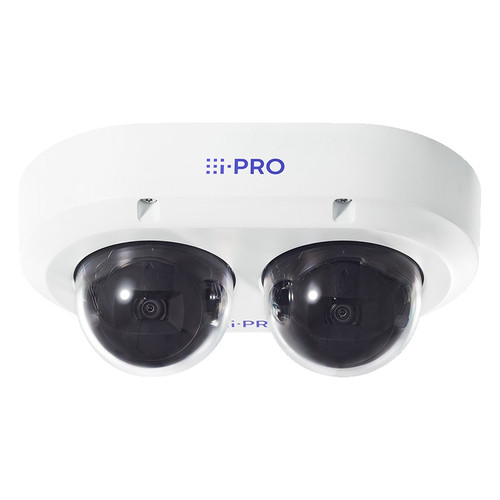
Both the Hanwha XND-9083RV and the i-PRO WV-U85402-V2L are fixed IP dome cameras targeting the 8MP-class market, but they differ fundamentally in architecture: the Hanwha is a single-sensor 4K (3840×2160) indoor/outdoor vandal dome, while the i-PRO is a dual-sensor design combining two 4MP (2688×1520) imagers in one outdoor housing. A buyer comparing these is weighing single-sensor 4K resolution with superior WDR and richer AI analytics against a dual-lens 8MP-aggregate platform with broader environmental ratings and higher ingress protection.

In This Guide
How do the imaging specs compare?
The XND-9083RV uses a single 1/1.8" progressive CMOS sensor delivering a true 3840×2160 (4K) frame at 30 fps, with a motorized varifocal lens spanning 4.4–9.3 mm (2.1× zoom) and a wide-end aperture of F1.3. Its extremeWDR is rated at 120 dB, minimum color illumination is 0.04 lux, and IR range extends to 50 m via WiseIR. The WV-U85402-V2L pairs two 1/2.7" CMOS sensors, each at 2688×1520, for a combined 8MP field with a 2.9–7.3 mm motorized lens (2.5× optical zoom) and an F2.0 wide-end aperture. Its Super Dynamic WDR tops out at 108 dB, and minimum illumination is 0.12 lux color, with IR reaching 40 m at 30 IRE.
On DORI metrics, the Hanwha holds a detection range of 50.8 m (wide) vs. the i-PRO's 45.1 m (wide), and extends to 176.6 m at tele vs. 136.5 m at tele—reflecting the higher native resolution. The Hanwha's 120 dB extremeWDR outpaces the i-PRO's 108 dB Super Dynamic rating by 12 dB, and its F1.3 aperture gathers more light than the i-PRO's F2.0 at wide-end, translating to the lower 0.04 lux figure versus 0.12 lux. The i-PRO offers a marginally longer zoom stroke (2.5× vs. 2.1×) but at the cost of a smaller sensor and narrower aperture.
What about installation and environment?
The XND-9083RV carries an IP52 / IK10 rating—dust-protected and splash-resistant but not rain-immersion rated—making it suitable for sheltered outdoor or indoor vandal environments. Operating temperature is –25 °C to +50 °C. It is PoE+ (802.3at Class 4) or 12 VDC, with a maximum draw of 22.5 W. The dome measures ø160×125 mm and weighs 1,600 g. It is aluminum-bodied with a hard-coated bubble.
The WV-U85402-V2L is rated IP67 / IP66, NEMA 4X, and IK10, meaning full dust-tight and submersion-level water resistance suitable for direct rain and washdown environments—significantly more robust than the Hanwha's IP52. Its operating range is –40 °C (power-on –20 °C) to +60 °C, a wider envelope than the Hanwha on both ends. It also includes an anti-condensation Temish element and NEMA TS 2 compliance for traffic applications. Power is PoE+ (18.9 W) or DC 54V. Physical footprint is 250×150×105 mm at approximately 1.8 kg. For fully exposed outdoor deployments—rooftops, parking structures, direct precipitation—the i-PRO's ingress protection is the decisive environmental advantage.
Which fits your VMS and analytics better?
Both cameras support ONVIF Profile S/G/T and H.265/H.264/MJPEG compression. The Hanwha additionally declares ONVIF Profile M (metadata), SUNAPI, and Wisenet SDK, and streams up to 10 simultaneous profiles with 3 virtual channels for up to 20 unicast users. The i-PRO supports 24 simultaneous users and adds ONVIF Profile G for on-board storage management. Edge storage is dual microSD slots up to 1 TB total on the Hanwha versus a single microSD up to 512 GB on the i-PRO.
On analytics, the Hanwha runs an AI engine classifying Person, Face, Vehicle (with sub-type: car/bus/truck/motorcycle/bicycle), and License Plate, plus virtual line crossing, virtual area intrusion, people counting, queue management, and heatmap—all on-device. It supports up to 32 privacy mask zones and 8 motion detection polygons. The i-PRO lists VMD (4 areas), SCD (1 area), and audio detection on-spec; its AI Analytics field is listed as '–' in the provided specification, meaning AI object classification is not spec-confirmed for this SKU. Security posture differs: the Hanwha specifies TPM 2.0 (FIPS 140-2 Level 2); the i-PRO specifies FIPS 140-2 Level 3—the higher of the two. Both support 802.1X, HTTPS, and audio I/O.
Which should you choose: the XND-9083RV or the U85402-V2L?
Our take: The XND-9083RV is the stronger choice when resolution, WDR headroom, and on-device AI analytics are the primary decision drivers. It delivers a true 3840×2160 4K image versus the i-PRO's 2688×1520 per-sensor output, a 120 dB extremeWDR rating versus 108 dB, and a spec-confirmed AI engine classifying five object types including license plates—versus the i-PRO's unconfirmed AI analytics field. Its F1.3 aperture and 0.04 lux minimum illumination also undercut the i-PRO's 0.12 lux. However, the WV-U85402-V2L is the correct selection for fully exposed outdoor installations: its IP67/NEMA 4X rating is substantially more robust than the Hanwha's IP52, its operating range extends to –40 °C versus –25 °C, and its dual-sensor architecture provides overlapping coverage in a single mount. Choose the Hanwha for high-resolution analytics in sheltered or semi-exposed locations; choose the i-PRO where sustained weather exposure and dual-coverage geometry are non-negotiable.
Side-by-Side Comparison
Spec-for-spec, from manufacturer data.
| Specification | Hanwha XND-9083RV | i-PRO U85402-V2L |
|---|---|---|
| Resolution | 3840×2160 (8MP, single sensor) | 2688×1520 per sensor × 2 (dual 4MP) |
| Image Sensor | 1/1.8" progressive CMOS | 2× 1/2.7" CMOS |
| Lens / Focal Length | 4.4–9.3 mm motorized varifocal (2.1×) | 2.9–7.3 mm motorized varifocal (2.5×) |
| Max Aperture (Wide) | F1.3 | F2.0 |
| Min Illumination | 0.04 lux color / 0 lux (IR) | 0.12 lux (BW, 50IRE, F2.0, 1/30s) |
| IR Range | 50 m (WiseIR) | 40 m (30IRE) / 30 m (50IRE) |
| WDR | 120 dB (extremeWDR) | 108 dB (Super Dynamic) |
| Max Frame Rate | 30 fps @ 8MP | 30 fps |
| Video Compression | H.265, H.264, MJPEG | H.265, H.264, MJPEG |
| IP Rating | IP52 | IP67 / IP66 / NEMA 4X |
| IK / Impact Rating | IK10 | IK10 |
| Operating Temperature | –25°C to +50°C | –40°C to +60°C (power-on: –20°C) |
| Power Input / PoE Class | PoE+ (802.3at Class 4) or 12 VDC; 22.5 W max | PoE+ (802.3at); 18.9 W or DC 54V |
| Edge Storage | Dual microSD up to 1 TB (512 GB × 2) | Single microSD up to 512 GB |
| AI Analytics | On-device: Person, Face, Vehicle (sub-types), License Plate, people counting, heatmap | VMD (4 areas), SCD (1 area); AI Analytics not spec-confirmed (listed '–') |
| ONVIF Profiles | S / G / T / M | G / S / T |
| Security / TPM | TPM 2.0 (FIPS 140-2 Level 2), 802.1X | FIPS 140-2 Level 3, 802.1X |
| Alarm I/O | 2 configurable I/O ports | 3 alarm I/O terminals |
| Weight | 1,600 g (3.53 lb) | Approx. 1.8 kg |
| Warranty | 3-year | 3-year |
Frequently Asked Questions
Which should you choose: the XND-9083RV or the U85402-V2L?
The XND-9083RV is the stronger choice when resolution, WDR headroom, and on-device AI analytics are the primary decision drivers. It delivers a true 3840×2160 4K image versus the i-PRO's 2688×1520 per-sensor output, a 120 dB extremeWDR rating versus 108 dB, and a spec-confirmed AI engine classifying five object types including license plates—versus the i-PRO's unconfirmed AI analytics field. Its F1.3 aperture and 0.04 lux minimum illumination also undercut the i-PRO's 0.12 lux. However, the WV-U85402-V2L is the correct selection for fully exposed outdoor installations: its IP67/NEMA 4X rating is substantially more robust than the Hanwha's IP52, its operating range extends to –40 °C versus –25 °C, and its dual-sensor architecture provides overlapping coverage in a single mount. Choose the Hanwha for high-resolution analytics in sheltered or semi-exposed locations; choose the i-PRO where sustained weather exposure and dual-coverage geometry are non-negotiable.
Is the XND-9083RV or WV-U85402-V2L better for low-light performance?
Based on the provided specs, the XND-9083RV has a lower minimum color illumination (0.04 lux vs. 0.12 lux) and a wider maximum aperture (F1.3 vs. F2.0 at wide-end), along with a longer IR range (50 m vs. 40 m). On these spec-sheet figures, the XND-9083RV has the advantage in low-light and no-light IR conditions.
Which camera can be installed in direct rain or outdoor washdown areas?
The WV-U85402-V2L is rated IP67, IP66, and NEMA 4X, meaning it is fully dust-tight and rated for temporary water immersion and high-pressure washdown. The XND-9083RV is rated IP52, which is dust-protected and splash-resistant but not submersion or heavy rain rated. For direct outdoor exposure, the i-PRO is the appropriate choice.
Does either camera include AI object classification on the edge without a separate server?
The XND-9083RV's specifications explicitly list on-device AI analytics classifying Person, Face, Vehicle (with sub-types: car, bus, truck, motorcycle, bicycle), and License Plate, plus business intelligence features (people counting, queue management, heatmap). The WV-U85402-V2L's 'AI Analytics' field is listed as '–' in the provided specification, so AI object classification is not confirmed for this SKU from the available data.
Get a Second Opinion on Your Camera Choice
Share your site layout, coverage goals, and budget. Our team will validate the camera selection, flag anything we would change, and recommend products that match the use case.