
Hanwha XNB-9002 vs Hanwha XNB-9003: Specification Comparison
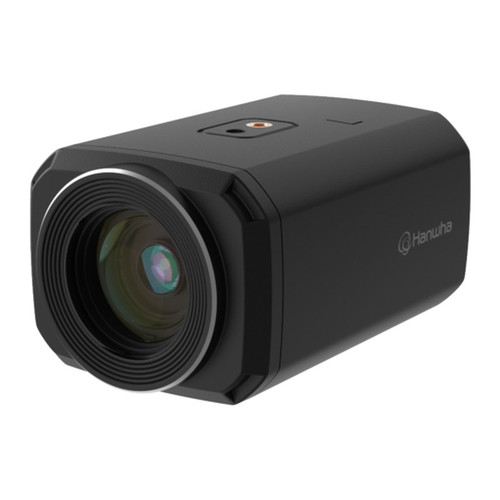
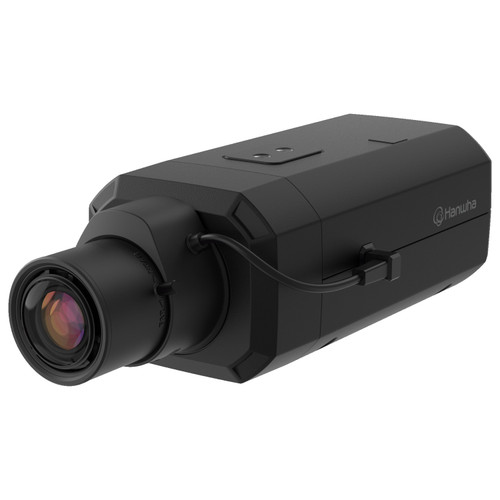
The Hanwha XNB-9002 and XNB-9003 are both 8MP (3840×2160) wired box-type IP cameras sharing the same physical footprint, PoE Class 3 power budget, and C/CS-mount lens compatibility. Both target installers who need a high-resolution, lens-interchangeable platform for demanding fixed-camera deployments. The meaningful differences lie in sensor size and low-light sensitivity, the depth of on-board AI analytics, smart-codec generation, and cybersecurity hardening — areas where the two models diverge despite their near-identical external specifications.
In This Guide
How do the imaging specs compare?
The most substantive hardware difference is the image sensor. The XNB-9002 uses a 1/2.8" progressive CMOS, while the XNB-9003 steps up to a larger 1/1.8" progressive CMOS. A larger sensor captures more light per pixel at the same resolution, which is directly reflected in the minimum illumination figures: the XNB-9002 is rated at 0.05 Lux color / 0.005 Lux B/W, whereas the XNB-9003 reaches 0.03 Lux color / 0.003 Lux B/W — a 40% improvement in low-light sensitivity in both color and monochrome modes. Both cameras deliver 3840×2160 at 30fps with extremeWDR rated at 120dB, and both support Auto(ICR) Day/Night switching.
Lens mount compatibility is identical between the two models: DC auto iris, P-iris, Manual, and I-CS lens types are all supported on both, using C or CS mount. Both offer Simple Focus control. Digital noise reduction differs: the XNB-9002 uses SSNR V alone, while the XNB-9003 adds WiseNR II (AI-engine-based) on top of SSNR V, which can deliver cleaner imagery under the same low-light conditions. Both include built-in gyro-based digital image stabilization, defog support, and identical LDC (fill/stretch) capability. Electronic shutter range is specified as 1/12,000 sec on the XNB-9002; the XNB-9003 spec lists 2–1/12,000 sec, indicating a defined slow-shutter floor.
What about installation and environment?
Physical installation parameters are nearly identical. Both cameras share the same aluminum-body box form factor measuring 81(W)×67(H)×165(D) mm and weighing 880g (1.94 lb). Both accept PoE IEEE 802.3af Class 3 and 12VDC; the XNB-9002 additionally lists 24VAC as an input option, which the XNB-9003 spec does not include. Maximum power draw is 12.95W on both models. Neither model carries an IP or IK ingress/impact rating in the provided specifications — box cameras of this type require a separate housing for outdoor or vandal-resistant deployment, so installers should factor in housing selection independently for both units.
Operating temperature range is specified as -10°C to +55°C for both cameras, with 0–95% RH non-condensing. Storage temperature is -50°C to +60°C on both. EMC and safety certifications are identical across both models: FCC 47 CFR 15 Subpart B Class A, ICES-3(A)/NMB-3(A), CE/UKCA, VCCI CISPR 32 Class A, RCM AS/NZS CISPR 32 Class A, KS C 9832 Class A, UL 62368-1, CAN/CSA C22.2 NO. 62368-1, and IEC/EN 62471. Both carry a 3-year warranty. RS-485 serial interface with multiple protocol support and 2 configurable alarm I/O ports are present on both.
Which fits your VMS and analytics better?
ONVIF compatibility differs in one meaningful way: the XNB-9002 is listed as ONVIF Profile S/G/T, while the XNB-9003 adds Profile M — the profile that standardizes metadata streaming for AI/analytics events. For VMS platforms that consume ONVIF Profile M for structured object metadata, the XNB-9003 is the compatible choice. Both support SUNAPI/HTTP API and the Wisenet open platform. Smart codec support also diverges: the XNB-9002 supports WiseStream II plus manual area-based smart codec (5 areas), while the XNB-9003 supports both WiseStream II and WiseStream III. Both support identical streaming parameters (up to 10 profiles, 3 virtual channels, 20 unicast users, multicast). The cybersecurity posture of the XNB-9003 is meaningfully stronger: it adds TPM 2.0 (FIPS 140-2 Level 2) hardware security, plus encrypted firmware, secure boot, and signed firmware — none of which are listed in the XNB-9002 spec.
Analytics capability is substantially deeper on the XNB-9003. The XNB-9002 provides rule-based analytics including defocus detection, directional detection, motion detection, digital auto tracking, appear/disappear, enter/exit, loitering, tampering, fog detection, virtual line, audio detection, sound classification, shock detection, and face/upper body detection, plus business intelligence functions (people counting, queue management, heatmap). The XNB-9003 replaces and extends this with an AI-engine-driven analytics set: classified object detection by type (person, face, vehicle, license plate), vehicle sub-classification (car, bus, truck, motorcycle, bicycle), DetectionShot support, and AI-powered counting, queuing, and heatmaps. Edge storage is identical on both: dual Micro SD/SDHC/SDXC slots supporting up to 512GB each (1TB total). RAM and flash are the same at 4GB RAM / 512MB flash. Audio input and output specs are functionally equivalent on both models.
Which should you choose: the XNB-9002 or the XNB-9003?
Our take: The XNB-9003 is the stronger choice when AI-classified object metadata, enhanced cybersecurity compliance, or superior low-light sensitivity are priorities. The XNB-9003's 1/1.8" sensor achieves 0.03 Lux color vs. the XNB-9002's 0.05 Lux — a 40% low-light improvement — making it meaningfully better in dim or variable-lighting environments. Its AI analytics engine classifies persons, faces, vehicles, and license plates with sub-type vehicle attributes, compared to the XNB-9002's rule-based detection which lacks structured object classification. The XNB-9003 also adds ONVIF Profile M for metadata streaming, TPM 2.0 (FIPS 140-2 Level 2) hardware security with secure boot and signed firmware, and WiseStream III — none present on the XNB-9002. The XNB-9002 holds one noted advantage: it additionally accepts 24VAC power input, which the XNB-9003 spec does not list. Installers working in IT-security-conscious environments or deploying into ONVIF Profile M-capable VMS platforms should select the XNB-9003.
Side-by-Side Comparison
Spec-for-spec, from manufacturer data.
| Specification | Hanwha XNB-9002 | Hanwha XNB-9003 |
|---|---|---|
| Camera Type | Box | Box |
| Resolution | 3840×2160 (8MP) | 3840×2160 (8MP) |
| Image Sensor | 1/2.8" progressive CMOS | 1/1.8" progressive CMOS |
| Min. Illumination (Color / B/W) | 0.05 Lux / 0.005 Lux | 0.03 Lux / 0.003 Lux |
| Wide Dynamic Range | extremeWDR (120dB) | extremeWDR (120dB) |
| Max Frame Rate | 30fps @ 8MP | 30fps @ 8MP |
| Digital Noise Reduction | SSNR V | WiseNR II (AI-based) + SSNR V |
| Smart Codec | WiseStream II, Manual (5 areas) | WiseStream II, WiseStream III |
| Video Compression | H.265, H.264 (Main/Baseline/High), MJPEG | H.265, H.264 (Main/Baseline/High), MJPEG |
| Lens / Mount Type | DC auto iris, P-iris, Manual, I-CS; C/CS mount | DC auto iris, P-iris, Manual, I-CS; C/CS mount |
| ONVIF Profiles | S, G, T | S, G, T, M |
| On-Board AI Analytics | Rule-based: loitering, virtual line, face/upper body, audio detection, +more | AI-engine: person/face/vehicle/license plate classification, vehicle sub-type, DetectionShot, +more |
| Cybersecurity | HTTPS, Digest Auth, IP filtering, 802.1X, device certificate | TPM 2.0 (FIPS 140-2 L2), secure boot, signed firmware, encrypted firmware + all XNB-9002 features |
| Power Input | PoE IEEE 802.3af Class 3, 12VDC, 24VAC | PoE IEEE 802.3af Class 3, 12VDC |
| Max Power Consumption | 12.95W | 12.95W |
| Edge Storage | Dual microSD/SDHC/SDXC, max 1TB (512GB×2) | Dual microSD/SDHC/SDXC, max 1TB (512GB×2) |
| Operating Temperature | -10°C to +55°C | -10°C to +55°C |
| IP / IK Rating | — (not specified) | — (not specified) |
| Dimensions (W×H×D) | 81×67×165 mm (3.19×2.64×6.48") | 81×67×165 mm (3.19×2.64×6.48") |
| Weight | 880g (1.94 lb) | 880g (1.94 lb) |
| Warranty | 3-year | 3-year |
Frequently Asked Questions
Which should you choose: the XNB-9002 or the XNB-9003?
The XNB-9003 is the stronger choice when AI-classified object metadata, enhanced cybersecurity compliance, or superior low-light sensitivity are priorities. The XNB-9003's 1/1.8" sensor achieves 0.03 Lux color vs. the XNB-9002's 0.05 Lux — a 40% low-light improvement — making it meaningfully better in dim or variable-lighting environments. Its AI analytics engine classifies persons, faces, vehicles, and license plates with sub-type vehicle attributes, compared to the XNB-9002's rule-based detection which lacks structured object classification. The XNB-9003 also adds ONVIF Profile M for metadata streaming, TPM 2.0 (FIPS 140-2 Level 2) hardware security with secure boot and signed firmware, and WiseStream III — none present on the XNB-9002. The XNB-9002 holds one noted advantage: it additionally accepts 24VAC power input, which the XNB-9003 spec does not list. Installers working in IT-security-conscious environments or deploying into ONVIF Profile M-capable VMS platforms should select the XNB-9003.
Is the XNB-9002 or XNB-9003 better for low-light surveillance?
Based on the provided specifications, the XNB-9003 is better for low-light conditions. Its larger 1/1.8" sensor achieves a minimum illumination of 0.03 Lux color / 0.003 Lux B/W, compared to the XNB-9002's 0.05 Lux color / 0.005 Lux B/W — a 40% sensitivity advantage. The XNB-9003 also adds AI-based WiseNR II noise reduction on top of SSNR V, which can further improve image clarity in low-light situations.
Can either camera classify vehicles or read license plates on-board without a separate analytics server?
Only the XNB-9003 includes on-board AI analytics capable of classifying object types (person, face, vehicle, license plate) and vehicle sub-types (car, bus, truck, motorcycle, bicycle) using its built-in AI engine. The XNB-9002 provides rule-based analytics including face/upper body detection and motion-based events, but does not list vehicle classification or license plate detection in its specifications.
Do both cameras work with the same lenses and mounting hardware?
Yes. Both the XNB-9002 and XNB-9003 use C mount and CS mount, and both support DC auto iris, P-iris, Manual, and I-CS lens types. Their physical dimensions are identical at 81×67×165 mm and 880g, so existing lens inventory and housing enclosures are interchangeable between the two models.
Get a Second Opinion on Your Camera Choice
Share your site layout, coverage goals, and budget. Our team will validate the camera selection, flag anything we would change, and recommend products that match the use case.