
Geovision BX8700V-3D010 vs Hanwha XNB-9002: Specification Comparison
Both the Geovision BX8700V-3D010 and the Hanwha XNB-9002 are wired, PoE-powered, ONVIF-compliant 8MP box-format IP cameras targeted at fixed-installation surveillance deployments. Buyers evaluating either model are typically specifying a lens-interchangeable box camera for applications requiring high-resolution detail capture—such as license plate reading, facial identification corridors, or retail analytics. This comparison draws exclusively from the supplied specification data for each model to help integrators and IT procurement teams understand where the two cameras differ in imaging performance, installation requirements, and platform integration.

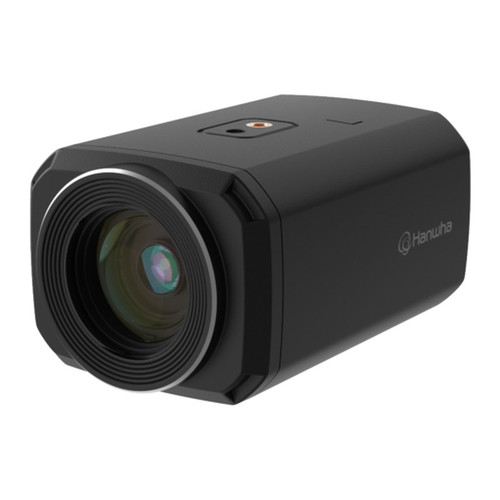
In This Guide
How do the imaging specs compare?
The Hanwha XNB-9002 carries a 1/2.8" progressive CMOS sensor delivering a native 3840×2160 (4K UHD) resolution at up to 30fps, with a minimum illumination of 0.05 Lux (color) and 0.005 Lux (B/W). Its WDR implementation is rated at 120dB extremeWDR and is supplemented by SSNR V digital noise reduction, defog support, and a built-in gyro-based digital image stabilizer. The Geovision BX8700V-3D010 is specified at 8MP resolution with WDR listed as a feature; however, the supplied data does not state the specific sensor size, sensor model, minimum illumination figure, WDR dB rating, or frame rate.
For lens compatibility, the XNB-9002 supports C-mount, CS-mount, DC auto iris, P-iris, manual, and i-CS lens types, offering broad integrator flexibility. The BX8700V-3D010's supplied specifications do not detail supported lens mount types or iris control options. Both cameras support H.265 and H.264 compression; the XNB-9002 additionally lists MJPEG. The XNB-9002 also supports WiseStream II smart codec with up to 10 streaming profiles, while the BX8700V-3D010's streaming configuration details are not provided in the supplied data.
What about installation and environment?
The Hanwha XNB-9002 accepts PoE (IEEE 802.3af, Class 3), 12VDC, and 24VAC power inputs, with a stated maximum power draw of 12.95W. Its operating temperature range is –10°C to +55°C (14°F to 131°F) at 0–95% RH non-condensing, and storage temperature extends to –50°C to +60°C. Physical dimensions are 81(W)×67(H)×165(D)mm and weight is 880g (1.94 lb). The housing material is aluminum. No IP or IK ingress/impact rating is stated in the provided specifications for the XNB-9002, which is typical for indoor box cameras that rely on a separately specified housing.
The Geovision BX8700V-3D010 is listed as PoE-powered and supports ceiling, wall, and recessed mount types. However, the supplied data does not include operating temperature range, power draw, dimensions, weight, or IP/IK rating. Neither camera includes an IP rating in the provided data, consistent with bare box-camera form factors that are installed inside protective enclosures. Buyers requiring outdoor or harsh-environment deployment must factor in a compatible weatherproof housing for either model.
Which fits your VMS and analytics better?
The Geovision BX8700V-3D010 explicitly lists VMS compatibility with Geovision, Milestone, and Axis Camera Station in addition to ONVIF. Its analytics coverage in the provided data is limited to Face Detection. The Hanwha XNB-9002 is ONVIF Profile S/G/T compliant and supports SUNAPI (HTTP API) and the Wisenet open platform. Its analytics suite is substantially broader: defocus detection, directional detection, motion detection, digital auto tracking, appear/disappear, enter/exit, loitering, tampering, fog detection, virtual line, audio detection, sound classification, shock detection, and face/upper body detection. Business intelligence functions include people counting, queue management, and heatmap.
The XNB-9002 provides two configurable alarm I/O ports, RS-485 serial interface, built-in microphone input (selectable mic/line/built-in), line-level audio output, and dual Micro SD/SDHC/SDXC card slots supporting up to 1TB (512GB×2) of edge storage. It also supports MQTT, SRTP, 802.1X (EAP-TLS/LEAP/PEAP), and SNMPv1/v2c/v3 for enterprise network integration. The Geovision BX8700V-3D010's supplied specifications do not list audio capabilities, on-board storage, alarm I/O, or detailed protocol support, so those capabilities cannot be confirmed from available data.
Which should you choose: the BX8700V-3D010 or the XNB-9002?
Our take: The Hanwha XNB-9002 is the stronger choice when analytics depth, imaging fidelity, and enterprise integration are primary requirements. The XNB-9002 delivers a documented 3840×2160 native resolution at 30fps versus the BX8700V-3D010's unspecified frame rate, a rated 120dB extremeWDR versus an unquantified WDR claim, and a minimum illumination of 0.05 Lux color / 0.005 Lux B/W versus no stated figure for the Geovision. Its analytics library spans 14 on-camera functions plus three business intelligence modules, compared to Face Detection alone listed for the BX8700V-3D010. The XNB-9002 also brings dual SD card edge storage (up to 1TB), alarm I/O, RS-485, and 802.1X security—none of which are confirmed in the Geovision's supplied specifications. The BX8700V-3D010 may be preferred in a Geovision, Milestone, or Axis Camera Station environment where native VMS integration is documented, but integrators should obtain Geovision's full datasheet to verify sensor, illumination, and storage specs before final selection.
Side-by-Side Comparison
Spec-for-spec, from manufacturer data.
| Specification | Geovision BX8700V-3D010 | Hanwha XNB-9002 |
|---|---|---|
| Resolution | 8MP (exact pixel count not stated) | 3840×2160 (8MP / 4K UHD) |
| Max Frame Rate | — | 30fps @ 8MP |
| Image Sensor | — | 1/2.8" progressive CMOS |
| Min. Illumination | — | 0.05 Lux color / 0.005 Lux B/W |
| Wide Dynamic Range | WDR (dB not stated) | extremeWDR (120dB) |
| Digital Noise Reduction | — | SSNR V |
| Video Compression | H.265, H.264 | H.265, H.264, MJPEG |
| Lens Mount | — | C-mount, CS-mount; DC auto iris, P-iris, Manual, i-CS |
| Operating Temperature | — | –10°C to +55°C (14°F to 131°F) |
| Power Input / PoE Class | PoE | PoE IEEE 802.3af Class 3; 12VDC; 24VAC |
| Max Power Draw | — | 12.95W |
| Edge Storage | — | Micro SD/SDHC/SDXC, 2 slots, up to 1TB |
| Audio | — | Mic in / Line in / Built-in mic; Line out |
| Alarm I/O | — | 2 configurable I/O ports |
| Analytics | Face Detection | Loitering, directional, enter/exit, virtual line, face/upper body, people counting, queue mgmt, heatmap, +more |
| ONVIF | Yes | Profile S/G/T |
| VMS Compatibility | Geovision, Milestone, Axis Camera Station, ONVIF | ONVIF, SUNAPI, Wisenet open platform |
| Weight | — | 880g (1.94 lb) |
| Warranty | — | 3 years |
Frequently Asked Questions
Which should you choose: the BX8700V-3D010 or the XNB-9002?
The Hanwha XNB-9002 is the stronger choice when analytics depth, imaging fidelity, and enterprise integration are primary requirements. The XNB-9002 delivers a documented 3840×2160 native resolution at 30fps versus the BX8700V-3D010's unspecified frame rate, a rated 120dB extremeWDR versus an unquantified WDR claim, and a minimum illumination of 0.05 Lux color / 0.005 Lux B/W versus no stated figure for the Geovision. Its analytics library spans 14 on-camera functions plus three business intelligence modules, compared to Face Detection alone listed for the BX8700V-3D010. The XNB-9002 also brings dual SD card edge storage (up to 1TB), alarm I/O, RS-485, and 802.1X security—none of which are confirmed in the Geovision's supplied specifications. The BX8700V-3D010 may be preferred in a Geovision, Milestone, or Axis Camera Station environment where native VMS integration is documented, but integrators should obtain Geovision's full datasheet to verify sensor, illumination, and storage specs before final selection.
Is the BX8700V-3D010 or XNB-9002 better for low-light performance?
Based on the supplied specifications, only the Hanwha XNB-9002 provides a stated minimum illumination figure: 0.05 Lux in color and 0.005 Lux in black-and-white. The Geovision BX8700V-3D010's supplied data does not include a minimum illumination rating, so a direct low-light comparison cannot be made from available specs. Buyers should request Geovision's full datasheet to obtain that figure before comparing.
Which camera offers more on-camera analytics for retail or perimeter use?
The Hanwha XNB-9002 offers a significantly broader analytics set per the supplied specifications, including loitering, directional detection, enter/exit, virtual line, appear/disappear, face/upper body detection, people counting, queue management, and heatmap—covering both security and business intelligence use cases. The Geovision BX8700V-3D010 lists only Face Detection in the provided data. If on-camera analytics depth is a decision factor, the XNB-9002 has the documented advantage.
Does the BX8700V-3D010 or XNB-9002 support edge recording without a separate NVR?
The Hanwha XNB-9002 supports dual Micro SD/SDHC/SDXC card slots with up to 1TB (512GB per slot) of on-board edge storage, enabling standalone recording triggered by events or schedule. The supplied specifications for the Geovision BX8700V-3D010 do not mention on-board storage support, so edge recording capability for that model cannot be confirmed from available data.
Get a Second Opinion on Your Camera Choice
Share your site layout, coverage goals, and budget. Our team will validate the camera selection, flag anything we would change, and recommend products that match the use case.