
Hanwha XNB-6003 vs i-PRO U11300-V2: Specification Comparison
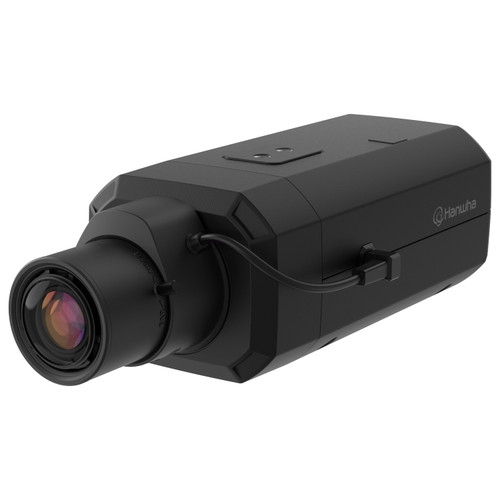
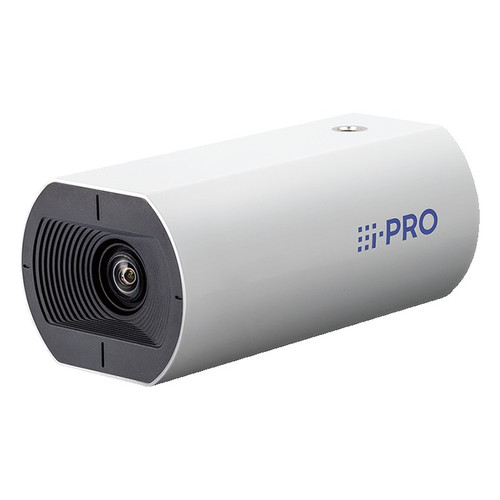
Both the Hanwha XNB-6003 and i-PRO WV-U11300-V2 are 2MP (1920×1080) indoor box IP cameras powered by PoE, targeting integrators who need a fixed-lens platform for indoor surveillance. The XNB-6003 differentiates on frame rate, WDR depth, AI analytics breadth, and dual SD-card edge storage, while the U11300-V2 leads on built-in motorized varifocal zoom, lower minimum illumination figures, a lighter form factor, and a longer warranty. This comparison evaluates the two on imaging capability, installation fit, and VMS/analytics integration based solely on published specifications.
In This Guide
How do the imaging specs compare?
Both cameras share an approximately 1/2.8-inch progressive CMOS sensor at 1920×1080 resolution. The XNB-6003 delivers a maximum frame rate of 120 fps at full resolution (H.265/H.264), compared to the U11300-V2's 30 fps ceiling — a four-to-one advantage for motion-critical or high-speed object capture. On dynamic range, the XNB-6003 specifies extremeWDR at 150 dB, while the U11300-V2's Super Dynamic mode reaches a maximum of 120 dB — a 30 dB gap that is meaningful in scenes with simultaneous bright windows and dark interiors.
Minimum illumination figures favor the U11300-V2 for low-light work: it specifies 0.006 lx color / 0.0025 lx B&W, versus the XNB-6003's 0.007 lx color / 0.0007 lx B&W. The U11300-V2 achieves a lower color lux floor, while the XNB-6003 achieves a markedly lower B&W floor. On optics, the U11300-V2 includes a built-in 2.5× motorized varifocal lens (2.9–7.3 mm, 43–100° horizontal FOV) with motorized focus — no separate lens purchase required. The XNB-6003 is a bare-board box camera requiring a separately sourced C-mount or CS-mount lens (DC auto iris, P-iris, Manual, or I-CS types supported); no focal length or FOV is specified in the provided data.
What about installation and environment?
Neither camera carries an IP or IK ingress/impact rating in the provided specifications — both are rated for indoor environments only. Operating temperature range is -10 °C to +55 °C for the XNB-6003 and -10 °C to +50 °C for the U11300-V2, a 5 °C advantage for the Hanwha in warmer plant or atrium environments. Both accept PoE 802.3af as primary power; the XNB-6003 is also rated for 12 VDC, giving an additional wiring option. PoE class differs: the XNB-6003 draws up to 12.95 W (Class 3), while the U11300-V2 draws only 4.3 W (Class 2) — the i-PRO draws roughly one-third the power, which matters on large switch deployments with tight power budgets.
Form-factor and weight diverge substantially. The XNB-6003 measures 81 × 67 × 165 mm and weighs 880 g (1.94 lb) in aluminum, which accommodates its gyro-based digital image stabilization hardware and dual SD slots. The U11300-V2 measures 59 × 49 × 116 mm and weighs approximately 165 g (0.36 lb) in PC/ABS resin — less than one-fifth the weight, useful for lightweight bracket or ceiling-tile mounts. The XNB-6003 also includes an RS-485 serial interface and 2 configurable alarm I/O ports; the U11300-V2's alarm source and actions are limited to VMD, SCD, command alarm, email, HTTP, TCP, and SD recording per the provided spec; no discrete I/O port count is stated.
Which fits your VMS and analytics better?
Both cameras support ONVIF, but profile coverage differs. The XNB-6003 supports ONVIF Profile S, G, T, and M; the U11300-V2 supports Profile G, S, and T — the XNB-6003 adds Profile M, which covers metadata streaming for analytics events. The XNB-6003's AI engine classifies person, face, vehicle (car/bus/truck/motorcycle/bicycle), and license plate; supports virtual line crossing with direction, virtual area loitering, and business intelligence functions including people counting, queue management, and heatmap. The U11300-V2's analytics are limited to Video Motion Detection (4 areas), Scene Change Detection (1 area), and audio detection — no deep-learning object classification is specified.
On audio, both cameras support audio input and output with G.711 and G.726; the U11300-V2 adds AAC-LC (16–128 kbps) and explicitly lists half-duplex and full-duplex modes. The XNB-6003 provides dual microSD/SDHC/SDXC slots supporting up to 1 TB total (2 × 512 GB); the U11300-V2 provides a single microSD/SDHC/SDXC slot up to 512 GB. Concurrent user limits are 20 unicast users for the XNB-6003 versus 14 for the U11300-V2. Security posture: the XNB-6003 specifies TPM 2.0 (FIPS 140-2 Level 2) and a pre-installed Hanwha Techwin Root CA device certificate; the U11300-V2 specifies GlobalSign certificate, brute-force protection, and system/image logs — TPM is not mentioned in the provided U11300-V2 spec.
Which should you choose: the XNB-6003 or the U11300-V2?
Our take: The XNB-6003 is the stronger choice when the application demands high-frame-rate capture, deep AI analytics, or maximum edge storage capacity. It delivers 120 fps versus the U11300-V2's 30 fps — a critical delta for fast-moving objects — and its extremeWDR at 150 dB outpaces the U11300-V2's 120 dB Super Dynamic ceiling by 30 dB, meaningful in high-contrast lobbies. Its dual SD slots support up to 1 TB on-board versus the U11300-V2's 512 GB single slot, and it adds ONVIF Profile M plus full AI object classification and business intelligence. Conversely, the U11300-V2 is the better fit where lens flexibility, power efficiency, and warranty duration matter more: its built-in 2.5× motorized varifocal eliminates a separate lens purchase, it draws only 4.3 W (Class 2) versus 12.95 W (Class 3), and it carries a 5-year warranty versus the XNB-6003's 3-year coverage. The U11300-V2 also achieves a lower color lux floor (0.006 lx vs. 0.007 lx). Choose the XNB-6003 for analytics-driven or high-speed deployments; choose the U11300-V2 for cost-of-ownership and optics flexibility.
Side-by-Side Comparison
Spec-for-spec, from manufacturer data.
| Specification | Hanwha XNB-6003 | i-PRO U11300-V2 |
|---|---|---|
| Resolution | 1920×1080 (2MP) | 1920×1080 (2MP) |
| Image Sensor | 1/2.8" progressive CMOS | Approx. 1/2.8" type CMOS |
| Lens / Focal Length | C/CS-mount (sold separately); DC auto iris, P-iris, Manual, I-CS | Built-in motorized varifocal 2.9–7.3 mm (2.5× zoom) |
| Horizontal Field of View | — | 43°–100° |
| Min. Illumination (Color / B&W) | 0.007 lx / 0.0007 lx | 0.006 lx / 0.0025 lx |
| Wide Dynamic Range | extremeWDR 150 dB | Super Dynamic max 120 dB |
| Max. Frame Rate | 120 fps @ 1920×1080 | 30 fps @ 1920×1080 |
| Video Compression | H.265, H.264 (Main/Baseline/High), MJPEG | H.265, H.264, MJPEG |
| ONVIF Profiles | S, G, T, M | G, S, T |
| AI / Analytics | Person, face, vehicle (car/bus/truck/motorcycle/bicycle), license plate; virtual line, virtual area, people counting, queue management, heatmap | VMD (4 areas), SCD (1 area), audio detection |
| Audio | Mic in / line in / built-in mic; line out | Mic input / audio output; half duplex / full duplex |
| Alarm I/O | 2 configurable I/O ports | — |
| Edge Storage | Dual microSD/SDHC/SDXC, max 1 TB (2 × 512 GB) | Single microSDXC/SDHC/SD, max 512 GB |
| Power Input / PoE Class | PoE 802.3af Class 3 / 12 VDC; max 12.95 W | PoE 802.3af Class 2; 4.3 W |
| Operating Temperature | -10 °C to +55 °C | -10 °C to +50 °C |
| Dimensions (W × H × D) | 81 × 67 × 165 mm (3.19" × 2.64" × 6.48") | 59 × 49 × 116 mm |
| Weight | 880 g (1.94 lb) | Approx. 165 g (0.36 lb) |
| Warranty | 3 years | 5 years |
Frequently Asked Questions
Which should you choose: the XNB-6003 or the U11300-V2?
The XNB-6003 is the stronger choice when the application demands high-frame-rate capture, deep AI analytics, or maximum edge storage capacity. It delivers 120 fps versus the U11300-V2's 30 fps — a critical delta for fast-moving objects — and its extremeWDR at 150 dB outpaces the U11300-V2's 120 dB Super Dynamic ceiling by 30 dB, meaningful in high-contrast lobbies. Its dual SD slots support up to 1 TB on-board versus the U11300-V2's 512 GB single slot, and it adds ONVIF Profile M plus full AI object classification and business intelligence. Conversely, the U11300-V2 is the better fit where lens flexibility, power efficiency, and warranty duration matter more: its built-in 2.5× motorized varifocal eliminates a separate lens purchase, it draws only 4.3 W (Class 2) versus 12.95 W (Class 3), and it carries a 5-year warranty versus the XNB-6003's 3-year coverage. The U11300-V2 also achieves a lower color lux floor (0.006 lx vs. 0.007 lx). Choose the XNB-6003 for analytics-driven or high-speed deployments; choose the U11300-V2 for cost-of-ownership and optics flexibility.
Is the XNB-6003 or WV-U11300-V2 better for low-light performance?
It depends on the lighting mode. In color mode, the U11300-V2 specifies a lower minimum illumination of 0.006 lx versus the XNB-6003's 0.007 lx — a marginal advantage. In black-and-white mode, the XNB-6003's 0.0007 lx is significantly lower than the U11300-V2's 0.0025 lx, giving it an edge in near-dark conditions when color rendering is not required.
Do I need to buy a separate lens for either camera?
Yes, for the XNB-6003. It is a C/CS-mount box camera that requires a separately sourced lens — DC auto iris, P-iris, manual, or I-CS types are compatible, but no lens is included per the provided specifications. The WV-U11300-V2 includes a built-in 2.5× motorized varifocal lens covering 2.9–7.3 mm (43–100° horizontal field of view) with motorized focus, so no separate lens purchase is needed.
Which camera is easier to integrate with a VMS that uses ONVIF metadata analytics?
The XNB-6003 is the better fit. It supports ONVIF Profile M in addition to S, G, and T — Profile M covers metadata streaming, which is required for VMS platforms that consume AI-generated analytics events over ONVIF. The U11300-V2 supports ONVIF Profile G, S, and T but not Profile M per the provided specifications, and its on-camera analytics are limited to VMD (4 areas) and SCD (1 area) without deep-learning object classification.
Get a Second Opinion on Your Camera Choice
Share your site layout, coverage goals, and budget. Our team will validate the camera selection, flag anything we would change, and recommend products that match the use case.