
Hanwha SKY-SW28G-001 vs Vivotek FGT-260P-370: Specification Comparison
Both the Hanwha SKY-SW28G-001 and the Vivotek AW-FGT-260P-370 are 26-port PoE+ network switches sharing an identical port count (24 PoE+ data ports plus 2 uplinks) and the same 370W total PoE power budget, making them direct cross-shop candidates for IP camera infrastructure deployments. The comparison centers on three decision-critical axes: port architecture and throughput capacity; power delivery and environmental ratings; and management capability, platform integration, and installation flexibility.
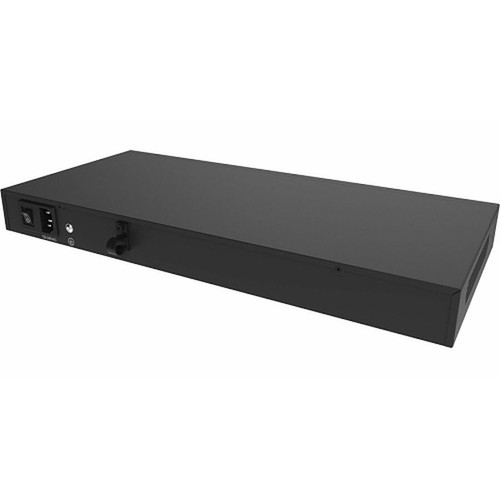
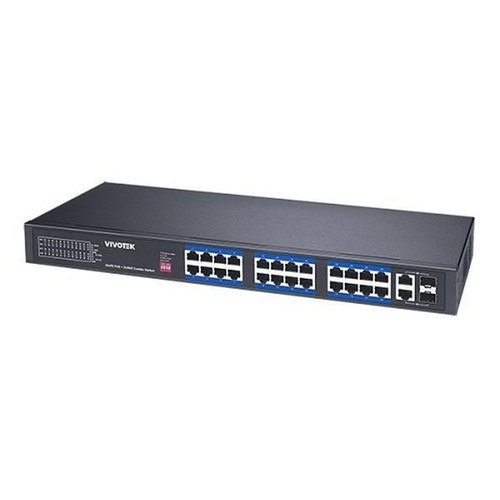
In This Guide
- How do the port architecture and switching throughput compare between the SKY-SW28G-001 and AW-FGT-260P-370?
- Which switch offers stronger power delivery standards and environmental resilience?
- How do the two switches differ in management capability and platform integration?
- Which should you choose: the SKY-SW28G-001 or the FGT-260P-370?
- Side-by-Side Specs
- FAQ
How do the port architecture and switching throughput compare between the SKY-SW28G-001 and AW-FGT-260P-370?
Both switches deliver 24 PoE+ ports at up to 30W per port, giving each model a per-port ceiling consistent with IEEE 802.3at. The uplink configuration diverges meaningfully: the Hanwha SKY-SW28G-001 provides 2x RJ-45 Gigabit uplinks plus 2x SFP fiber uplinks, yielding four distinct uplink paths for redundancy or fiber backbone connectivity. The Vivotek AW-FGT-260P-370 specifies 2 Gigabit Ethernet combo uplink ports; whether these support SFP modules is not stated in the provided specifications.
On switching fabric, the SKY-SW28G-001 is rated at 56 Gbps non-blocking throughput—a figure not provided for the AW-FGT-260P-370. The Vivotek unit is described only as 'Full Gigabit across all ports,' which confirms wire-speed per-port Gigabit capability but leaves aggregate fabric capacity unspecified. Buyers sizing for high-density 4K or multi-sensor camera streams should note the explicit 56 Gbps non-blocking rating on the Hanwha unit.
Which switch offers stronger power delivery standards and environmental resilience?
Both units share a 370W maximum PoE power budget and comply with IEEE 802.3at (PoE+), with the SKY-SW28G-001 also explicitly noting IEEE 802.3af backward compatibility. The Hanwha spec sheet lists the power standard as 802.3at (PoE+) in the validated spec fields; a separate metadata field references 802.3bt (PoE++), but this is not corroborated by the datasheet-sourced specs and should be verified directly with Hanwha before relying on it for PoE++ device planning.
Operating temperature for the SKY-SW28G-001 is specified at 0°C to 50°C (32°F to 122°F) in the validated spec fields. No operating temperature range is provided in the AW-FGT-260P-370 specifications. Neither unit carries an outdoor or wide-temperature rating in the provided data, so both should be treated as indoor-rated equipment absent additional documentation. The SKY-SW28G-001 supports rack and wall mounting; the AW-FGT-260P-370 is rated for rack mounting only, with a mounting kit referenced but wall-mount capability not confirmed in the specs.
How do the two switches differ in management capability and platform integration?
This is the sharpest functional divide between the two products. The Hanwha SKY-SW28G-001 is a managed switch with explicit integration into the Wisenet SKY Cloud VMS platform, enabling centralized monitoring and control within Hanwha's ecosystem. Managed switching typically provides VLAN segmentation, QoS prioritization, port-level diagnostics, and SNMP visibility—features essential for larger or more complex surveillance networks.
The Vivotek AW-FGT-260P-370 is architecturally unmanaged, operating as a plug-and-play device with no configuration interface. The provided specifications do not reference VMS integration, VLAN support, QoS, or SNMP. The unmanaged design eliminates configuration overhead and removes the need for IT staff involvement at deployment time, which is an explicit advantage in straightforward, flat-network camera installations. No VMS compatibility is listed for the Vivotek unit in the provided specifications.
Which should you choose: the SKY-SW28G-001 or the FGT-260P-370?
Our take: The SKY-SW28G-001 is the stronger choice when the deployment requires managed network control, VMS platform integration, or fiber uplink flexibility. Concretely: it delivers a specified 56 Gbps non-blocking switching fabric versus no stated aggregate throughput for the AW-FGT-260P-370; it adds 2x SFP fiber uplinks to its 2x RJ-45 uplinks where the Vivotek offers only 2 combo Gigabit uplinks with SFP capability unconfirmed; and it provides managed switching with Wisenet SKY Cloud VMS integration versus the Vivotek's unmanaged plug-and-play architecture. The AW-FGT-260P-370 holds a practical advantage for rapid field deployments on flat networks where configuration capability is unwanted and IT overhead must be minimized—its unmanaged design is a feature, not a limitation, in those contexts. Buyers operating Wisenet SKY environments or requiring VLAN/QoS control should specify the SKY-SW28G-001; integrators prioritizing zero-configuration speed should evaluate the AW-FGT-260P-370.
Side-by-Side Comparison
Spec-for-spec, from manufacturer data.
| Specification | Hanwha SKY-SW28G-001 | Vivotek FGT-260P-370 |
|---|---|---|
| SKU | SKY-SW28G-001 | AW-FGT-260P-370 |
| Total Ports | 26 (24 PoE+ + 2 uplinks) | 26 (24 PoE+ + 2 uplinks) |
| PoE+ Data Ports | 24 | 24 |
| PoE Standard | 802.3at (PoE+), 802.3af compatible | 802.3at (PoE+) |
| PoE Power Per Port (Max) | 30W | 30W |
| Total PoE Power Budget | 370W | 370W |
| Uplink Ports | 2x RJ-45 Gigabit + 2x SFP | 2x Gigabit Ethernet combo |
| SFP Uplink Support | Yes (2x SFP) | Not specified |
| Switching Fabric | 56 Gbps non-blocking | Not specified |
| Management | Managed | Unmanaged (plug-and-play) |
| VMS Integration | Wisenet SKY Cloud VMS | Not specified |
| Mount Type | Rack and wall | Rack |
| Operating Temperature | 0°C to 50°C (32°F to 122°F) | Not specified |
| Warranty | 5-year | Not specified |
| Housing Color | White | White |
| Weight | Not specified | 1.0 lbs |
Frequently Asked Questions
Which should you choose: the SKY-SW28G-001 or the FGT-260P-370?
The SKY-SW28G-001 is the stronger choice when the deployment requires managed network control, VMS platform integration, or fiber uplink flexibility. Concretely: it delivers a specified 56 Gbps non-blocking switching fabric versus no stated aggregate throughput for the AW-FGT-260P-370; it adds 2x SFP fiber uplinks to its 2x RJ-45 uplinks where the Vivotek offers only 2 combo Gigabit uplinks with SFP capability unconfirmed; and it provides managed switching with Wisenet SKY Cloud VMS integration versus the Vivotek's unmanaged plug-and-play architecture. The AW-FGT-260P-370 holds a practical advantage for rapid field deployments on flat networks where configuration capability is unwanted and IT overhead must be minimized—its unmanaged design is a feature, not a limitation, in those contexts. Buyers operating Wisenet SKY environments or requiring VLAN/QoS control should specify the SKY-SW28G-001; integrators prioritizing zero-configuration speed should evaluate the AW-FGT-260P-370.
Is the SKY-SW28G-001 or AW-FGT-260P-370 better for larger or more complex camera deployments?
The SKY-SW28G-001 is better suited to larger or more complex deployments. It is a managed switch with a specified 56 Gbps non-blocking fabric, 2x SFP fiber uplinks for backbone connectivity, and integration with Wisenet SKY Cloud VMS. These features enable VLAN segmentation, QoS, and centralized network visibility. The AW-FGT-260P-370 is unmanaged with no stated fabric throughput or VMS integration, making it more appropriate for simpler, flat-network installations.
Can either switch power PoE++ (802.3bt) devices such as high-wattage pan-tilt-zoom cameras?
Based on the provided specifications, neither switch is confirmed to support PoE++ (802.3bt). Both are rated at IEEE 802.3at (PoE+) with a 30W per-port ceiling. A separate metadata field on the SKY-SW28G-001 references 802.3bt, but this is not corroborated by the datasheet-sourced specifications and should be verified directly with Hanwha before connecting 802.3bt devices. The AW-FGT-260P-370 specs make no reference to 802.3bt.
Which switch is easier to install for a technician without IT networking experience?
The AW-FGT-260P-370 is easier to install for technicians without networking backgrounds. It is an unmanaged plug-and-play device requiring no configuration—connect power, connect cameras, and it operates. The SKY-SW28G-001 is a managed switch; while it supports rack and wall mounting and integrates with Wisenet SKY Cloud VMS, realizing the full value of its managed features requires network configuration knowledge or IT involvement.
More Network Switch Comparisons
Network Switch Buying Guides
Get a Second Opinion on Your Camera Choice
Share your site layout, coverage goals, and budget. Our team will validate the camera selection, flag anything we would change, and recommend products that match the use case.