
Hanwha QNV-8010R vs i-PRO X22500-V3L: Specification Comparison
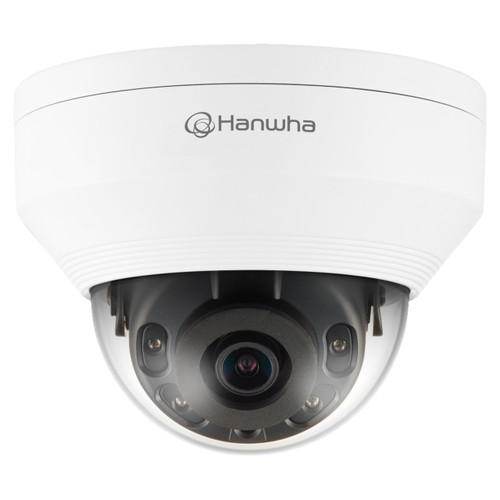
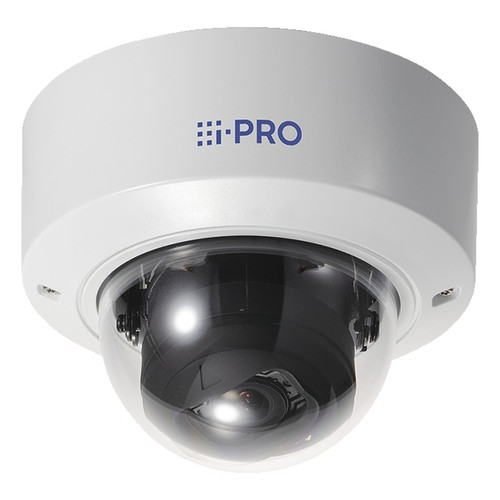
Both the Hanwha QNV-8010R and the i-PRO WV-X22500-V3L are 5MP indoor vandal-resistant IP dome cameras aimed at commercial and enterprise installations. The QNV-8010R offers a fixed 2.8mm lens and straightforward PoE operation, while the WV-X22500-V3L adds a 3.1x motorized varifocal lens, on-board AI analytics, and a higher-powered PoE+ supply. This comparison evaluates how each model's sensor, optics, environmental ratings, network integration, and analytics capabilities stack up for installers and IT buyers choosing between them.
In This Guide
How do the imaging specs compare?
Both cameras use an approximately 1/2.8-inch CMOS sensor and deliver 5MP output at 30fps. The QNV-8010R resolves at 2592×1944 (a 4:3 aspect), while the WV-X22500-V3L outputs 3072×1728 (a 16:9 aspect), giving the i-PRO model a wider native pixel grid in widescreen format. Minimum illumination differs substantially: the Hanwha specifies 0.15 Lux color / 0 Lux with IR active, while the i-PRO specifies 0.02 Lux in B&W with IR—a roughly 7.5× low-light sensitivity advantage on paper for the WV-X22500-V3L. IR range also diverges sharply: the QNV-8010R is rated at 20m (65.6ft), whereas the WV-X22500-V3L reaches 70m (230ft).
Dynamic range similarly favors the i-PRO: the WV-X22500-V3L is rated at a maximum 132dB (Super Dynamic On, Level 31) versus the QNV-8010R's 120dB WDR—a 12dB difference that can matter in high-contrast lobbies or perimeter zones with mixed lighting. The QNV-8010R uses a fixed 2.8mm lens with a 105° horizontal field of view and F2.0 aperture. The WV-X22500-V3L provides a 2.9–9mm motorized varifocal lens covering 105° to 33° horizontal FOV with apertures from F1.3 (wide) to F2.5 (tele), offering greater scene flexibility and a brighter wide-end aperture. DORI figures confirm the i-PRO's optical reach advantage: Detect range is 47.1m wide / 207.4m tele versus 40.0m for the Hanwha fixed lens.
What about installation and environment?
Both cameras carry an IK10 vandal-resistance rating per IEC 62262. The Hanwha QNV-8010R is rated IP66 for dust and water ingress, making it suitable for installation in areas exposed to water jets; the i-PRO WV-X22500-V3L does not list an IP ingress rating in the provided specifications. The QNV-8010R specifies an operating range of -30°C to +55°C, while the WV-X22500-V3L is rated -10°C to +50°C (with a 0°C power-on minimum), so the Hanwha is better suited to cold environments. Both are described as indoor-rated in the provided specifications.
Power requirements differ: the QNV-8010R draws a maximum of 7.5W and operates on IEEE 802.3af PoE (Class 3), compatible with standard PoE switches. The WV-X22500-V3L requires PoE+ (802.3at, Class 4) at 14W, which necessitates a PoE+ capable switch or injector and higher per-port power budgeting. The QNV-8010R also provides CVBS video output for installation alignment. Both cameras have an aluminum and plastic white housing. The QNV-8010R is specified with pan 0°–350°, tilt 0°–67°, and rotate 0°–355° adjustment ranges; the WV-X22500-V3L specifies pan ±180°, tilt -30° to +85°, and yaw ±100°. Accessories listed for the QNV-8010R include a hanging mount (SBP-122HMW) and backbox (SBV-120GW); no accessory part numbers are listed in the i-PRO specifications provided.
Which fits your VMS and analytics better?
Both cameras support ONVIF Profile S, G, and T. The WV-X22500-V3L additionally supports ONVIF Profile M, which covers metadata streaming for analytics events—relevant for VMS platforms that consume AI metadata natively. The QNV-8010R uses Hanwha's SUNAPI (HTTP API) and Wisenet open platform in addition to ONVIF; the i-PRO supports MQTT in addition to standard protocols, which broadens IoT integration options. The i-PRO supports up to 14 simultaneous users versus the Hanwha's 6 unicast users. Both support H.265, H.264, and MJPEG compression. The Hanwha includes WiseStream II smart codec for adaptive bitrate efficiency; no equivalent branded codec is specified for the i-PRO.
On-board analytics are a key differentiator. The QNV-8010R offers motion detection, tampering, defocus detection, virtual line crossing/direction, and virtual area intrusion/enter/exit. The WV-X22500-V3L adds AI-based face detection, people detection, vehicle detection, audio detection, and AI sound classification (gunshot, yell, vehicle horn, glass break)—capabilities not listed for the Hanwha. Edge storage capacity is also higher on the i-PRO: microSDXC up to 512GB versus 128GB on the QNV-8010R. The WV-X22500-V3L includes a built-in audio input (3.5mm jack) and audio output, plus 2 alarm inputs and 1 alarm output (4 total I/O terminals); the QNV-8010R provides 1 alarm input and 1 alarm output with no audio I/O listed. The i-PRO also specifies FIPS 140-2 Level 3 security and signed firmware; the Hanwha specifies firmware encryption, 802.1X (EAP-TLS/LEAP/PEAP), and SD card partition encryption.
Which should you choose: the QNV-8010R or the X22500-V3L?
Our take: The WV-X22500-V3L is the stronger choice when a project demands on-board AI analytics, extended IR coverage, or optical flexibility. Its 70m IR range triples the QNV-8010R's 20m reach, its motorized varifocal lens (2.9–9mm, 105°–33° FOV) eliminates lens-swap field trips, and its 132dB dynamic range versus 120dB gives a measurable edge in high-contrast scenes. The AI sound classification and face/people/vehicle detection capabilities are absent from the QNV-8010R entirely. The QNV-8010R is the pragmatic choice when budget, switch infrastructure, or cold-environment operation are constraints: it runs on standard 802.3af PoE (7.5W max) rather than PoE+ (14W), operates to -30°C versus the i-PRO's -10°C minimum, and carries an IP66 ingress rating not documented for the WV-X22500-V3L. Choose the QNV-8010R for PoE-constrained or cold-location deployments; choose the WV-X22500-V3L where AI metadata, long IR range, or varifocal optics drive the requirement.
Side-by-Side Comparison
Spec-for-spec, from manufacturer data.
| Specification | Hanwha QNV-8010R | i-PRO X22500-V3L |
|---|---|---|
| Resolution | 2592×1944 (5MP, 4:3) | 3072×1728 (5MP, 16:9) |
| Image Sensor | 1/2.8" CMOS | Approx. 1/2.8" CMOS |
| Lens / Focal Length | Fixed 2.8mm, F2.0 | Motorized varifocal 2.9–9mm, F1.3–F2.5 |
| Optical Zoom | — | 3.1x (motorized) |
| Horizontal FOV | 105° (fixed) | 33°–105° (varifocal) |
| Min. Illumination | 0.15 Lux color / 0 Lux IR | 0.02 Lux B&W with IR |
| IR Range | 20m (65.6ft) | 70m (230ft) |
| Wide Dynamic Range | 120dB | Max 132dB (Super Dynamic On, Level 31) |
| Max Frame Rate | 30fps @ 5MP | 30fps |
| Video Compression | H.265, H.264, MJPEG | H.265, H.264, MJPEG |
| IP Rating | IP66 | Not specified in provided specs |
| IK / Impact Rating | IK10 | IK10 |
| Operating Temperature | -30°C to +55°C | -10°C to +50°C (power-on min 0°C) |
| Power Input / PoE Class | PoE 802.3af, Class 3, max 7.5W | PoE+ 802.3at, Class 4, 14W |
| Edge Storage | microSD/SDHC/SDXC up to 128GB | microSDXC up to 512GB |
| Audio I/O | — | 3.5mm audio in + audio out |
| Alarm I/O | 1 input / 1 output | 2 inputs / 1 output / 1 AUX (4 terminals) |
| On-board AI Analytics | Motion, tampering, defocus, virtual line/area | AI face, people, vehicle, audio, sound classification |
| ONVIF Profiles | S, G, T | G, S, T, M |
| Simultaneous Users | 6 (unicast) | Up to 14 |
| Dimensions | ø120.3×91.7mm (ø4.74×3.61") | ø129.5×102.5mm (ø5-3/32"×4-1/32") |
| Weight | 510g (1.12 lb) | Approx. 820g (1.9 lb) |
| Warranty | 3 years | 5 years |
Frequently Asked Questions
Which should you choose: the QNV-8010R or the X22500-V3L?
The WV-X22500-V3L is the stronger choice when a project demands on-board AI analytics, extended IR coverage, or optical flexibility. Its 70m IR range triples the QNV-8010R's 20m reach, its motorized varifocal lens (2.9–9mm, 105°–33° FOV) eliminates lens-swap field trips, and its 132dB dynamic range versus 120dB gives a measurable edge in high-contrast scenes. The AI sound classification and face/people/vehicle detection capabilities are absent from the QNV-8010R entirely. The QNV-8010R is the pragmatic choice when budget, switch infrastructure, or cold-environment operation are constraints: it runs on standard 802.3af PoE (7.5W max) rather than PoE+ (14W), operates to -30°C versus the i-PRO's -10°C minimum, and carries an IP66 ingress rating not documented for the WV-X22500-V3L. Choose the QNV-8010R for PoE-constrained or cold-location deployments; choose the WV-X22500-V3L where AI metadata, long IR range, or varifocal optics drive the requirement.
Is the QNV-8010R or WV-X22500-V3L better for low-light performance?
Based on the provided specifications, the WV-X22500-V3L has a lower minimum illumination figure—0.02 Lux (B&W with IR)—compared to the QNV-8010R's 0.15 Lux color / 0 Lux IR. The i-PRO also has a substantially longer IR range at 70m versus 20m for the Hanwha, so it covers more ground in darkness. If low-light range and sensitivity are the primary criteria, the WV-X22500-V3L has the spec advantage.
Can I power either camera from a standard PoE switch?
The QNV-8010R draws a maximum of 7.5W and is rated for IEEE 802.3af PoE (Class 3), so it works with any standard PoE switch. The WV-X22500-V3L requires PoE+ (802.3at, Class 4) at 14W, which means your switch or midspan injector must support 802.3at on that port. If your existing switches are 802.3af-only, the Hanwha is the compatible choice without infrastructure upgrades.
Which camera has better built-in analytics for a retail or public-space deployment?
The WV-X22500-V3L includes on-board AI analytics for face detection, people detection, vehicle detection, audio detection, and AI sound classification (gunshot, yell, vehicle horn, glass break), as well as ONVIF Profile M for metadata streaming to compatible VMS platforms. The QNV-8010R provides video motion detection, tampering, defocus detection, and virtual line/area analytics, but does not list AI-class face, people, or sound classification in the provided specifications. For retail occupancy counting, facial detection, or public-safety audio events, the WV-X22500-V3L offers the broader on-board analytics set.
Get a Second Opinion on Your Camera Choice
Share your site layout, coverage goals, and budget. Our team will validate the camera selection, flag anything we would change, and recommend products that match the use case.