
Hanwha QNV-8010R vs i-PRO S22500-V3LG: Specification Comparison
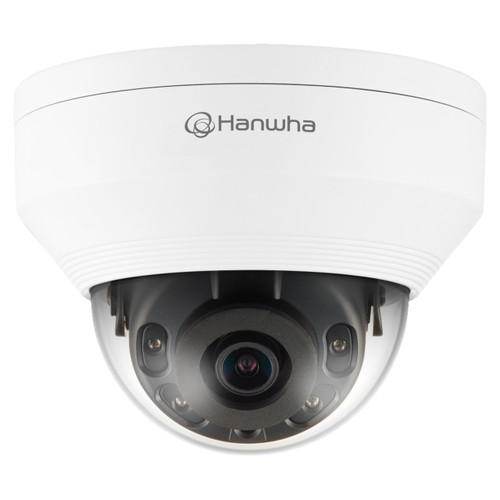
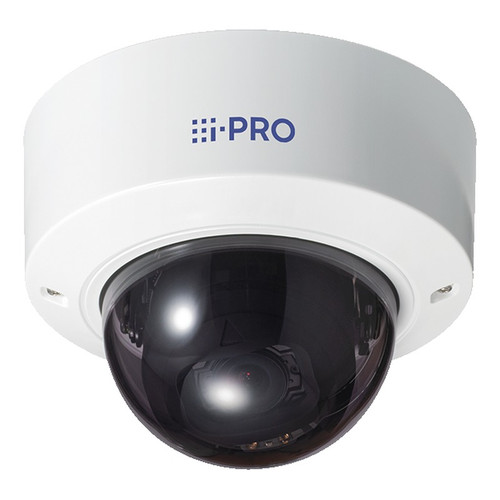
Both the Hanwha QNV-8010R and i-PRO WV-S22500-V3LG are 5MP IK10-rated indoor vandal-resistant dome cameras powered by PoE, targeting commercial interior surveillance. The Hanwha ships with a fixed 2.8mm wide-angle lens, while the i-PRO offers a 3.1x motorized zoom spanning 2.9–9mm. This comparison examines how their imaging hardware, environmental ratings, installation requirements, and VMS integration capabilities differ to help integrators and IT buyers determine which fits a given deployment.
In This Guide
How do the imaging specs compare?
Both cameras use an approximately 1/2.8-inch CMOS sensor and deliver 5MP at 30fps. The Hanwha QNV-8010R resolves at 2592×1944 through a fixed 2.8mm f/2.0 lens providing a 105° horizontal field of view, with minimum color illumination of 0.15 Lux and IR illumination rated at 20m (65.6ft) via 850nm LEDs. Its Wide Dynamic Range is specified at 120dB. The i-PRO WV-S22500-V3LG resolves at up to 3072×2304 (4:3) or 3072×1728 (16:9) through a 3.1x motorized zoom lens (2.9–9mm, f/1.3 wide to f/2.5 tele), spanning 105° to 33° horizontal field of view. Its IR range is specified at 25m. Dynamic range reaches a maximum of 132dB with Super Dynamic at level 31.
In low-light terms, the QNV-8010R is specified at 0.15 Lux color / 0 Lux IR (full IR cut-off), while the i-PRO lists 0.15 Lux color at 30IRE and 0.12 Lux in B&W at f/1.3. The i-PRO's faster wide-end aperture (f/1.3) versus the Hanwha's fixed f/2.0 provides a native light-gathering advantage before IR activates. The i-PRO also adds an Ambarella CV22 SoC with onboard AI analytics (face, vehicle, people detection, AI sound classification including gunshot and glass break), whereas the Hanwha's analytics cover motion detection, tampering, defocus, virtual line/area crossing, and intrusion without declared AI classification.
What about installation and environment?
Both cameras carry IK10 vandal resistance and are specified for indoor use. The QNV-8010R is rated IP66 and carries an operating range of -30°C to +55°C, making it usable in cold storage or unconditioned spaces. The i-PRO WV-S22500-V3LG does not list an IP ingress rating in the provided specifications; its operating range is -10°C to +50°C (with power-on limited to 0°C to +50°C), narrower on both ends. The Hanwha body is aluminum with a listed weight of 510g (1.12 lb) and dimensions of ø120.3×91.7mm. The i-PRO uses an aluminum die-cast body with polycarbonate dome, weighs approximately 800g (1.77 lb), and measures ø129.5×102.5mm.
Power for the QNV-8010R is PoE IEEE 802.3af Class 3, with a maximum draw of 7.5W. The i-PRO WV-S22500-V3LG accepts either DC 12V/1A or PoE IEEE 802.3af, consuming up to 12W—which exceeds the 15.4W Class 3 budget but is listed as Class 0, meaning switch budget planning should account for the actual 12W draw. The QNV-8010R supports a CVBS analog output for installation focus; the i-PRO similarly provides a 1.0V p-p 75Ω composite monitor output. The i-PRO also exposes 3 alarm I/O terminals plus 1 AUX output, versus the Hanwha's 1 alarm input and 1 alarm output.
Which fits your VMS and analytics better?
Both cameras support ONVIF Profiles G, S, and T. The i-PRO additionally supports ONVIF Profile M, which is relevant for metadata and analytics integration with compatible VMS platforms. The i-PRO supports up to 14 simultaneous users versus the Hanwha's 6 unicast users. Protocol support is broadly similar; the i-PRO adds SFTP and MQTT (both IPv4 and IPv6) to its stack, which the Hanwha's listed protocols do not include. The i-PRO is FIPS 140-2 Level 3 certified with an NXP EdgeLock SE050F secure element; the Hanwha provides firmware encryption, 802.1X (EAP-TLS/LEAP/PEAP), SRTP, and a Hanwha Private Root CA device certificate but does not list FIPS certification in the provided specs.
For on-board storage, both support microSD/SDHC/SDXC up to 128GB (Hanwha) or up to 512GB (i-PRO, with explicit 512GB microSDXC support listed). The i-PRO includes built-in audio: a 3.5mm mic input with plug-in power, a 3.5mm audio output, and supports G.726 ADPCM, G.711, and additional codecs with half/full duplex modes plus AI sound classification. The QNV-8010R does not list audio input/output hardware in the provided specifications. The i-PRO's AI analytics (face detection, vehicle detection, people detection, gunshot/yell/glass-break sound classification) are onboard; the Hanwha's edge analytics are event-driven (virtual line/area, tampering, defocus) without declared AI classification.
Which should you choose: the QNV-8010R or the S22500-V3LG?
Our take: The QNV-8010R is the stronger choice when wide-angle fixed coverage, extended cold-temperature operation, and a lighter PoE Class 3 power budget are the priorities. It operates down to -30°C versus the i-PRO's -10°C floor, draws a maximum 7.5W versus 12W, and is explicitly IP66-rated where the i-PRO's ingress rating is not stated in the provided specifications. Conversely, the WV-S22500-V3LG is the stronger choice when optical zoom flexibility, deeper AI analytics, audio I/O, higher concurrent-user capacity (14 vs. 6), FIPS 140-2 Level 3 security certification, expanded edge storage (up to 512GB vs. 128GB), or ONVIF Profile M compliance are required. Integrators deploying on a FIPS-required government or transit network, or needing onboard face and vehicle classification without a separate analytics server, should specify the i-PRO. Sites with cold-storage exposure or strict PoE budget constraints favor the Hanwha.
Side-by-Side Comparison
Spec-for-spec, from manufacturer data.
| Specification | Hanwha QNV-8010R | i-PRO S22500-V3LG |
|---|---|---|
| Resolution | 2592×1944 (5MP) | 3072×2304 4:3 / 3072×1728 16:9 (5MP) |
| Image Sensor | 1/2.8" CMOS | Approx. 1/2.8 type CMOS |
| Lens / Focal Length | 2.8mm fixed, f/2.0 | 2.9–9mm motorized zoom, f/1.3 (W) – f/2.5 (T) |
| Optical Zoom | Fixed (1x) | 3.1x motorized zoom |
| Horizontal Field of View | 105° (fixed) | 33°–105° (zoom range) |
| Min. Illumination (Color) | 0.15 Lux | 0.15 Lux (30IRE) |
| Min. Illumination (B&W) | 0 Lux (IR on) | 0.12 Lux (f/1.3) |
| IR Range | 20m (65.6ft), 850nm | 25m max |
| Wide Dynamic Range | 120dB | Max. 132dB (Super Dynamic Level 31) |
| IP Rating | IP66 | Not stated in provided specs |
| IK / Impact Rating | IK10 | IK10 (IEC 62262) |
| Operating Temperature | -30°C to +55°C | -10°C to +50°C (power-on: 0°C to +50°C) |
| Power Input / PoE Class | PoE IEEE 802.3af, Class 3, max 7.5W | PoE IEEE 802.3af or DC 12V/1A, Class 0, max 12W |
| Edge Storage | microSD/SDHC/SDXC, 1 slot, up to 128GB | microSD/SDHC/SDXC, up to 512GB |
| Audio | Not listed in provided specs | 3.5mm mic input + 3.5mm audio output; G.726/G.711; half/full duplex |
| Alarm I/O | 1 input / 1 output | 3 alarm terminals input/output + 1 AUX output |
| ONVIF Profiles | S, G, T | G, M, S, T |
| AI / Edge Analytics | Motion, tampering, defocus, virtual line/area | AI face, vehicle, people detection; AI sound classification (gunshot, yell, glass break, vehicle horn) |
| Security Certification | Firmware encryption, 802.1X, Hanwha Private Root CA | FIPS 140-2 Level 3, NXP EdgeLock SE050F |
| Max Simultaneous Users | 6 (unicast) | Up to 14 |
| Dimensions | ø120.3×91.7mm (ø4.74×3.61") | ø129.5×102.5mm (ø5-3/32"×4-1/32") |
| Weight | 510g (1.12 lb) | Approx. 800g (1.77 lb) |
| Warranty | 3-year | 5-year |
Frequently Asked Questions
Which should you choose: the QNV-8010R or the S22500-V3LG?
The QNV-8010R is the stronger choice when wide-angle fixed coverage, extended cold-temperature operation, and a lighter PoE Class 3 power budget are the priorities. It operates down to -30°C versus the i-PRO's -10°C floor, draws a maximum 7.5W versus 12W, and is explicitly IP66-rated where the i-PRO's ingress rating is not stated in the provided specifications. Conversely, the WV-S22500-V3LG is the stronger choice when optical zoom flexibility, deeper AI analytics, audio I/O, higher concurrent-user capacity (14 vs. 6), FIPS 140-2 Level 3 security certification, expanded edge storage (up to 512GB vs. 128GB), or ONVIF Profile M compliance are required. Integrators deploying on a FIPS-required government or transit network, or needing onboard face and vehicle classification without a separate analytics server, should specify the i-PRO. Sites with cold-storage exposure or strict PoE budget constraints favor the Hanwha.
Is the QNV-8010R or WV-S22500-V3LG better for low-light performance?
Both cameras share the same minimum color illumination figure of 0.15 Lux. In B&W mode the i-PRO WV-S22500-V3LG specifies 0.12 Lux at f/1.3, and its wide-end aperture of f/1.3 gathers more light natively than the Hanwha's fixed f/2.0. The i-PRO also extends IR range to 25m versus the Hanwha's 20m. On the specified numbers, the i-PRO holds a low-light edge, particularly in B&W mode and at optical zoom distances.
Can either camera be used in a freezer or cold-storage warehouse?
The Hanwha QNV-8010R is rated for operation from -30°C to +55°C and carries an IP66 rating, making it suitable for cold-storage environments. The i-PRO WV-S22500-V3LG is rated from -10°C to +50°C (power-on minimum 0°C), and no IP ingress rating is listed in the provided specifications. For freezer or near-freezing installations, the QNV-8010R's operating envelope is the better fit based on the specs provided.
Which camera is easier to integrate with a FIPS-compliant or government network?
The i-PRO WV-S22500-V3LG lists FIPS 140-2 Level 3 certification and an NXP EdgeLock SE050F secure element in its specifications. The Hanwha QNV-8010R does not list FIPS certification in the provided specs, though it does support firmware encryption, 802.1X authentication, SRTP, and a device certificate via Hanwha Private Root CA. For deployments with a hard FIPS 140-2 requirement, the i-PRO is the specified-compliant option.
Get a Second Opinion on Your Camera Choice
Share your site layout, coverage goals, and budget. Our team will validate the camera selection, flag anything we would change, and recommend products that match the use case.