
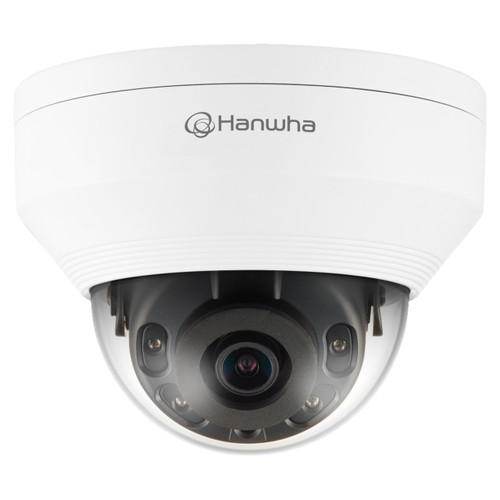
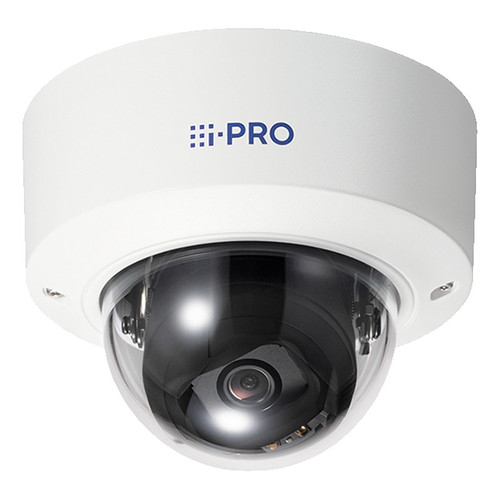
Hanwha QNV-8010R vs i-PRO S22500-F3L: Specification Comparison
Both the Hanwha QNV-8010R and the i-PRO WV-S22500-F3L are 5MP fixed vandal-resistant indoor dome cameras powered over PoE, targeting the same commercial and institutional indoor surveillance segment. This comparison examines their imaging performance, installation requirements, and integration capabilities—drawing exclusively from published specifications—to help integrators and IT buyers evaluate which unit best fits a given deployment scenario.
In This Guide
How do the imaging specs compare?
Both cameras use an approximately 1/2.8-inch CMOS sensor and deliver 5MP resolution at 30 fps, but they differ in native resolution mapping and WDR performance. The QNV-8010R outputs 2592×1944 in a 4:3 aspect ratio. The S22500-F3L tops out at 3072×2304 in 4:3 (and 3072×1728 in 16:9), giving it a larger pixel canvas. Dynamic range is a key differentiator: the QNV-8010R is rated at 120 dB WDR, while the S22500-F3L specifies up to 132 dB (Super Dynamic at Level 31). Color minimum illumination is 0.15 lux for the QNV-8010R versus 0.12 lux for the S22500-F3L; B&W with IR is 0 lux on both.
Lens characteristics also diverge. The QNV-8010R uses a fixed 2.8 mm lens at f/2.0 with a 105° horizontal field of view and no autofocus. The S22500-F3L uses a fixed 3.2 mm lens at f/2.0 with autofocus and a narrower 95° horizontal FOV, plus 1x–3x digital zoom at reduced resolution (640×360). IR reach is 20 m (65 ft) on the QNV-8010R and 25 m (82 ft, 30 IRE) on the S22500-F3L. DORI Detect is 40 m for the QNV-8010R and 56.3 m for the S22500-F3L, giving the i-PRO a meaningful edge at longer detection ranges.
What about installation and environment?
Both cameras share an IK10 vandal rating and an aluminum housing. The QNV-8010R carries an IP66 weatherproof rating and operates from −30 °C to +55 °C, making it suitable for unheated indoor spaces or sheltered outdoor installations. The S22500-F3L is specified as an indoor camera with no IP ingress rating listed in its specs; its operating range is −10 °C to +50 °C, a narrower window on both ends.
Power inputs differ by PoE class: the QNV-8010R draws a maximum of 7.5 W and is PoE Class 3, while the S22500-F3L is PoE Class 0 (also 802.3af-compliant, with an alternate DC 12 V 880 mA input). Physical size is close—QNV-8010R is ø120.3 × 91.7 mm at 510 g; S22500-F3L is ø129.5 × 102.5 mm at 800 g. The S22500-F3L also includes CVBS monitor output and 3.5 mm audio I/O jacks, which can simplify on-site commissioning and audio integration without additional adapters. The QNV-8010R includes a CVBS output and alarm I/O (1 in / 1 out); the S22500-F3L provides 3 alarm inputs, 1 alarm output, and 1 AUX output.
Which fits your VMS and analytics better?
Both cameras support ONVIF Profile S, G, and T. The S22500-F3L additionally supports ONVIF Profile M. The QNV-8010R exposes Hanwha's SUNAPI (HTTP API) and Wisenet Open Platform for third-party application hosting. The S22500-F3L lists no equivalent open-platform SDK in its published specs. Protocol support is broadly comparable, though the S22500-F3L adds SFTP and MQTT to its IPv4 stack—useful for cloud-forwarding and IoT-adjacent deployments. The S22500-F3L supports up to 14 simultaneous users versus the QNV-8010R's 6 unicast users.
On-board analytics differ meaningfully. The QNV-8010R offers motion detection, tampering, defocus detection, virtual line crossing/direction, and virtual area intrusion/enter/exit. The S22500-F3L adds AI-based face detection, vehicle detection, AI video motion detection, scene change detection, and AI sound classification (gunshot, yell, vehicle horn, glass break). Audio hardware is absent on the QNV-8010R; the S22500-F3L provides a 3.5 mm mic input and audio output with G.711/G.726 compression. Edge storage reaches 512 GB microSDXC on the S22500-F3L versus 128 GB on the QNV-8010R. Security posture on the S22500-F3L includes FIPS 140-2 Level 3 and an NXP SE050F secure element; the QNV-8010R specifies firmware encryption, 802.1X (EAP-TLS/LEAP/PEAP), SRTP, and SD-card partition encryption, but does not cite FIPS certification in the provided specs.
Which should you choose: the QNV-8010R or the S22500-F3L?
Our take: The S22500-F3L is the stronger choice when maximum dynamic range, longer IR reach, AI-class analytics, and audio capture are priorities in a controlled indoor environment. Its 132 dB Super Dynamic rating outstrips the QNV-8010R's 120 dB WDR, its IR range extends 5 m further (25 m vs. 20 m), and its DORI Detect distance of 56.3 m versus 40 m means fewer cameras per linear meter of corridor. It also supports 512 GB edge storage, FIPS 140-2 Level 3 security, ONVIF Profile M, up to 14 simultaneous users, and a 5-year warranty versus 3 years on the QNV-8010R. Choose the QNV-8010R when the deployment runs into harsh thermal conditions (−30 °C floor vs. −10 °C), requires an IP66-rated enclosure for splash or dust exposure, needs Hanwha's SUNAPI or Wisenet Open Platform SDK, or where the Hanwha VMS ecosystem is already standardized on-site.
Side-by-Side Comparison
Spec-for-spec, from manufacturer data.
| Specification | Hanwha QNV-8010R | i-PRO S22500-F3L |
|---|---|---|
| Resolution (max) | 2592×1944 (5MP, 4:3) | 3072×2304 (5MP, 4:3) / 3072×1728 (16:9) |
| Image Sensor | 1/2.8" CMOS | Approx. 1/2.8" CMOS |
| Lens / Focal Length | 2.8 mm fixed, f/2.0, no autofocus | 3.2 mm fixed, f/2.0, autofocus |
| Horizontal FOV | 105° | 95° |
| Min. Illumination (Color) | 0.15 lux | 0.12 lux |
| Min. Illumination (B&W / IR) | 0 lux (IR on) | 0 lux (IR on) |
| Wide Dynamic Range | 120 dB | Up to 132 dB (Super Dynamic Level 31) |
| IR Range | 20 m (65 ft) | 25 m (82 ft, 30 IRE) |
| DORI Detect | 40.0 m (131 ft) | 56.3 m (184.7 ft) |
| Max Frame Rate | 30 fps @ 5MP | 30 fps |
| Video Compression | H.265, H.264, MJPEG | H.265, H.264, MJPEG |
| IP Rating | IP66 | Not specified (indoor) |
| IK / Impact Rating | IK10 | IK10 |
| Operating Temperature | −30 °C to +55 °C | −10 °C to +50 °C |
| Power Input / PoE Class | PoE 802.3af, Class 3 (max 7.5 W) | PoE 802.3af, Class 0; or DC 12 V 880 mA |
| Edge Storage | microSD/SDHC/SDXC up to 128 GB | microSDXC up to 512 GB |
| Audio | — | 3.5 mm mic input + 3.5 mm audio output; G.711/G.726 |
| Alarm I/O | 1 input / 1 output | 3 inputs / 1 output / 1 AUX output |
| ONVIF Profiles | S, G, T | S, G, T, M |
| AI Analytics | — | Face detection, vehicle detection, AI VMD, AI sound classification |
| Security Certification | Firmware encryption, 802.1X, SRTP, SD partition encrypt | FIPS 140-2 Level 3, NXP SE050F secure element |
| Simultaneous Users | 6 (unicast) | Up to 14 |
| Weight | 510 g (1.12 lb) | 800 g (1.77 lb) |
| Warranty | 3 years | 5 years |
Frequently Asked Questions
Which should you choose: the QNV-8010R or the S22500-F3L?
The S22500-F3L is the stronger choice when maximum dynamic range, longer IR reach, AI-class analytics, and audio capture are priorities in a controlled indoor environment. Its 132 dB Super Dynamic rating outstrips the QNV-8010R's 120 dB WDR, its IR range extends 5 m further (25 m vs. 20 m), and its DORI Detect distance of 56.3 m versus 40 m means fewer cameras per linear meter of corridor. It also supports 512 GB edge storage, FIPS 140-2 Level 3 security, ONVIF Profile M, up to 14 simultaneous users, and a 5-year warranty versus 3 years on the QNV-8010R. Choose the QNV-8010R when the deployment runs into harsh thermal conditions (−30 °C floor vs. −10 °C), requires an IP66-rated enclosure for splash or dust exposure, needs Hanwha's SUNAPI or Wisenet Open Platform SDK, or where the Hanwha VMS ecosystem is already standardized on-site.
Is the QNV-8010R or S22500-F3L better for low-light performance?
Both cameras reach 0 lux in B&W mode when IR is active. In color mode, the S22500-F3L has a slight edge at 0.12 lux versus 0.15 lux for the QNV-8010R. The S22500-F3L also extends IR range to 25 m (30 IRE) compared to 20 m on the QNV-8010R, giving it greater reach in unlit corridors.
Can either camera be installed outdoors or in wet locations?
The QNV-8010R carries an IP66 rating, meaning it is protected against powerful water jets and dust ingress, and it operates down to −30 °C—making it usable in sheltered outdoor or harsh indoor environments. The S22500-F3L's published specifications do not list an IP ingress rating, and its operating temperature floor is −10 °C; i-PRO markets it as an indoor camera.
Which camera offers stronger built-in analytics?
The S22500-F3L includes AI-based face detection, vehicle detection, AI video motion detection, scene change detection, and AI sound classification (gunshot, yell, vehicle horn, glass break). The QNV-8010R provides video analytics covering virtual line crossing, direction, and area intrusion/enter/exit, plus defocus and tampering detection, but does not list AI object classification in its published specs.
Get a Second Opinion on Your Camera Choice
Share your site layout, coverage goals, and budget. Our team will validate the camera selection, flag anything we would change, and recommend products that match the use case.