
Hanwha QNV-7082R vs i-PRO S35402-F2L: Specification Comparison
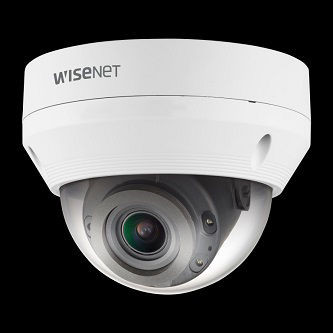
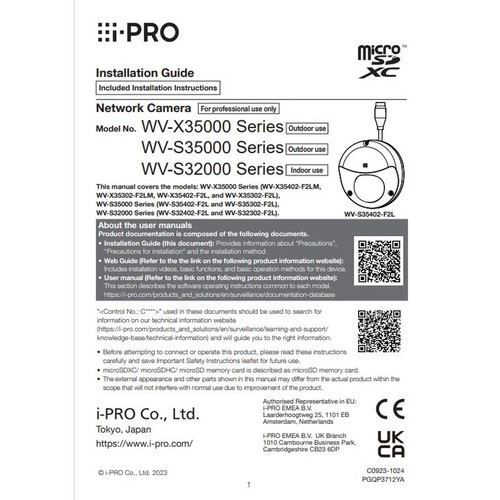
Both the Hanwha QNV-7082R and i-PRO WV-S35402-F2L are 4MP outdoor vandal-rated IP dome cameras targeting perimeter and general surveillance applications. The QNV-7082R is a motorized varifocal model with 30m IR, while the S35402-F2L is a fixed-lens AI-enabled camera with on-device analytics. Buyers comparing these two are typically choosing between optical zoom flexibility and advanced AI classification — both at the same resolution tier, same housing type, and similar environmental ratings.
In This Guide
How do the imaging specs compare?
The QNV-7082R uses a 1/3" CMOS sensor at 2560×1440 resolution, while the S35402-F2L uses an approx. 1/2.8" CMOS sensor at 2688×1520 — the i-PRO sensor is physically larger and yields marginally higher pixel count. Low-light performance favors the i-PRO: minimum illumination is 0.06 Lux (B&W, 50IRE) versus 0.1 Lux color / 0 Lux IR (B&W) for the Hanwha. Both cameras reach 0 Lux in IR mode. Wide dynamic range is a clear differentiator: the i-PRO reaches 132dB (Super Dynamic On, Level 31) versus the Hanwha's 120dB — a meaningful 12dB advantage for scenes with extreme contrast such as entrance lobbies or parking structures facing direct sun.
On optics, the two cameras diverge significantly. The QNV-7082R offers a 3.2–10mm (3.1×) motorized varifocal lens with DC auto iris, providing a 98.6°–30.8° horizontal field of view and enabling remote focus adjustment — a practical advantage during commissioning at height. The S35402-F2L is fixed at 2.4mm with a 121° horizontal FOV; there is no zoom capability, though an electronic extra-zoom up to 4× is available at reduced resolution (640×360). IR range is 30m (98ft) on the QNV-7082R versus 14m (46ft) on the S35402-F2L — the Hanwha reaches more than twice the IR distance, which is significant for open parking lots or extended corridors.
What about installation and environment?
Both cameras share IP66 and IK10 ratings, making them equivalent for outdoor vandal-resistant deployment. The Hanwha QNV-7082R operates from -40°C to +55°C, while the i-PRO S35402-F2L operates from -40°C to +50°C (with a power-on minimum of -20°C noted in the spec). The Hanwha therefore tolerates 5°C higher ambient heat, which can matter in rooftop or metal-enclosure installations in hot climates. The i-PRO additionally carries NEMA 4X and UL Type 4X ratings not listed for the Hanwha, and specifies wind resistance up to 40 m/s (approx. 89 mph), which the Hanwha spec does not address.
Power draw differs: the QNV-7082R draws up to 11.4W (PoE IEEE 802.3af, Class 3; also accepts 12VDC), while the S35402-F2L draws up to 8.6W (PoE IEEE 802.3af, Class 0). The i-PRO's lower wattage is favorable when deploying at the edge of PoE switch port budgets or using long cable runs. The Hanwha is physically larger and heavier at Ø137×106.1mm / 710g versus 109×53×119mm / 475g for the i-PRO. The Hanwha provides CVBS video output for installation alignment; the i-PRO spec does not list a CVBS output. The Hanwha also has an alarm I/O (1 in / 1 out); the i-PRO alarm I/O is not specified in the provided data.
Which fits your VMS and analytics better?
Both cameras support ONVIF Profile S, G, and T, ensuring compatibility with standard VMS platforms. The i-PRO adds ONVIF Profile M, which is relevant for metadata and analytics integration. The i-PRO S35402-F2L runs on an Ambarella CV25M SoC and provides on-device AI analytics — AI Video Motion Detection, Face Detection, People Detection, and Vehicle Detection — plus AI Sound Classification covering gunshot, yell, vehicle horn, and glass break. These are edge-processed; no external server license is required per the spec. The QNV-7082R's analytics are limited to defocus detection, directional detection, motion detection, enter/exit, tampering, and virtual line crossing — no on-device face or vehicle classification is listed. For deployments where AI metadata must feed downstream VMS rules without server-side analytics licenses, the i-PRO has a clear structural advantage.
Audio support is present on both: the QNV-7082R has a line-in audio input; the i-PRO spec indicates audio detection and AI sound classification, implying a built-in microphone, though the spec field lists 'Built-in mic'. Neither camera lists a built-in speaker in the provided specs. Edge storage is comparable: both support microSD/SDHC/SDXC up to 512GB (i-PRO) and 128GB (Hanwha spec states 128GB max). The i-PRO supports up to 14 simultaneous streaming users; the Hanwha supports 6 unicast users with up to 3 stream profiles. The i-PRO lists FIPS 140-2 Level 3 compliance, a requirement for U.S. federal and critical-infrastructure projects; the Hanwha lists HTTPS/SSL, 802.1X, and IP filtering but does not specify FIPS compliance.
Which should you choose: the QNV-7082R or the S35402-F2L?
Our take: The QNV-7082R is the stronger choice when variable scene framing and long-range IR coverage are priorities — its 3.2–10mm motorized varifocal lens enables remote optical adjustment unavailable on the fixed-lens S35402-F2L, its IR range of 30m is more than double the i-PRO's 14m, and it tolerates 5°C higher ambient temperature (+55°C vs +50°C). The S35402-F2L is the stronger choice when on-device AI analytics and cybersecurity compliance are the deciding factors: it delivers 132dB dynamic range versus 120dB, runs face/people/vehicle detection and AI sound classification natively on its Ambarella CV25M SoC, achieves FIPS 140-2 Level 3 certification (not listed for the Hanwha), and draws 2.8W less from the PoE infrastructure. Installers serving federal, education, or enterprise sites with analytics-aware VMS platforms should favor the i-PRO; those needing optical flexibility and IR depth in parking structures or perimeter fencing should favor the Hanwha.
Side-by-Side Comparison
Spec-for-spec, from manufacturer data.
| Specification | Hanwha QNV-7082R | i-PRO S35402-F2L |
|---|---|---|
| Resolution | 2560×1440 (4MP) | 2688×1520 (4MP) |
| Image Sensor | 1/3" CMOS | Approx. 1/2.8" CMOS |
| Lens / Focal Length | 3.2–10mm motorized varifocal (3.1×) | 2.4mm fixed |
| Horizontal FOV | 98.6° (wide) – 30.8° (tele) | 121° (16:9) |
| Min. Illumination | 0.1 Lux color / 0 Lux IR | 0.06 Lux B&W (50IRE) / 0 Lux IR |
| IR Range | 30m (98.4 ft) | 14m (46 ft) at 30IRE |
| Wide Dynamic Range | 120dB | 132dB max (Super Dynamic On, Level 31) |
| Video Compression | H.265, H.264, MJPEG | H.265, H.264, JPEG |
| Max Frame Rate | 30fps | Not explicitly stated (spec says 'High') |
| IP Rating | IP66 | IP66, NEMA 4X, UL Type 4X |
| IK / Impact Rating | IK10 | IK10 |
| Operating Temperature | -40°C to +55°C | -40°C to +50°C (power-on: -20°C min) |
| Power Input / PoE Class | PoE 802.3af Class 3; 12VDC alt. / 11.4W max | PoE 802.3af Class 0 / 8.6W max |
| Edge Storage | microSD/SDHC/SDXC up to 128GB | microSD/SDHC/SDXC up to 512GB |
| On-device AI Analytics | Motion, enter/exit, virtual line, tampering, defocus | AI VMD, Face, People, Vehicle detection; AI Sound Classification |
| FIPS 140-2 Level 3 | — | Yes |
| ONVIF Profiles | S / G / T | G / M / S / T |
| Audio | Line input | Built-in mic; audio detection |
| Alarm I/O | 1 input / 1 output | Not specified in provided data |
| Dimensions | Ø137.0 × 106.1mm | 109 × 53 × 119mm |
| Weight | 710g (1.57 lb) | 475g (1.05 lb) |
| Warranty | 3 years | 3 years |
Frequently Asked Questions
Which should you choose: the QNV-7082R or the S35402-F2L?
The QNV-7082R is the stronger choice when variable scene framing and long-range IR coverage are priorities — its 3.2–10mm motorized varifocal lens enables remote optical adjustment unavailable on the fixed-lens S35402-F2L, its IR range of 30m is more than double the i-PRO's 14m, and it tolerates 5°C higher ambient temperature (+55°C vs +50°C). The S35402-F2L is the stronger choice when on-device AI analytics and cybersecurity compliance are the deciding factors: it delivers 132dB dynamic range versus 120dB, runs face/people/vehicle detection and AI sound classification natively on its Ambarella CV25M SoC, achieves FIPS 140-2 Level 3 certification (not listed for the Hanwha), and draws 2.8W less from the PoE infrastructure. Installers serving federal, education, or enterprise sites with analytics-aware VMS platforms should favor the i-PRO; those needing optical flexibility and IR depth in parking structures or perimeter fencing should favor the Hanwha.
Is the QNV-7082R or WV-S35402-F2L better for low-light performance?
In color mode the i-PRO WV-S35402-F2L has a lower minimum illumination — 0.06 Lux (B&W, 50IRE) versus the Hanwha QNV-7082R's 0.1 Lux color. Both cameras drop to 0 Lux when their IR illuminators activate. However, the Hanwha's IR range reaches 30m versus 14m on the i-PRO, so for longer unlit spaces the Hanwha illuminates more of the scene. If the priority is color low-light before IR kicks in, the i-PRO's larger 1/2.8" sensor and lower lux figure have the edge.
Do I need a separate analytics server if I deploy the WV-S35402-F2L?
Based on the provided specifications, the i-PRO WV-S35402-F2L performs AI Video Motion Detection, Face Detection, People Detection, Vehicle Detection, and AI Sound Classification on-camera using its Ambarella CV25M SoC. The spec does not mention a required server-side license for these functions. The QNV-7082R does not list face or vehicle classification analytics, so those capabilities would need to be handled by the VMS or a separate analytics server if required.
Which camera is easier to aim and focus after installation?
The QNV-7082R's 3.2–10mm motorized varifocal lens supports remote zoom and simple-focus adjustment via the camera interface, which allows an installer to dial in the field of view and focus from a laptop without physically repositioning a ladder or adjusting a fixed lens. The WV-S35402-F2L has a fixed 2.4mm lens with a 121° horizontal FOV; the field of view cannot be optically adjusted after mounting. The Hanwha also provides CVBS video output (specified in the specs) for local alignment on a monitor during installation, which the i-PRO spec does not list.
Get a Second Opinion on Your Camera Choice
Share your site layout, coverage goals, and budget. Our team will validate the camera selection, flag anything we would change, and recommend products that match the use case.