
Hanwha QNO-8020R vs i-PRO X15500-V3L: Specification Comparison
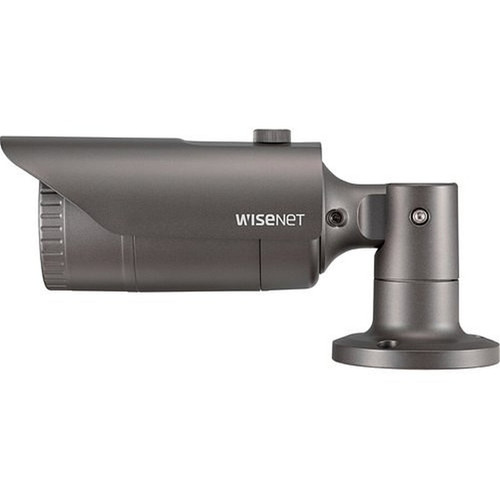
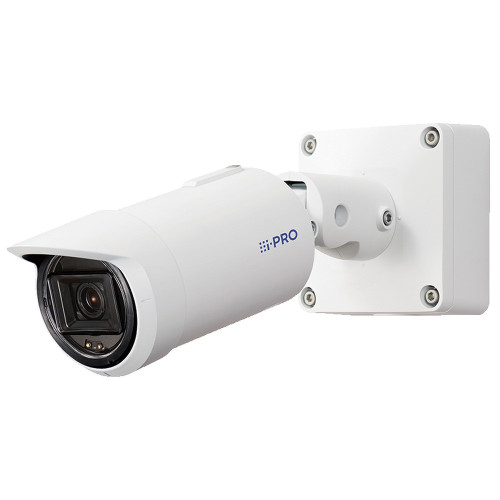
Both the Hanwha QNO-8020R and the i-PRO WV-X15500-V3L are 5MP outdoor bullet IP cameras targeting perimeter and area surveillance applications. The QNO-8020R ships with a fixed 4mm lens and IR illumination to 25m, while the X15500-V3L features a 3.1x motorized varifocal lens and IR to 70m, along with an Ambarella CV52 SoC enabling on-camera AI classification. This comparison examines sensor performance, environmental ratings, installation requirements, and analytics capabilities to help integrators and IT buyers select the right unit for their deployment.
In This Guide
How do the imaging specs compare?
Both cameras use an approximately 1/2.8-inch CMOS sensor at 5MP, but their lens configurations differ significantly. The QNO-8020R uses a fixed 4.0mm focal length at F1.6, delivering an 80° horizontal field of view with no optical zoom capability. The i-PRO X15500-V3L uses a motorized varifocal lens spanning 2.9–9mm at F1.3 (wide) to F2.5 (tele), providing a 34–106° horizontal field of view and a 3.1x optical zoom extendable to 12.4x digital extra zoom. The X15500-V3L's wider maximum aperture of F1.3 contributes to a specified minimum illumination of 0.02 Lux (B&W, 50IRE, F1.3, 1/30s), compared to the QNO-8020R's 0.15 Lux color / 0 Lux IR.
IR illumination range is a material differentiator: the QNO-8020R's IR LEDs (850nm) reach 25m (82ft), while the X15500-V3L's IR illuminator reaches 70m (230ft), nearly three times the distance. On dynamic range, the X15500-V3L specifies a maximum of 132 dB with Super Dynamic processing enabled at level 31, versus the QNO-8020R's 120 dB WDR. The QNO-8020R's DORI figures for detection and recognition at a fixed 4mm are 62.0m and 12.4m respectively; the X15500-V3L's DORI figures span 46.3–201.0m (detect) and 9.3–40.2m (recognize) depending on zoom position. The X15500-V3L also includes image stabilization (available in 30fps mode) and fog compensation (0–8 levels); neither feature is listed in the QNO-8020R's specifications.
What about installation and environment?
Both cameras carry IP66 and IK10 ratings, confirming dust-tight housings and resistance to high-pressure water jets, as well as impact resistance to 20J. The i-PRO X15500-V3L additionally holds IP67, NEMA 4X, and Type 4X (UL50E) certifications, adding immersion protection and North American corrosion-resistance compliance not present in the QNO-8020R's listed certifications. Operating temperature ranges are nearly identical at the upper end (both to +55°C), but the X15500-V3L extends to -40°C versus the QNO-8020R's -30°C lower limit, relevant for northern or high-altitude deployments. The X15500-V3L also specifies wind resistance up to 40 m/s (approx. 89 mph), a figure absent from the QNO-8020R's published specifications.
Power requirements differ: the QNO-8020R draws a maximum of 7.5W via PoE (IEEE 802.3af, Class 3), while the X15500-V3L requires PoE+ (802.3at, Class 4) at up to 14W, or an external DC12V 1.2A supply. Existing PoE switches without PoE+ ports will need an upgrade or midspan injector for the X15500-V3L. Physically, the X15500-V3L is considerably larger and heavier at 133×133×383mm and approximately 2.5kg (5.6 lbs), compared to the QNO-8020R's ø70×246mm body at 680g (1.5 lbs). The QNO-8020R includes one alarm input and one output; the X15500-V3L provides four alarm I/O terminals (IN1, IN2, IN3, OUT, AUX) plus audio input and audio output jacks (3.5mm), which the QNO-8020R does not list.
Which fits your VMS and analytics better?
Both cameras declare ONVIF Profile S, G, and T compliance. The i-PRO X15500-V3L adds ONVIF Profile M, which covers metadata and analytics interoperability — relevant for VMS platforms that leverage standardized AI metadata streams. The QNO-8020R integrates via Hanwha's SUNAPI (HTTP API) and Wisenet Open Platform in addition to ONVIF. The X15500-V3L supports up to 14 simultaneous streams (network-dependent), while the QNO-8020R supports unicast up to 6 users or multicast, with up to 3 configurable stream profiles. Network protocol support is broadly similar; the X15500-V3L adds SFTP and MQTT to its listed protocols, which the QNO-8020R does not specify. The X15500-V3L's security posture includes FIPS 140-2 Level 3 certification and secure boot; the QNO-8020R lists firmware encryption, AES encryption, 802.1X (EAP-TLS/LEAP/PEAP), and a Hanwha Private Root CA device certificate.
On-camera analytics diverge notably. The QNO-8020R offers motion detection (polygonal zones), tampering, defocus detection, virtual line crossing/direction, and virtual area intrusion/enter/exit. The X15500-V3L's Ambarella CV52 SoC enables AI-classified motion detection (person, face, vehicle, occupancy), scene change detection, and audio detection with AI sound classification across four categories (gunshot, yell, vehicle horn, glass break) — capabilities not listed for the QNO-8020R. Both cameras support on-board microSD storage: the QNO-8020R accepts cards up to 128GB; the X15500-V3L supports up to 512GB microSDXC. The QNO-8020R includes 512MB RAM and 256MB Flash on-board; equivalent figures are not published in the X15500-V3L's provided specifications.
Which should you choose: the QNO-8020R or the X15500-V3L?
Our take: The QNO-8020R is the stronger choice when budget, infrastructure simplicity, and a fixed wide-angle field of view are the primary drivers. It operates within standard IEEE 802.3af PoE (max 7.5W, Class 3), requires no switch upgrades, and weighs 680g versus the X15500-V3L's 2.5kg, easing single-technician installation. Conversely, the i-PRO WV-X15500-V3L is the stronger choice when range, AI analytics depth, and environmental ratings are decisive. Its IR illuminator reaches 70m versus 25m, its dynamic range is specified at 132 dB versus 120 dB, its motorized 2.9–9mm varifocal lens allows post-install field-of-view adjustment without a hardware change, and it adds IP67 / NEMA 4X / FIPS 140-2 Level 3 certifications and AI sound classification absent from the QNO-8020R. Choose the QNO-8020R for cost-sensitive, PoE-af-only deployments with fixed wide-angle coverage; specify the X15500-V3L where long-range IR, flexible framing, deep AI metadata, or stringent environmental compliance are required.
Side-by-Side Comparison
Spec-for-spec, from manufacturer data.
| Specification | Hanwha QNO-8020R | i-PRO X15500-V3L |
|---|---|---|
| Resolution | 2592×1944 (5MP) | 3072×1728 (5MP) |
| Image Sensor | 1/2.8" CMOS | Approx. 1/2.8" CMOS |
| Lens / Focal Length | 4.0mm fixed, F1.6 | 2.9–9mm motorized varifocal, F1.3–F2.5 |
| Optical Zoom | — | 3.1x (motorized) |
| Horizontal Field of View | 80° | 34–106° (zoom-dependent) |
| Minimum Illumination | 0.15 Lux color / 0 Lux IR | 0.02 Lux (B&W, 50IRE, F1.3, 1/30s) |
| IR Range | 25m (82ft) | 70m (230ft) |
| Wide Dynamic Range | 120 dB | Max. 132 dB (Super Dynamic On, Level 31) |
| Max Frame Rate | 30fps @ 5MP | 30fps (specs provided; 60fps not listed in provided specs) |
| Video Compression | H.265, H.264, MJPEG | H.265, H.264, MJPEG |
| IP Rating | IP66 | IP66 / IP67 / NEMA 4X / Type 4X (UL50E) |
| Vandal / Impact Rating | IK10 | IK10 (IEC 62262) |
| Operating Temperature | -30°C to +55°C | -40°C to +55°C |
| Power Input / PoE Class | PoE IEEE 802.3af, Class 3, max 7.5W | PoE+ 802.3at, Class 4, 14W; or DC12V 1.2A |
| Edge Storage | microSD/SDHC/SDXC up to 128GB | microSDXC up to 512GB |
| Audio | — | 3.5mm audio input and output |
| Alarm I/O | 1 input / 1 output | 4 alarm I/O terminals (IN1, IN2, IN3, OUT, AUX) |
| AI Analytics | VMD, virtual line/area, tampering, defocus | AI motion, face, vehicle, occupancy; AI sound classification (gunshot, yell, vehicle horn, glass break) |
| ONVIF Profiles | S / G / T | G / S / T / M |
| Weight | 680g (1.5 lbs) | Approx. 2.5 kg (5.6 lbs) |
| Dimensions | ø70.0×246.0mm | 133×133×383mm |
| Warranty | 3-year | 5-year |
Frequently Asked Questions
Which should you choose: the QNO-8020R or the X15500-V3L?
The QNO-8020R is the stronger choice when budget, infrastructure simplicity, and a fixed wide-angle field of view are the primary drivers. It operates within standard IEEE 802.3af PoE (max 7.5W, Class 3), requires no switch upgrades, and weighs 680g versus the X15500-V3L's 2.5kg, easing single-technician installation. Conversely, the i-PRO WV-X15500-V3L is the stronger choice when range, AI analytics depth, and environmental ratings are decisive. Its IR illuminator reaches 70m versus 25m, its dynamic range is specified at 132 dB versus 120 dB, its motorized 2.9–9mm varifocal lens allows post-install field-of-view adjustment without a hardware change, and it adds IP67 / NEMA 4X / FIPS 140-2 Level 3 certifications and AI sound classification absent from the QNO-8020R. Choose the QNO-8020R for cost-sensitive, PoE-af-only deployments with fixed wide-angle coverage; specify the X15500-V3L where long-range IR, flexible framing, deep AI metadata, or stringent environmental compliance are required.
Is the QNO-8020R or WV-X15500-V3L better for low-light performance?
Based on published specifications, the WV-X15500-V3L has the advantage in low-light conditions on both metrics. Its minimum illumination is specified at 0.02 Lux (B&W, 50IRE, F1.3, 1/30s) compared to the QNO-8020R's 0.15 Lux color, and its IR illuminator reaches 70m (230ft) versus the QNO-8020R's 25m (82ft). The X15500-V3L also has a wider maximum aperture of F1.3 at the wide end versus the QNO-8020R's F1.6.
Can I power the WV-X15500-V3L from my existing PoE switch?
Only if your switch supports PoE+ (IEEE 802.3at). The WV-X15500-V3L requires PoE+ at up to 14W (Class 4) or an external DC12V 1.2A supply. The QNO-8020R, by contrast, operates on standard PoE (IEEE 802.3af, Class 3) at a maximum of 7.5W, so it will work with a wider range of installed PoE infrastructure without additional hardware.
Which camera offers better built-in analytics for detecting people and vehicles?
The i-PRO WV-X15500-V3L specifies AI-classified analytics for motion, face, vehicle, and occupancy detection, plus AI sound classification for gunshot, yell, vehicle horn, and glass break, enabled by its Ambarella CV52 SoC and ONVIF Profile M support. The QNO-8020R provides virtual line and area analytics, tampering, and defocus detection, but does not list AI-based person, face, or vehicle classification in its published specifications.
Get a Second Opinion on Your Camera Choice
Share your site layout, coverage goals, and budget. Our team will validate the camera selection, flag anything we would change, and recommend products that match the use case.