
Hanwha QNO-8020R vs i-PRO S15500-V3LK: Specification Comparison
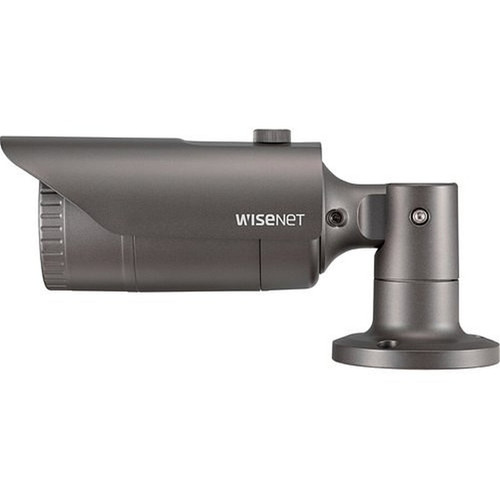
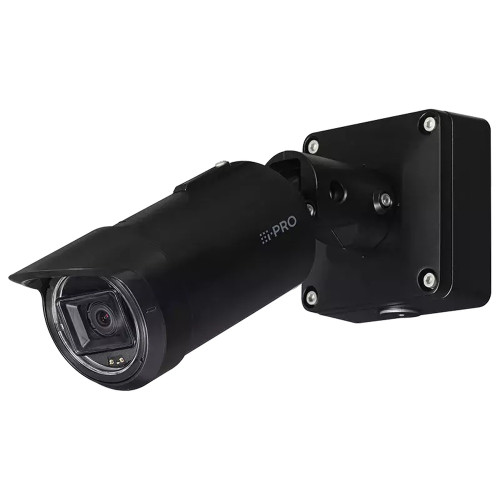
Both the Hanwha QNO-8020R and the i-PRO WV-S15500-V3LK are 5-megapixel outdoor bullet IP cameras designed for perimeter and area surveillance in demanding environments. This comparison evaluates how they differ across imaging capability, installation requirements, and systems integration — drawing exclusively on published specifications for each model. Neither product is declared a universal winner; the right choice depends on site-specific requirements around lens flexibility, analytics depth, environmental extremes, and platform compatibility.
In This Guide
How do the imaging specs compare?
Both cameras use an approximately 1/2.8-inch CMOS sensor delivering 2592×1944 (5MP) at up to 30fps. Low-light performance differs meaningfully: the i-PRO WV-S15500-V3LK reaches 0.05 Lux color and 0.04 Lux B&W, while the Hanwha QNO-8020R is rated at 0.15 Lux color with 0 Lux IR (active illumination). The i-PRO's Super Dynamic WDR reaches a maximum of 132 dB at Level 30+ / 15fps, versus the Hanwha's 120 dB SSDR/WDR. Backlight compensation on the Hanwha includes BLC, WDR, and SSDR; the i-PRO adds Adaptive Black Stretch, HLC, and Fog Compensation as additional scene-correction tools.
Lens architecture is the sharpest divergence between these two models. The QNO-8020R uses a fixed 4.0mm lens at F1.6, delivering a fixed horizontal field of view of 80°. The WV-S15500-V3LK is equipped with a 3.1x motorized varifocal lens (2.9–9mm, F1.3 wide to F2.5 tele) with autofocus, yielding a horizontal FOV range of 34°–106° and an Extra Zoom mode extending to 9.3x at reduced resolution. IR illumination also differs: the Hanwha's integrated IR LEDs cover 25m (82ft), while the i-PRO's IR reaches 70m at 30IRE or 50m at 50IRE — nearly three times the Hanwha's stated IR range. DORI Detect at the i-PRO's tele end (201.0m) far exceeds the Hanwha's fixed-lens Detect distance of 62.0m.
What about installation and environment?
Both cameras carry IP66 and IK10 ratings, confirming equivalent ingress protection and impact resistance. Operating temperature ranges differ: the i-PRO WV-S15500-V3LK is rated from -40°C to +60°C with a built-in anti-condensation system (Temish element, heater, and moisture absorption gel), and additionally meets NEMA 4X and ISO 14993 salt-damage resistance standards, plus wind resistance up to 40 m/s (approx. 89 mph). The Hanwha QNO-8020R operates from -30°C to +55°C with 0–90% RH non-condensing, with no anti-condensation system specified. For extreme cold, coastal, or high-wind installations the i-PRO holds a measurable environmental advantage.
Power input also differs. The QNO-8020R is powered solely by PoE (IEEE 802.3af, Class 3; max 7.5W, typical 6.1W), with no local power input specified. The WV-S15500-V3LK accepts either DC 12V 1.0A (12W) or PoE Class 0 (11.5W), providing a dual-power option useful in sites where PoE infrastructure is unavailable or where local power is preferred. Physically, the i-PRO is substantially larger and heavier (ø133×383mm, 2.4 kg) compared to the Hanwha (ø70×246mm, 680g), which is relevant for bracket load ratings and conduit routing. The Hanwha's aluminum body and the i-PRO's aluminum die cast with polycarbonate and stainless steel construction both provide metal housings suited for commercial outdoor use.
Which fits your VMS and analytics better?
Both cameras support ONVIF Profile S, G, and T. The i-PRO WV-S15500-V3LK additionally supports ONVIF Profile M, which covers metadata for AI analytics interoperability — relevant for VMS platforms leveraging that profile. The i-PRO supports up to 14 simultaneous unicast users; the Hanwha supports up to 6. Protocol depth differs: the i-PRO adds SFTP and MQTT (useful for IoT/edge integration pipelines) to a largely overlapping protocol stack. The Hanwha's API layer includes SUNAPI (HTTP API) and the Wisenet open platform in addition to ONVIF, while the i-PRO exposes standard ONVIF and browser-based access across Edge, Firefox, and Chrome.
Analytics diverge significantly. The QNO-8020R provides motion detection, tampering, defocus detection, and virtual line/area analytics (intrusion, enter, exit, crossing, direction) on-board. The WV-S15500-V3LK adds AI Video Analytics covering 8 detection types, AI Sound Classification (gunshot, yell, vehicle horn, glass break), and Scene Change Detection — a materially deeper on-camera analytics stack. Audio support is another clear differentiator: the i-PRO has a 3.5mm stereo mic input, 3.5mm audio output, and supports G.726, G.711, and AAC-LC compression with half/full-duplex transmission; the Hanwha QNO-8020R has no audio I/O specified in the provided specs. Edge storage capacity also differs: the Hanwha supports microSD up to 128GB; the i-PRO supports up to 512GB. Alarm inputs likewise favor the i-PRO with 3 alarm inputs versus 1 on the Hanwha, plus an AUX output in addition to the standard alarm output. Security credentials include FIPS 140-2 Level 3 and NXP SE050F on the i-PRO; the Hanwha offers AES encryption, SD card partition encryption, and device certificate via Hanwha Private Root CA.
Which should you choose: the QNO-8020R or the S15500-V3LK?
Our take: The QNO-8020R is the stronger choice when budget, compact form factor, and a fixed wide-angle (80° H) field of view at a known focal length are the primary criteria, particularly in sites already standardized on Wisenet/SUNAPI VMS infrastructure. However, on the three most consequential spec deltas: IR range (i-PRO 70m vs. Hanwha 25m), dynamic range ceiling (i-PRO 132 dB vs. Hanwha 120 dB), and operating temperature floor (i-PRO -40°C vs. Hanwha -30°C), the WV-S15500-V3LK holds a clear advantage. Add the i-PRO's 3.1x motorized varifocal lens with autofocus, AI Sound Classification, FIPS 140-2 Level 3 security, 512GB edge storage capacity, and 5-year warranty versus the Hanwha's 3-year, and the i-PRO is the stronger specification for long-range perimeter coverage, harsh-environment deployments, and sites requiring on-camera AI analytics or audio event detection.
Side-by-Side Comparison
Spec-for-spec, from manufacturer data.
| Specification | Hanwha QNO-8020R | i-PRO S15500-V3LK |
|---|---|---|
| Resolution | 2592×1944 (5MP) @ 30fps | 2048×1536 (4:3) / 1920×1080 (16:9) @ 30fps; 5MP effective sensor |
| Image Sensor | 1/2.8" CMOS | Approx. 1/2.8" CMOS; 5.12mm (H) × 3.84mm (V) scanning area |
| Lens / Focal Length | 4.0mm fixed, F1.6 | 2.9–9mm motorized varifocal, F1.3 (W) – F2.5 (T); autofocus; 3.1x optical zoom |
| Min Illumination (Color) | 0.15 Lux | 0.05 Lux |
| Min Illumination (B&W) | — | 0.04 Lux |
| IR Range | 25m (82ft) @ 850nm | 70m (30IRE) / 50m (50IRE) |
| Wide Dynamic Range | 120 dB | 132 dB max (Super Dynamic On, Level 30+, 15fps) |
| Max Frame Rate | 30fps @ 5MP | 30fps |
| Video Compression | H.265 / H.264 Main+High / MJPEG; CBR/VBR; WiseStream II | H.265 / H.264 / MJPEG (JPEG); CBR/VBR; Variable GOP 1s–60s |
| ONVIF Profile | S / G / T | G / M / S / T |
| IP Rating | IP66 | IP66, NEMA 4X |
| IK / Impact Rating | IK10 | IK10 (IEC 62262) |
| Operating Temperature | -30°C to +55°C | -40°C to +60°C; anti-condensation system; ISO 14993 salt resistance |
| Power Input | PoE IEEE 802.3af Class 3 (max 7.5W) | DC 12V 1.0A (12W) or PoE Class 0 (11.5W) |
| Edge Storage | MicroSD/SDHC/SDXC up to 128GB | MicroSD/SDHC/SDXC up to 512GB |
| Audio I/O | — | Mic in: 3.5mm stereo jack; Audio out: 3.5mm stereo jack; G.726 / G.711 / AAC-LC |
| Alarm I/O | 1 input / 1 output | 3 inputs / 1 output / 1 AUX output |
| Simultaneous Streams/Users | Up to 6 unicast users / 3 profiles | Up to 14 simultaneous users |
| Warranty | 3 years | 5 years |
Frequently Asked Questions
Which should you choose: the QNO-8020R or the S15500-V3LK?
The QNO-8020R is the stronger choice when budget, compact form factor, and a fixed wide-angle (80° H) field of view at a known focal length are the primary criteria, particularly in sites already standardized on Wisenet/SUNAPI VMS infrastructure. However, on the three most consequential spec deltas: IR range (i-PRO 70m vs. Hanwha 25m), dynamic range ceiling (i-PRO 132 dB vs. Hanwha 120 dB), and operating temperature floor (i-PRO -40°C vs. Hanwha -30°C), the WV-S15500-V3LK holds a clear advantage. Add the i-PRO's 3.1x motorized varifocal lens with autofocus, AI Sound Classification, FIPS 140-2 Level 3 security, 512GB edge storage capacity, and 5-year warranty versus the Hanwha's 3-year, and the i-PRO is the stronger specification for long-range perimeter coverage, harsh-environment deployments, and sites requiring on-camera AI analytics or audio event detection.
Can the i-PRO WV-S15500-V3LK be adjusted remotely after installation?
Yes. The WV-S15500-V3LK features a 3.1x motorized varifocal lens (2.9–9mm) with motorized autofocus, so focal length and focus can both be adjusted remotely after mounting — useful when fine-tuning a scene without physical access to the camera. The Hanwha QNO-8020R uses a fixed 4.0mm lens with no remote adjustment capability.
Do both cameras work with third-party VMS platforms via ONVIF?
Both cameras support ONVIF Profile S, G, and T. The i-PRO WV-S15500-V3LK additionally supports ONVIF Profile M, which carries AI metadata and analytics interoperability. Either camera will integrate with any ONVIF-compliant VMS for basic video streaming and event handling; Profile M support on the i-PRO extends compatibility with analytics-aware platforms.
Is audio recording supported on the Hanwha QNO-8020R?
Audio I/O is not specified in the provided specifications for the QNO-8020R. The i-PRO WV-S15500-V3LK includes a 3.5mm stereo microphone input, a 3.5mm audio output, and supports G.726, G.711, and AAC-LC audio compression with half- and full-duplex transmission, making it the appropriate choice where on-camera audio capture or two-way audio is required.
Get a Second Opinion on Your Camera Choice
Share your site layout, coverage goals, and budget. Our team will validate the camera selection, flag anything we would change, and recommend products that match the use case.