
Hanwha QNO-8020R vs Hanwha XNB-8000: Specification Comparison
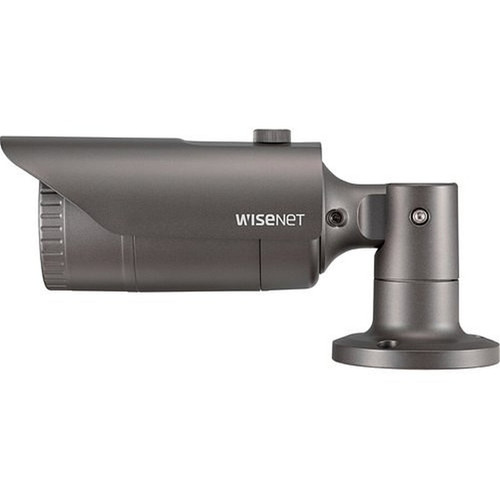
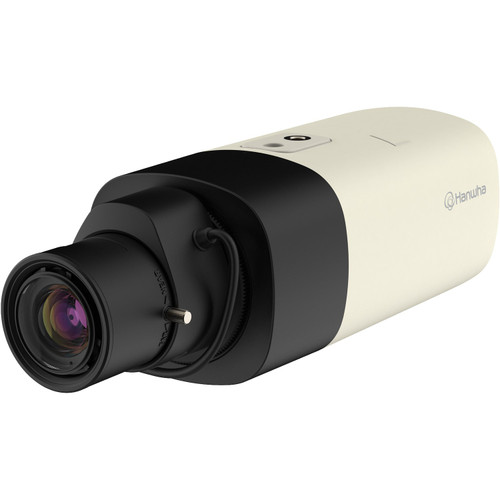
Both the Hanwha QNO-8020R and XNB-8000 are 5MP fixed outdoor bullet IP cameras in the same resolution class, powered via PoE and built for perimeter surveillance. The QNO-8020R is a self-contained unit with a fixed 4mm lens and built-in IR illumination, while the XNB-8000 is a box-body bullet accepting C/CS-mount lenses with no factory-fitted IR. This comparison examines imaging performance, installation and environmental ratings, and integration capabilities to help installers and IT buyers choose the right platform for their deployment.
In This Guide
How do the imaging specs compare?
The QNO-8020R uses a 1/2.8" CMOS sensor capturing 2592×1944 at 30fps, paired with a fixed 4.0mm F1.6 lens delivering an 80° horizontal field of view. Its minimum illumination is 0.15 Lux in color mode, dropping to 0 Lux with active IR — the built-in 850nm IR LEDs cover a rated range of 25m (82ft). Wide dynamic range is specified at 120dB via WDR and SSDR. The XNB-8000 uses a larger 1/1.8" 6MP CMOS sensor — despite outputting a 5MP (2560×1920) stream — which yields a measurably better minimum illumination of 0.07 Lux color and 0.007 Lux B/W without IR assistance. No factory IR illuminator is fitted to the XNB-8000; it accepts external IR, but no on-board IR range is specified. WDR is also rated at 120dB.
The sensor size difference is meaningful: the XNB-8000's 1/1.8" chip is physically larger than the QNO-8020R's 1/2.8", which directly contributes to its roughly 20× lower color minimum illumination (0.07 vs 0.15 Lux). However, the QNO-8020R's built-in 25m IR gives it a defined night-vision envelope with zero ambient light — the XNB-8000 cannot claim any rated zero-lux performance from its own hardware. The XNB-8000 also adds digital image stabilization (built-in gyro) and an optical defog filter, neither of which appears in the QNO-8020R specification. Lens flexibility is a further differentiator: the XNB-8000 accepts C and CS mount lenses with DC auto-iris or P-iris control, whereas the QNO-8020R is locked to its fixed 4mm optic.
What about installation and environment?
The QNO-8020R carries IP66 weatherproofing and IK10 impact resistance, making it suitable for rain exposure and vandal-prone locations. Its operating temperature range is -30°C to +55°C, which covers cold-climate deployments. It is powered exclusively by PoE (IEEE 802.3af, Class 3) at a maximum of 7.5W. Physical form is a traditional fixed bullet housing in aluminum, measuring ø70×246mm and weighing 680g (1.50 lb). Pan/tilt/rotate adjustment is available during installation (0–360°/0–100°/0–360°). The XNB-8000 provides no IK impact rating in the provided specifications. Its IP rating is not explicitly stated in the spec sheet fields — only an "Outdoor certified" tag and a weatherproof connector cap are noted. Operating temperature range is narrower at -10°C to +55°C (vs -30°C for the QNO-8020R). It supports PoE (802.3af, Class 3) but also accepts 24VAC or 12VDC, adding power-input flexibility. The body is plastic, measures 73.1×66.6×147.8mm, and weighs only 420g (0.93 lb) — notably lighter and more compact. It accepts C/CS lens mounts, requiring a separately purchased lens, and includes a Micro USB port for installation viewing.
Which fits your VMS and analytics better?
Both cameras share ONVIF Profile S/G/T, SUNAPI (HTTP API), and Wisenet open platform compatibility, and both implement H.265/H.264 (CBR/VBR) and MJPEG compression with WiseStream II smart codec. The QNO-8020R streams up to 3 profiles to 6 unicast users. The XNB-8000 scales significantly further: up to 10 streaming profiles and 20 unicast users simultaneously, which benefits high-density VMS environments. Edge storage also diverges: the QNO-8020R has one microSD/SDHC/SDXC slot supporting up to 128GB; the XNB-8000 has two slots supporting up to 512GB total. The XNB-8000 adds an RS-485 serial interface for PTZ controller or third-party device integration, which the QNO-8020R lacks.
On analytics, the QNO-8020R includes motion detection, tampering, defocus detection, virtual area (intrusion/enter/exit), and virtual line (crossing/direction) — plus alarm I/O (1 in/1 out). The XNB-8000 lists motion detection, loitering, directional detection, fog detection, digital auto-tracking, sound classification, and handover — also with 1 in/1 out alarm I/O. The XNB-8000 adds full two-way audio: a selectable mic/line input with built-in microphone and a line-level output, with G.711 and G.726 audio compression. The QNO-8020R has no audio capability listed in the provided specifications. Privacy masking is substantially more capable on the XNB-8000: 32 polygonal zones with color and mosaic options versus 6 rectangular zones on the QNO-8020R.
Which should you choose: the QNO-8020R or the XNB-8000?
Our take: The XNB-8000 is the stronger choice when the deployment demands lens flexibility, audio, high-density VMS integration, or richer analytics — but the QNO-8020R is the practical choice for vandal-prone, cold-climate, or no-external-lens installations. Three concrete spec deltas illustrate the gap: the XNB-8000's 1/1.8" sensor achieves 0.07 Lux color versus 0.15 Lux on the QNO-8020R's 1/2.8" chip, its dual microSD slots support up to 512GB versus 128GB on a single slot, and it supports 20 unicast streams across 10 profiles versus 6 streams across 3 profiles. Conversely, the QNO-8020R delivers a defined 25m IR night-vision envelope (the XNB-8000 has no factory IR), an IK10 vandal rating (not specified on the XNB-8000), and a -30°C minimum operating temperature versus -10°C. Choose the QNO-8020R for all-in-one vandal-resistant outdoor bullet deployments; choose the XNB-8000 where lens selection, audio, expanded storage, or broader VMS scalability drives the requirement.
Side-by-Side Comparison
Spec-for-spec, from manufacturer data.
| Specification | Hanwha QNO-8020R | Hanwha XNB-8000 |
|---|---|---|
| Resolution | 2592×1944 (5MP) | 2560×1920 (5MP) |
| Image Sensor | 1/2.8" CMOS | 1/1.8" 6MP CMOS |
| Lens / Focal Length | 4.0mm fixed, F1.6 | C/CS mount, DC auto-iris or P-iris (lens sold separately) |
| Min. Illumination (Color) | 0.15 Lux | 0.07 Lux |
| Min. Illumination (B/W) | Not specified | 0.007 Lux |
| IR Illumination | 850nm IR LEDs, 25m (82ft) | — (no factory IR; external required) |
| Wide Dynamic Range | 120dB | 120dB |
| Max Frame Rate | 30fps @ 5MP | 30fps |
| Video Compression | H.265 / H.264 / MJPEG | H.265 / H.264 / MJPEG |
| Smart Codec | WiseStream II | WiseStream II; Manual (5-area) |
| Simultaneous Streams / Users | 3 profiles / 6 unicast | 10 profiles / 20 unicast |
| IP Rating | IP66 | — (not explicitly stated in specs) |
| IK / Vandal Rating | IK10 | — (not specified) |
| Operating Temperature | -30°C to +55°C | -10°C to +55°C |
| Power Input | PoE IEEE 802.3af, Class 3 (max 7.5W) | PoE IEEE 802.3af Class 3 / 24VAC / 12VDC (max 8.5W) |
| Edge Storage | 1× microSD, up to 128GB | 2× microSD, up to 512GB |
| Audio | — (none specified) | Mic/line in + built-in mic; line out; G.711 / G.726 |
| Serial Interface | — | RS-485 (multiple protocols) |
| Digital Image Stabilization | — | Yes (built-in gyro sensor) |
| Defog | — | Yes (built-in optical filter) |
| Analytics | Motion, tampering, defocus, virtual area/line | Motion, loitering, directional, fog, auto-tracking, sound classification, handover |
| Privacy Masking | 6 rectangular zones | 32 polygonal zones (color + mosaic) |
| RAM | 512MB | 1024MB |
| Housing Material | Aluminum | Plastic |
| Dimensions | ø70.0×246.0mm (ø2.76×9.69") | 73.1×66.6×147.8mm (2.88×2.62×5.82") |
| Weight | 680g (1.50 lb) | 420g (0.93 lb) |
| Warranty | 3 years | 3 years |
Frequently Asked Questions
Which should you choose: the QNO-8020R or the XNB-8000?
The XNB-8000 is the stronger choice when the deployment demands lens flexibility, audio, high-density VMS integration, or richer analytics — but the QNO-8020R is the practical choice for vandal-prone, cold-climate, or no-external-lens installations. Three concrete spec deltas illustrate the gap: the XNB-8000's 1/1.8" sensor achieves 0.07 Lux color versus 0.15 Lux on the QNO-8020R's 1/2.8" chip, its dual microSD slots support up to 512GB versus 128GB on a single slot, and it supports 20 unicast streams across 10 profiles versus 6 streams across 3 profiles. Conversely, the QNO-8020R delivers a defined 25m IR night-vision envelope (the XNB-8000 has no factory IR), an IK10 vandal rating (not specified on the XNB-8000), and a -30°C minimum operating temperature versus -10°C. Choose the QNO-8020R for all-in-one vandal-resistant outdoor bullet deployments; choose the XNB-8000 where lens selection, audio, expanded storage, or broader VMS scalability drives the requirement.
Is the QNO-8020R or XNB-8000 better for low-light performance?
The XNB-8000 has a lower minimum illumination in color mode — 0.07 Lux versus 0.15 Lux on the QNO-8020R — due to its larger 1/1.8" sensor. However, the QNO-8020R includes built-in 850nm IR LEDs rated to 25m, enabling operation at 0 Lux with no ambient light. The XNB-8000 has no factory-fitted IR illuminator, so achieving zero-lux performance requires an external IR source. If passive low-light sensitivity is the priority and IR lighting will be provided externally, the XNB-8000's sensor has the edge; for self-contained zero-lux coverage, the QNO-8020R is the clear choice.
Can the XNB-8000 be used in freezing temperatures like the QNO-8020R?
No — not according to the provided specifications. The XNB-8000 is rated for operation from -10°C to +55°C, while the QNO-8020R is rated from -30°C to +55°C. For outdoor deployments in climates where temperatures fall below -10°C, the QNO-8020R is the appropriate choice based on the spec data provided.
Which camera stores more video on-board, the QNO-8020R or the XNB-8000?
The XNB-8000 supports significantly more on-board storage. It has two microSD/SDHC/SDXC slots with a combined capacity up to 512GB. The QNO-8020R has a single microSD/SDHC/SDXC slot supporting up to 128GB. Both cameras also support NAS recording via network event triggers.
Get a Second Opinion on Your Camera Choice
Share your site layout, coverage goals, and budget. Our team will validate the camera selection, flag anything we would change, and recommend products that match the use case.