
Hanwha QNO-8010R vs Hanwha XNB-8000: Specification Comparison
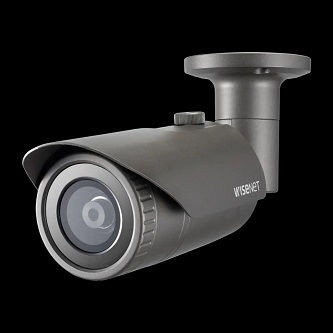
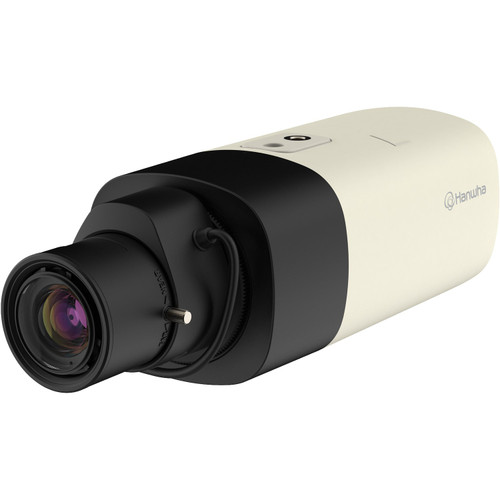
Both the Hanwha QNO-8010R and XNB-8000 are fixed outdoor bullet IP cameras delivering 5MP resolution at 30fps, making them direct cross-shop candidates for perimeter and area surveillance installations. The QNO-8010R is a self-contained fixed-lens unit with integrated IR illumination, while the XNB-8000 is a box-style bullet camera with interchangeable C/CS-mount lenses, onboard audio I/O, and a built-in gyro stabilizer. This comparison covers imaging performance, installation and environmental fit, and VMS/analytics integration to help integrators and IT buyers select the right platform for their deployment.
In This Guide
How do the imaging specs compare?
The QNO-8010R uses a 1/2.8" CMOS sensor at 2592×1944 (5MP) with a fixed 2.8mm lens at F2.0, yielding a 105° horizontal field of view. Minimum illumination is 0.15 Lux color and 0 Lux in IR mode, supported by an 850nm IR LED array with a rated range of 20m (65.62ft). The XNB-8000 uses a larger 1/1.8" CMOS sensor at 2560×1920 (5MP) with no fixed focal length — it accepts C/CS-mount lenses with DC auto-iris or P-iris control and simple focus adjustment. Minimum illumination is 0.07 Lux color and 0.007 Lux B/W. No IR illuminator or IR range is specified in the XNB-8000 data; IR night vision is listed as a feature but no illumination distance is provided in the supplied specs.
Both cameras deliver 120dB Wide Dynamic Range and share WDR, BLC, and ATW/AWC white balance. Both operate at up to 30fps and support H.265/H.264/MJPEG with WiseStream II smart codec and CBR/VBR bitrate control. The XNB-8000 adds HLC (Highlight Compensation) and built-in defog via an optical filter, plus Digital Image Stabilization via an integrated gyro sensor — none of which appear in the QNO-8010R specifications. The QNO-8010R specifies SSNR for digital noise reduction; the XNB-8000 lists SSNRV. The XNB-8000 also carries 1024MB RAM versus the QNO-8010R's 512MB.
What about installation and environment?
The QNO-8010R is rated IP66 and IK10 with an aluminum housing, making it suitable for high-impact, washdown, and exposed outdoor environments. Its operating temperature range is -30°C to +55°C, giving it strong cold-climate tolerance. It is powered exclusively by PoE (IEEE 802.3af, Class 3) at a maximum of 7.5W. Physical dimensions are ø70.0×246.0mm and weight is 680g (1.50 lb), with an optional backbox (SBO-100B1). The lens is fixed at 2.8mm, so field of view is set at installation and cannot be adjusted.
The XNB-8000 uses a plastic housing and its IP/IK rating is not stated in the provided specifications — only 'outdoor certified' and 'weatherproof' appear in marketing fields, with no IK rating listed. Its operating temperature range is -10°C to +55°C, narrower on the cold end by 20°C versus the QNO-8010R. Power inputs include PoE (IEEE 802.3af, Class 3), 24VAC, or 12VDC, offering greater power flexibility. Maximum power draw is 8.5W. Dimensions are 73.1×66.6×147.8mm and weight is 420g (0.93 lb). It accepts C and CS-mount lenses, enabling focal length selection to match the scene — a significant installation advantage when field of view needs to be tailored post-design.
Which fits your VMS and analytics better?
Both cameras support ONVIF Profile S/G/T, SUNAPI (HTTP API), and the Wisenet open platform, ensuring broad VMS compatibility. The QNO-8010R supports up to 6 unicast users and 3 streaming profiles. The XNB-8000 supports up to 20 unicast users and 10 streaming profiles, making it substantially better suited to high-concurrency or multi-VMS deployments. Edge storage on the QNO-8010R is a single microSD/SDHC/SDXC slot supporting up to 128GB. The XNB-8000 provides dual microSD slots supporting up to 512GB total. The QNO-8010R specifies no audio hardware; the XNB-8000 includes a selectable audio input (mic-in/line-in/built-in mic) and line-level audio output, plus G.711 and G.726 audio compression, and an RS-485 serial interface — none of which appear in the QNO-8010R specifications.
On analytics, the QNO-8010R offers motion detection (4 polygonal zones), tampering, defocus detection, virtual area (intrusion/enter/exit), and virtual line (crossing/direction). The XNB-8000 lists motion detection (8 polygonal zones, 8-point), loitering, directional detection, fog detection, digital auto-tracking, sound classification, and handover — a broader built-in analytics set. Privacy masking on the XNB-8000 supports 32 polygonal zones with color and mosaic options versus the QNO-8010R's 6 rectangular zones. Security feature sets are comparable: both include 802.1X, HTTPS, digest authentication, and IP filtering; the QNO-8010R additionally specifies AES encryption, SRTP, device certificate (Hanwha Private Root CA), and SD card partition encryption.
Which should you choose: the QNO-8010R or the XNB-8000?
Our take: The XNB-8000 is the stronger choice when installation flexibility, concurrent stream capacity, and expanded analytics are the primary requirements. Its 1/1.8" sensor delivers lower minimum illumination (0.07 Lux color vs. 0.15 Lux on the QNO-8010R), it supports 20 unicast users and 10 streaming profiles versus 6 users and 3 profiles, and its dual microSD slots provide up to 512GB edge storage versus the QNO-8010R's single 128GB slot. Its C/CS-mount interchangeability, built-in audio I/O, RS-485, gyro stabilizer, and broader analytics set (loitering, fog detection, sound classification) add further integration value. However, the QNO-8010R offers an IK10 impact rating and aluminum housing not confirmed on the XNB-8000, a wider cold-temperature operating range (-30°C vs. -10°C), integrated 20m IR illumination with a specified range, and stronger documented cybersecurity features (AES encryption, device certificate, SD card partition encryption). Choose the QNO-8010R for high-impact or sub-freezing environments with a fixed wide-angle requirement; choose the XNB-8000 for lens-flexible, audio-enabled, high-concurrency deployments.
Side-by-Side Comparison
Spec-for-spec, from manufacturer data.
| Specification | Hanwha QNO-8010R | Hanwha XNB-8000 |
|---|---|---|
| Resolution | 2592×1944 (5MP) | 2560×1920 (5MP) |
| Image Sensor | 1/2.8" CMOS | 1/1.8" CMOS |
| Lens / Focal Length | 2.8mm fixed, F2.0 | C/CS-mount, DC auto-iris / P-iris (lens not included) |
| Horizontal Field of View | 105° | — |
| Min. Illumination (Color / B&W) | 0.15 Lux / 0 Lux (IR) | 0.07 Lux / 0.007 Lux |
| IR Illumination Range | 20m (65.62ft) @ 850nm | — (not specified) |
| Wide Dynamic Range | 120dB | 120dB |
| Max Frame Rate | 30fps @ 5MP | 30fps |
| Video Compression | H.265 / H.264 / MJPEG | H.265 / H.264 / MJPEG |
| IP Rating | IP66 | — (not stated in provided specs) |
| IK / Impact Rating | IK10 | — (not stated in provided specs) |
| Operating Temperature | -30°C to +55°C | -10°C to +55°C |
| Power Input / PoE Class | PoE 802.3af Class 3 only; max 7.5W | PoE 802.3af Class 3 / 24VAC / 12VDC; max 8.5W |
| Edge Storage | 1× microSD slot, up to 128GB | 2× microSD slots, up to 512GB |
| Concurrent Unicast Users / Stream Profiles | 6 users / 3 profiles | 20 users / 10 profiles |
| Audio | — | Mic-in / Line-in / Built-in mic; Line out; G.711 / G.726 |
| Housing Material | Aluminum | Plastic |
| Dimensions (mm) / Weight | ø70.0×246.0mm / 680g (1.50 lb) | 73.1×66.6×147.8mm / 420g (0.93 lb) |
| Warranty | 3 years | 3 years |
Frequently Asked Questions
Which should you choose: the QNO-8010R or the XNB-8000?
The XNB-8000 is the stronger choice when installation flexibility, concurrent stream capacity, and expanded analytics are the primary requirements. Its 1/1.8" sensor delivers lower minimum illumination (0.07 Lux color vs. 0.15 Lux on the QNO-8010R), it supports 20 unicast users and 10 streaming profiles versus 6 users and 3 profiles, and its dual microSD slots provide up to 512GB edge storage versus the QNO-8010R's single 128GB slot. Its C/CS-mount interchangeability, built-in audio I/O, RS-485, gyro stabilizer, and broader analytics set (loitering, fog detection, sound classification) add further integration value. However, the QNO-8010R offers an IK10 impact rating and aluminum housing not confirmed on the XNB-8000, a wider cold-temperature operating range (-30°C vs. -10°C), integrated 20m IR illumination with a specified range, and stronger documented cybersecurity features (AES encryption, device certificate, SD card partition encryption). Choose the QNO-8010R for high-impact or sub-freezing environments with a fixed wide-angle requirement; choose the XNB-8000 for lens-flexible, audio-enabled, high-concurrency deployments.
Is the QNO-8010R or XNB-8000 better for low-light performance?
Based on the provided specifications, the XNB-8000 has a lower minimum illumination rating — 0.07 Lux color and 0.007 Lux B/W — compared to the QNO-8010R's 0.15 Lux color. The QNO-8010R specifies integrated 850nm IR LEDs with a rated illumination range of 20m (65.62ft) and achieves 0 Lux in IR mode. The XNB-8000 lists IR as a night-vision feature but no IR illumination distance is stated in the supplied specifications. For passive low-light sensitivity, the XNB-8000's larger 1/1.8" sensor has the edge; for a self-contained IR solution with a specified range, the QNO-8010R provides more explicit data.
Can the XNB-8000 use a telephoto lens, or is it fixed like the QNO-8010R?
Yes. The XNB-8000 accepts C-mount and CS-mount lenses with DC auto-iris or P-iris control and supports simple focus adjustment, so the integrator can select any compatible focal length at installation. The QNO-8010R has a fixed 2.8mm focal length with a fixed focus mechanism; the field of view is set permanently at 105° horizontal and cannot be changed without replacing the camera.
Which camera is better suited for cold-climate outdoor deployments?
The QNO-8010R is specified for operating temperatures down to -30°C, versus -10°C for the XNB-8000 — a 20°C advantage at the cold end. The QNO-8010R also uses an aluminum housing with an IK10 impact rating, while the XNB-8000 uses a plastic housing and no IK rating is stated in the provided specifications. For sub-freezing or high-impact environments, the QNO-8010R is the better-documented choice based on the supplied specs.
Get a Second Opinion on Your Camera Choice
Share your site layout, coverage goals, and budget. Our team will validate the camera selection, flag anything we would change, and recommend products that match the use case.