
Hanwha QNO-7082R vs i-PRO U1542LA: Specification Comparison
Both the Hanwha QNO-7082R and i-PRO WV-U1542LA are 4MP wired outdoor bullet cameras with motorized varifocal lenses, PoE power, IP66/IK10 ratings, and H.265/H.264/MJPEG compression — a pairing installers and IT buyers routinely cross-shop for perimeter and parking-lot coverage. The comparison that follows draws exclusively from the published specifications for each model, covering imaging performance, installation and environmental suitability, and VMS/analytics integration, to help buyers identify which unit better fits a specific project requirement.
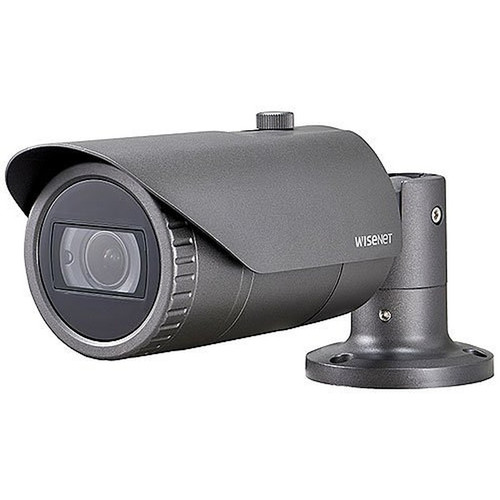
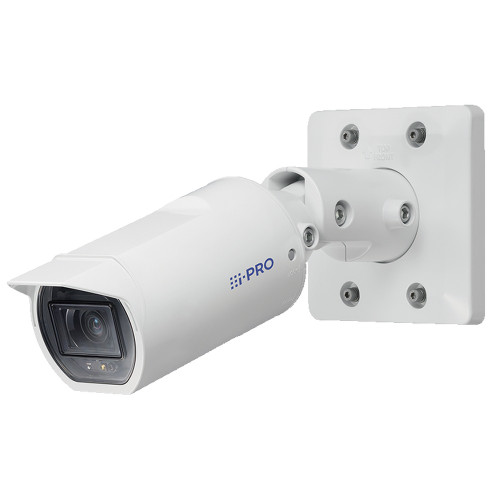
In This Guide
How do the imaging specs compare?
Both cameras deliver 4MP resolution at up to 30fps. The Hanwha QNO-7082R specifies a 3.2–10mm motorized varifocal lens with DC auto-iris; the i-PRO WV-U1542LA specifies a 2.9–7.3mm motorized varifocal lens providing 2.5x optical zoom (expandable to 3.3x at 1080p crop) and a maximum aperture ratio of f/2.0 (wide) to f/3.0 (tele). The QNO-7082R covers a longer focal-length range on the tele end (10mm vs 7.3mm), while the U1542LA publishes angular field-of-view figures (44–103° horizontal) and DORI detection distances (detect to 126.7m tele, identify to 12.7m tele) that the QNO-7082R spec sheet does not include.
On low-light and dynamic range, the i-PRO U1542LA specifies a minimum illumination of 0.3 lux (color) / 0.12 lux (B&W), a sensor size of approximately 1/2.7-type CMOS, 20m IR range, and a maximum Super Dynamic (WDR) level of 102 dB. The Hanwha QNO-7082R lists WDR as a supported feature and includes IR night vision, but its published specifications do not state a minimum illumination figure, a sensor size, an IR distance in meters, or a maximum WDR dB value. Buyers requiring quantified low-light or WDR performance should note that only the U1542LA provides those numbers in the available specs.
What about installation and environment?
Both cameras carry IP66 ingress protection and IK10 vandal resistance, and both are rated for outdoor use. The i-PRO WV-U1542LA adds NEMA 4X and Type 4X (UL50E) compliance, an anti-condensation Temish element, and a stated wind resistance of up to 40 m/s (approx. 89 mph) — none of which appear in the QNO-7082R spec sheet. The U1542LA's operating temperature range is -30°C to +50°C; the QNO-7082R's is -40°C to +55°C, giving it a wider cold-side margin (-10°C lower) and a slightly higher heat ceiling (+5°C higher).
Both cameras are powered by PoE IEEE 802.3af. The QNO-7082R is specified as PoE Class 3 and also accepts 12VDC, providing a dual-power fallback option. The U1542LA is listed as PoE Class 0 with a stated consumption of 7.2W at DC48V/150mA; no auxiliary DC input is listed for the U1542LA in the available specs. The QNO-7082R weighs approximately 1.98 lbs (spec sheet value); the U1542LA is specified at approximately 860g (1.90 lbs). The U1542LA publishes ceiling- and wall-mounting pan/tilt/yaw adjustment ranges; the QNO-7082R spec sheet does not include mounting adjustment figures.
Which fits your VMS and analytics better?
Both cameras support ONVIF Profile S, G, and T, and both offer HTTPS encryption for secure streams. The Hanwha QNO-7082R additionally lists SUNAPI (HTTP API) support, 512MB RAM / 256MB Flash on-board memory, defocus detection, and directional detection analytics. The i-PRO WV-U1542LA specifies Video Motion Detection (VMD) with up to four areas, Scene Change Detection (SCD) with one area, and up to eight privacy zones; its analytics listing in the available specs does not include directional detection or defocus detection. The U1542LA supports an extensive protocol stack including IPv6, SNMPv3, MQTT, and LLDP, plus UL/CSA/CE/FCC/ICES/EN safety and EMC certifications; the QNO-7082R spec sheet does not list equivalent protocol or certification details.
For on-board storage, the QNO-7082R supports microSD; the U1542LA supports microSDXC up to 512GB and microSDHC up to 32GB — a larger specified capacity ceiling. Audio input is listed for both cameras, though neither spec sheet details an audio output or two-way audio capability. The U1542LA specifies audio compression and audio transmission mode fields as blank ('—'), while the QNO-7082R lists 'Audio input' without further detail. The QNO-7082R carries a 3-year warranty; the U1542LA carries a 5-year warranty.
Which should you choose: the QNO-7082R or the U1542LA?
Our take: The WV-U1542LA is the stronger choice when quantified low-light performance, regulatory compliance, and long-term warranty coverage are project requirements, while the QNO-7082R is the stronger choice when the widest possible operating temperature range, dual-power flexibility, or a longer tele focal length is the priority. Key spec deltas: the U1542LA publishes a 0.3 lux (color) / 0.12 lux (B&W) minimum illumination and 102 dB maximum WDR versus no equivalent figures in the QNO-7082R sheet; the QNO-7082R operates to -40°C versus -30°C for the U1542LA and adds 12VDC as a backup power source; the U1542LA specifies a microSDXC ceiling of 512GB versus an unspecified microSD limit on the QNO-7082R; and the U1542LA warranty is 5 years versus 3 years. On ONVIF-based VMS platforms, both integrate comparably via Profiles S/G/T.
Side-by-Side Comparison
Spec-for-spec, from manufacturer data.
| Specification | Hanwha QNO-7082R | i-PRO U1542LA |
|---|---|---|
| Resolution | 4MP | 4MP |
| Image Sensor | — | Approx. 1/2.7-type CMOS |
| Lens / Focal Length | Motorized varifocal 3.2–10mm | Motorized varifocal 2.9–7.3mm (2.5x optical zoom) |
| Minimum Illumination | — | 0.3 lux (Color) / 0.12 lux (B&W) |
| IR Range | — | 20m |
| WDR / Dynamic Range | WDR (dB not specified) | Max. 102 dB (Super Dynamic On, Level 31) |
| Max Frame Rate | 30fps | 30fps |
| Video Compression | H.265, H.264, MJPEG | H.265, H.264, MJPEG |
| IP Rating | IP66 | IP66, NEMA 4X, Type 4X (UL50E) |
| IK / Impact Rating | IK10 | IK10 |
| Operating Temperature | -40°C to +55°C | -30°C to +50°C |
| Power Input / PoE Class | PoE 802.3af Class 3; 12VDC | PoE 802.3af Class 0; 7.2W; no aux DC listed |
| Edge Storage | microSD (capacity not specified) | microSDXC up to 512GB / microSDHC up to 32GB |
| Audio | Audio input | Audio input (compression/transmission: —) |
| Weight | 1.98 lbs (spec sheet) | Approx. 860g (1.90 lbs) |
| Warranty | 3-year | 5-year |
Frequently Asked Questions
Which should you choose: the QNO-7082R or the U1542LA?
The WV-U1542LA is the stronger choice when quantified low-light performance, regulatory compliance, and long-term warranty coverage are project requirements, while the QNO-7082R is the stronger choice when the widest possible operating temperature range, dual-power flexibility, or a longer tele focal length is the priority. Key spec deltas: the U1542LA publishes a 0.3 lux (color) / 0.12 lux (B&W) minimum illumination and 102 dB maximum WDR versus no equivalent figures in the QNO-7082R sheet; the QNO-7082R operates to -40°C versus -30°C for the U1542LA and adds 12VDC as a backup power source; the U1542LA specifies a microSDXC ceiling of 512GB versus an unspecified microSD limit on the QNO-7082R; and the U1542LA warranty is 5 years versus 3 years. On ONVIF-based VMS platforms, both integrate comparably via Profiles S/G/T.
Is the QNO-7082R or WV-U1542LA better for low-light performance?
Based on the published specifications, the i-PRO WV-U1542LA is the only model that states a minimum illumination figure (0.3 lux color / 0.12 lux B&W) and a maximum WDR dynamic range (102 dB Super Dynamic). The Hanwha QNO-7082R lists WDR and IR night vision as supported features but does not publish a minimum illumination value, WDR dB rating, or IR range in meters in the available spec sheet. Buyers who need verified low-light numbers should rely on the U1542LA's published data.
Which camera handles colder installation environments better?
The Hanwha QNO-7082R specifies an operating temperature floor of -40°C (-40°F), which is 10°C lower than the i-PRO WV-U1542LA's stated floor of -30°C (-22°F). For sites in extreme cold climates — arctic storage yards, northern outdoor perimeters — the QNO-7082R's specified temperature range extends further on the cold side. The QNO-7082R also accepts 12VDC in addition to PoE, which may matter in installations where a PoE switch is not available.
Do both cameras work with my existing ONVIF-compatible VMS?
Yes — both the Hanwha QNO-7082R and i-PRO WV-U1542LA support ONVIF Profile S, G, and T, which are the profiles most VMS platforms use for live video, recording, and PTZ/event integration. The QNO-7082R also publishes SUNAPI (HTTP API) support for deeper integration with Hanwha-ecosystem VMS software. Neither camera lists RTSP as a protocol in the U1542LA spec, though the QNO-7082R spec does not itemize supported protocols beyond ONVIF. Verify with your VMS vendor if proprietary API features are required.
Get a Second Opinion on Your Camera Choice
Share your site layout, coverage goals, and budget. Our team will validate the camera selection, flag anything we would change, and recommend products that match the use case.