
Hanwha QND-8080R vs Hanwha XND-8081VZ: Specification Comparison
Both the Hanwha QND-8080R and XND-8081VZ are 5MP indoor dome cameras with motorized varifocal lenses, PoE power, H.265 compression, and ONVIF compatibility—making them genuine cross-shop candidates for integrators specifying indoor fixed-dome surveillance. The comparison covers imaging performance, installation and environmental suitability, and VMS/analytics integration, drawing solely from the published specifications of each model. Neither carries PTZ motor-driven continuous rotation; both use motorized varifocal lenses with remote pan/tilt adjustment brackets.
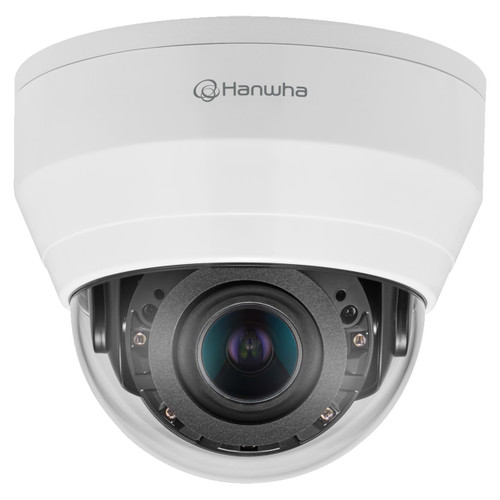
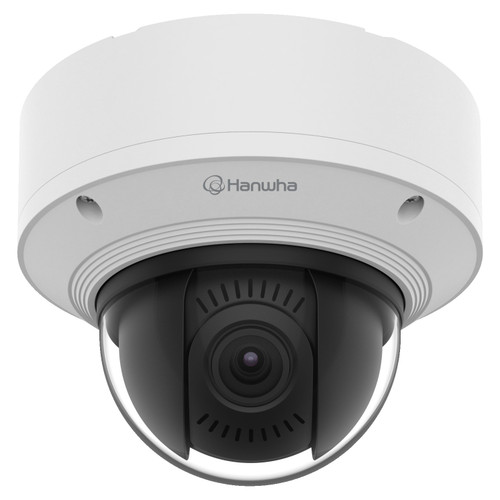
In This Guide
How do the imaging specs compare?
The QND-8080R uses a 1/2.8" 5MP CMOS sensor delivering 2592×1944 resolution at 30fps, while the XND-8081VZ uses a larger 1/1.8" 6MP CMOS sensor outputting 2560×1920 at 30fps. The larger sensor in the XND-8081VZ directly benefits low-light performance: minimum color illumination is 0.07 Lux versus 0.15 Lux on the QND-8080R, and monochrome sensitivity drops to 0.007 Lux B/W on the XND-8081VZ—no equivalent B/W figure is published for the QND-8080R. Both cameras deliver 120dB Wide Dynamic Range. The QND-8080R's maximum aperture of F1.6 (wide) is slightly more open than the XND-8081VZ's F1.2 (wide), though both narrow at the tele end (F2.9 vs F2.4 respectively).
On the lens side, the QND-8080R offers a 3.2–10mm motorized varifocal (3.1x zoom ratio) versus the XND-8081VZ's 3.6–9.4mm (2.6x zoom ratio). The QND-8080R therefore provides slightly more optical reach and a marginally wider zoom range. Horizontal field of view is comparable: 101° (QND-8080R) versus 102.5° (XND-8081VZ) at wide end. The QND-8080R specifies an IR illuminator range of 20m (65.62ft) at 850nm; the XND-8081VZ lists IR illumination but its throw distance is not published in the provided specifications. DORI detection distances are published for the QND-8080R (Wide: 43.3m / Tele: 185.7m detect) but are absent for the XND-8081VZ.
What about installation and environment?
The QND-8080R is rated IP42 (dust-partially protected, splash from vertical drip only) with no impact rating published, and its operating temperature range is -10°C to +55°C. The XND-8081VZ carries IP52 (dust-protected, drip-resistant) and additionally holds an IK10 vandal-resistance rating, making it the more robust choice in environments where tampering or accidental impact is a concern. Its operating temperature range is broader: -25°C to +60°C, better suited to unconditioned spaces or equipment rooms with temperature extremes.
Both cameras are powered via PoE IEEE 802.3af Class 3. The QND-8080R draws a maximum of 8.90W (6.60W typical), while the XND-8081VZ draws up to 11W maximum—note that the XND-8081VZ also accepts 12VDC as an alternative input, which the QND-8080R does not. The QND-8080R weighs 430g (0.95 lb) and measures ø120.3×102.0mm, while the XND-8081VZ is considerably larger and heavier at 1.45kg (3.2 lb) and ø160×125mm. The QND-8080R's installation video output is CVBS composite; the XND-8081VZ uses Micro USB Type B for installation alignment.
Which fits your VMS and analytics better?
Both cameras support ONVIF Profile S/G/T, SUNAPI HTTP API, and the Wisenet open platform, ensuring compatibility with leading VMS platforms. The XND-8081VZ offers substantially more capable on-board analytics: 8 polygonal motion zones (versus 4 on the QND-8080R), 32 privacy masking zones with color/mosaic options (versus 6 rectangular zones), Digital Image Stabilization, Defog, Face Detection, Digital Auto Tracking, Appear/Disappear, Loitering, Sound Classification, Shock Detection, and full business intelligence functions (People Counting, Queue Management, Heatmap). The QND-8080R's analytics are limited to motion detection, tampering, defocus, virtual area intrusion/enter/exit, and virtual line crossing. For edge-only analytics deployments the XND-8081VZ is substantially more capable.
On audio and storage, the XND-8081VZ provides bi-directional audio (mic/line/built-in microphone input; line output) and dual microSD card slots supporting up to 512GB total edge storage, along with 1024MB RAM. The QND-8080R has no audio input or output specified and supports a single microSD slot up to 128GB with 512MB RAM. The XND-8081VZ also supports up to 10 simultaneous streaming profiles and 20 unicast users, compared to 3 profiles and 6 unicast users on the QND-8080R—relevant for multi-client VMS or redundant stream architectures.
Which should you choose: the QND-8080R or the XND-8081VZ?
Our take: The XND-8081VZ is the stronger choice when the installation demands vandal resistance, superior low-light sensitivity, audio capability, or advanced edge analytics. Its 1/1.8" sensor achieves 0.007 Lux B/W versus the QND-8080R's 0.15 Lux color floor—a meaningful gap in dimly lit corridors or lobbies. The IK10 rating adds physical protection the IP42-only QND-8080R cannot match. Dual microSD slots (512GB vs 128GB) and 10 streaming profiles (vs 3) give the XND-8081VZ a clear infrastructure edge in multi-VMS or high-retention deployments. The QND-8080R is the practical pick when budget, mounting footprint, or switch power budget is constrained: it draws only 6.6W typical (vs 11W max for the XND-8081VZ), is substantially lighter (430g vs 1.45kg), and offers a slightly longer 3.1x zoom ratio at a smaller physical size. Both carry a 3-year warranty and identical ONVIF Profile S/G/T support.
Side-by-Side Comparison
Spec-for-spec, from manufacturer data.
| Specification | Hanwha QND-8080R | Hanwha XND-8081VZ |
|---|---|---|
| Resolution | 2592×1944 (5MP) | 2560×1920 (5MP nominal, 1/1.8" 6MP sensor) |
| Image Sensor | 1/2.8" CMOS | 1/1.8" 6MP CMOS |
| Focal Length / Zoom Ratio | 3.2–10mm (3.1x motorized varifocal) | 3.6–9.4mm (2.6x motorized varifocal) |
| Max Aperture | F1.6 (Wide) / F2.9 (Tele) | F1.2 (Wide) / F2.4 (Tele) |
| Horizontal Field of View | 101° | 102.5° |
| Min. Illumination (Color) | 0.15 Lux | 0.07 Lux |
| Min. Illumination (B/W) | Not published | 0.007 Lux |
| Wide Dynamic Range | 120dB | 120dB |
| Video Compression | H.265 / H.264 (Main/High) / MJPEG | H.265 / H.264 (Main/Baseline/High) / MJPEG |
| Smart Codec | WiseStream II | WiseStream II + Manual (5 area) |
| Max Streaming Profiles / Unicast Users | 3 profiles / 6 users | 10 profiles / 20 users |
| IP Rating | IP42 | IP52 |
| IK / Impact Rating | — | IK10 |
| Operating Temperature | -10°C to +55°C | -25°C to +60°C |
| Power Input | PoE IEEE 802.3af, Class 3 only | PoE IEEE 802.3af, Class 3 or 12VDC |
| Max Power Draw | 8.90W (6.60W typical) | 11W |
| Edge Storage | 1× microSD/SDHC/SDXC up to 128GB | 2× microSD/SDHC/SDXC up to 512GB total |
| RAM / Flash | 512MB RAM / 256MB Flash | 1024MB RAM / 256MB Flash |
| Audio | — | In: mic/line/built-in mic; Out: line out |
| Business Intelligence Analytics | — | People Counting, Queue Management, Heatmap |
| Digital Image Stabilization | — | Supported |
| Defog | — | Supported |
| Dimensions | ø120.3×102.0mm (ø4.74×4.02") | ø160×125mm (ø6.3×4.9") |
| Weight | 430g (0.95 lb) | 1.45kg (3.2 lb) |
| Warranty | 3-year | 3-year |
Frequently Asked Questions
Which should you choose: the QND-8080R or the XND-8081VZ?
The XND-8081VZ is the stronger choice when the installation demands vandal resistance, superior low-light sensitivity, audio capability, or advanced edge analytics. Its 1/1.8" sensor achieves 0.007 Lux B/W versus the QND-8080R's 0.15 Lux color floor—a meaningful gap in dimly lit corridors or lobbies. The IK10 rating adds physical protection the IP42-only QND-8080R cannot match. Dual microSD slots (512GB vs 128GB) and 10 streaming profiles (vs 3) give the XND-8081VZ a clear infrastructure edge in multi-VMS or high-retention deployments. The QND-8080R is the practical pick when budget, mounting footprint, or switch power budget is constrained: it draws only 6.6W typical (vs 11W max for the XND-8081VZ), is substantially lighter (430g vs 1.45kg), and offers a slightly longer 3.1x zoom ratio at a smaller physical size. Both carry a 3-year warranty and identical ONVIF Profile S/G/T support.
Is the QND-8080R or XND-8081VZ better for low-light performance?
The XND-8081VZ is significantly better in low light. Its minimum color illumination is 0.07 Lux versus 0.15 Lux for the QND-8080R, and it adds a 0.007 Lux B/W sensitivity figure not published for the QND-8080R. This advantage comes from its larger 1/1.8" sensor compared to the QND-8080R's 1/2.8" sensor.
Can I install the XND-8081VZ in a vandal-prone area where the QND-8080R would not be suitable?
Yes. The XND-8081VZ is rated IK10 for impact resistance, making it appropriate for areas where physical tampering is a risk. The QND-8080R carries only an IP42 ingress rating with no IK impact rating published, so it is not specified for vandal-prone environments.
Does either camera support two-way audio for intercommunication?
Only the XND-8081VZ supports audio. It provides a selectable audio input (microphone in, line in, or built-in microphone) and a line output, with G.711/G.726 audio compression. The QND-8080R has no audio input or output specified in its published specifications.
Get a Second Opinion on Your Camera Choice
Share your site layout, coverage goals, and budget. Our team will validate the camera selection, flag anything we would change, and recommend products that match the use case.