
Hanwha PNM-9085RQZ1 vs i-PRO S65501-Z1: Specification Comparison
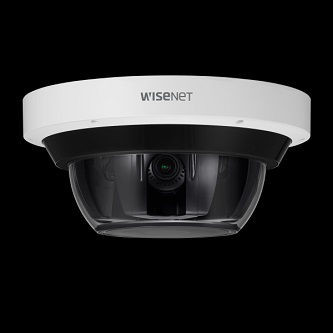
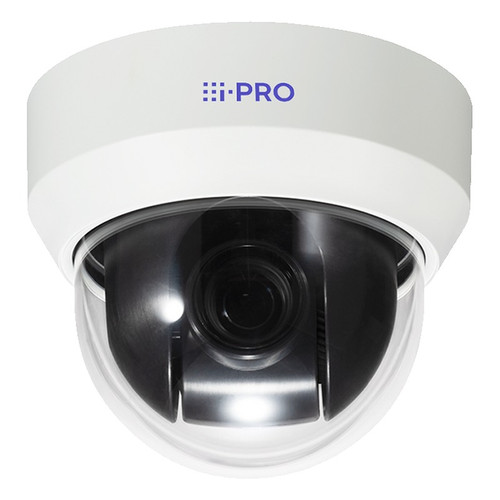
Both the Hanwha PNM-9085RQZ1 and the i-PRO WV-S65501-Z1 are 5MP outdoor IP dome cameras with PTZ capability, IP66/IK10 ratings, and H.265 compression—making them direct cross-shop candidates for mid-to-large perimeter and wide-area surveillance projects. The Hanwha takes a multi-sensor approach (four independent 5MP channels on one PoE++ drop), while the i-PRO is a single-sensor 10x optical zoom PTZ. This comparison examines how their imaging, installation, and integration specs stack up for installers and IT buyers.
In This Guide
How do the imaging specs compare?
The Hanwha PNM-9085RQZ1 uses four independent 1/1.8" 5MP CMOS sensors, each delivering 2560×1920 at 30 fps, for a combined 20MP aggregate view. Its motorized varifocal lens covers 4.13–9.4 mm (2.3x zoom) with a maximum aperture of F1.92 (wide) and minimum illumination of 0.11 lux color / 0 lux IR, supported by a built-in IR illuminator rated to 30 m (98 ft). WDR is specified at 120 dB. The i-PRO WV-S65501-Z1 fields a single 1/2.8" 5MP CMOS sensor at up to 3072×1728, also at 30 fps, but with a 10x optical motorized zoom (4.7–47 mm), extendable to 15x at 1280×720. Its minimum illumination is 0.004 lux monochrome (16/30s), significantly lower than the Hanwha, and its Super Dynamic WDR is rated at 132 dB.
On detection range the gap is substantial: the i-PRO's DORI figures reach 945 m (tele detect) versus the Hanwha's 151.5 m (tele detect at 25 ppm). The Hanwha's IR coverage (30 m) and 2.3x zoom suit close-to-medium perimeter work across four simultaneous views, while the i-PRO's 10x optical zoom and 0.004 lux sensitivity are purpose-built for long-range single-scene monitoring in near-dark conditions. The i-PRO also includes a built-in gyro-based image stabilizer and an Ambarella CV22 SoC. The Hanwha lists 5 GB RAM / 1280 MB Flash; the i-PRO's onboard RAM/Flash spec is not provided in the supplied data.
What about installation and environment?
Both cameras carry IP66 and IK10 ratings and are NEMA 4X certified, making them suitable for exposed outdoor installations subject to water jets and vandal attack. The Hanwha operates from -40 °C to +55 °C, giving it a wider cold-weather envelope than the i-PRO's -30 °C to +55 °C operational range (-20 °C power-on). The i-PRO adds a wind-resistance rating of up to 40 m/s (~89 mph) and includes a Temish anti-condensation element; neither spec is listed for the Hanwha in the supplied data.
Power requirements differ substantially. The Hanwha requires HPoE (IEEE 802.3bt, Class 6 / Type 3) at up to 45 W or 12 VDC, meaning PoE++ switches or injectors are mandatory. The i-PRO runs on PoE (12.95 W), PoE+ (18.9 W), or DC 12 V (15.4 W), offering more flexible switch compatibility. Physically, the Hanwha is considerably larger and heavier—Ø315×145.9 mm / 5.2 kg—versus the i-PRO's Ø165×139 mm / 1.6 kg. The Hanwha's compatible hanging mount is the SBP-317HMW; the i-PRO's mounting accessories are not enumerated in the supplied data. The Hanwha includes a 3/4" conduit hole; conduit compatibility for the i-PRO is not specified in the supplied data.
Which fits your VMS and analytics better?
The Hanwha PNM-9085RQZ1 supports ONVIF Profile S and T, Wisenet SUNAPI (HTTP API), and the Wisenet open platform. It provides four independent Micro SD/SDHC/SDXC slots (one per channel), each supporting up to 256 GB, for a total of up to 1 TB on-device edge storage. Analytics include defocus detection, directional detection, fog detection, face detection, motion detection (8 polygonal zones), appear/disappear, enter/exit, loitering, tampering, virtual line, and audio detection. Audio I/O includes a selectable mic/line input (2.5 VDC, 2 KΩ) and a line output (1 Vrms max), with G.711 and G.726 compression.
The i-PRO WV-S65501-Z1 supports ONVIF Profiles G, M, S, and T—adding Profile G (edge recording) and Profile M (metadata/analytics) over the Hanwha. It carries FIPS 140-2 Level 3 certification and a GlobalSign certificate, distinguishing it in cybersecurity-sensitive deployments. AI analytics include AI Video Motion Detection, face/vehicle/people detection, scene change detection, and AI Sound Classification (gunshot, yell, vehicle horn, glass break)—the last capability not present in the Hanwha spec. The i-PRO supports up to 256 preset positions, 360° endless pan, and preset recall at 500°/s (PoE+). Audio uses a 3.5 mm stereo mini-jack input and output; the Hanwha uses screw-terminal audio I/O. Both support a single microSD card slot (i-PRO) versus four slots (Hanwha). The i-PRO's simultaneous user count is specified at 14; the Hanwha supports up to 20 unicast users.
Which should you choose: the PNM-9085RQZ1 or the S65501-Z1?
Our take: The PNM-9085RQZ1 is the stronger choice when a single cable must deliver four simultaneous 5MP views of a wide-area scene with close-to-medium IR coverage and maximum on-board redundancy. Its four independent 1/1.8" sensors and four 256 GB SD slots—up to 1 TB edge storage—are unmatched by the single-sensor i-PRO. However, the WV-S65501-Z1 is the superior choice for long-range single-scene PTZ work: its 10x optical zoom extends DORI detect range to 945 m versus the Hanwha's 151.5 m, its minimum illumination of 0.004 lux monochrome is roughly 27× more sensitive than the Hanwha's 0.11 lux, and its 132 dB WDR exceeds the Hanwha's 120 dB. The i-PRO also adds ONVIF Profile G/M, FIPS 140-2 Level 3, AI Sound Classification, and PoE/PoE+ flexibility in a 1.6 kg package. Choose the Hanwha for multi-lane or multi-zone wide-area coverage on one PoE++ drop; choose the i-PRO for long-range, near-dark, cyber-hardened single-point PTZ deployments.
Side-by-Side Comparison
Spec-for-spec, from manufacturer data.
| Specification | Hanwha PNM-9085RQZ1 | i-PRO S65501-Z1 |
|---|---|---|
| Resolution | 2560×1920 per channel (4 channels) | 3072×1728 (single channel) |
| Image Sensor | 1/1.8" 5MP CMOS × 4 | Approx. 1/2.8" 5MP CMOS × 1 |
| Lens / Focal Length | 4.13–9.4 mm, 2.3x motorized varifocal | 4.7–47 mm, 10x motorized (15x extra zoom at 720p) |
| Min. Illumination | 0.11 lux color / 0 lux IR | 0.004 lux B&W (16/30s) / 0.007 lux color |
| IR Range | 30 m (98 ft) | Not specified in supplied data |
| Wide Dynamic Range | 120 dB | 132 dB |
| Max Frame Rate | 30 fps per channel | 30 fps (15 fps above WDR level 30) |
| Video Compression | H.265 / H.264 (Main/Baseline/High) / MJPEG | H.265 / H.264 / MJPEG |
| ONVIF Profiles | Profile S, T | Profile G, M, S, T |
| IP Rating | IP66 / NEMA 4X | IP66 / Type 4X |
| IK / Impact Rating | IK10 | IK10 |
| Operating Temperature | -40 °C to +55 °C | -30 °C to +55 °C (-20 °C power-on) |
| Power Input | HPoE 802.3bt Class 6 (45 W max) / 12 VDC | PoE 12.95 W / PoE+ 18.9 W / DC 12 V 15.4 W |
| Edge Storage | 4× microSD/SDHC/SDXC up to 256 GB each | 1× microSDXC |
| Dimensions | Ø315 × 145.9 mm | Ø165 × 139 mm |
| Weight | 5.2 kg (11.5 lb) | Approx. 1.6 kg (3.53 lb) |
| Cybersecurity Certification | — | FIPS 140-2 Level 3, GlobalSign cert |
| Warranty | 3 years | 3 years |
Frequently Asked Questions
Which should you choose: the PNM-9085RQZ1 or the S65501-Z1?
The PNM-9085RQZ1 is the stronger choice when a single cable must deliver four simultaneous 5MP views of a wide-area scene with close-to-medium IR coverage and maximum on-board redundancy. Its four independent 1/1.8" sensors and four 256 GB SD slots—up to 1 TB edge storage—are unmatched by the single-sensor i-PRO. However, the WV-S65501-Z1 is the superior choice for long-range single-scene PTZ work: its 10x optical zoom extends DORI detect range to 945 m versus the Hanwha's 151.5 m, its minimum illumination of 0.004 lux monochrome is roughly 27× more sensitive than the Hanwha's 0.11 lux, and its 132 dB WDR exceeds the Hanwha's 120 dB. The i-PRO also adds ONVIF Profile G/M, FIPS 140-2 Level 3, AI Sound Classification, and PoE/PoE+ flexibility in a 1.6 kg package. Choose the Hanwha for multi-lane or multi-zone wide-area coverage on one PoE++ drop; choose the i-PRO for long-range, near-dark, cyber-hardened single-point PTZ deployments.
Is the PNM-9085RQZ1 or WV-S65501-Z1 better for low-light performance?
Based on the supplied specifications, the i-PRO WV-S65501-Z1 is significantly more sensitive in low light. Its minimum illumination is 0.004 lux monochrome (16/30s exposure), compared to the Hanwha PNM-9085RQZ1's 0.11 lux color / 0 lux IR (with IR illuminator active). In true darkness without IR assistance, the i-PRO's sensor outperforms; the Hanwha achieves 0 lux only when its built-in 30 m IR illuminator is engaged.
Can I use either camera with a standard PoE switch?
No for the Hanwha, yes for the i-PRO. The PNM-9085RQZ1 requires HPoE (IEEE 802.3bt Class 6 / Type 3) at up to 45 W, so a PoE++ switch or injector is mandatory. The WV-S65501-Z1 operates at PoE (12.95 W) or PoE+ (18.9 W), meaning a standard 802.3af/at switch is sufficient, though 500°/s preset speed requires PoE+ per the supplied spec.
Which camera is better suited for cybersecurity-sensitive government or enterprise deployments?
The i-PRO WV-S65501-Z1 carries FIPS 140-2 Level 3 certification and a GlobalSign certificate, specs not listed for the Hanwha PNM-9085RQZ1 in the supplied data. Both support HTTPS/TLS and 802.1X authentication, but the i-PRO's FIPS 140-2 Level 3 rating is a formal cryptographic module certification often required in federal and regulated-enterprise environments. The Hanwha's security feature list does not include an equivalent certification based on the specs provided.
Get a Second Opinion on Your Camera Choice
Share your site layout, coverage goals, and budget. Our team will validate the camera selection, flag anything we would change, and recommend products that match the use case.