
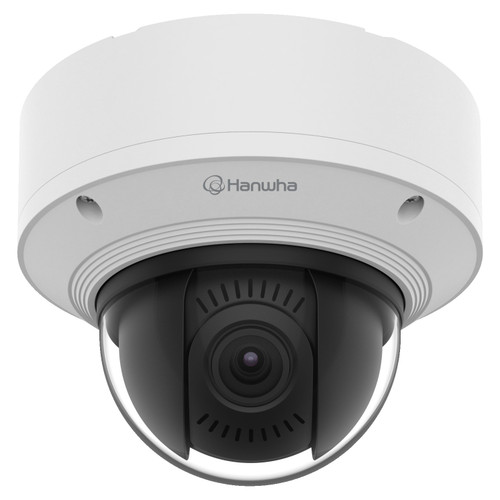
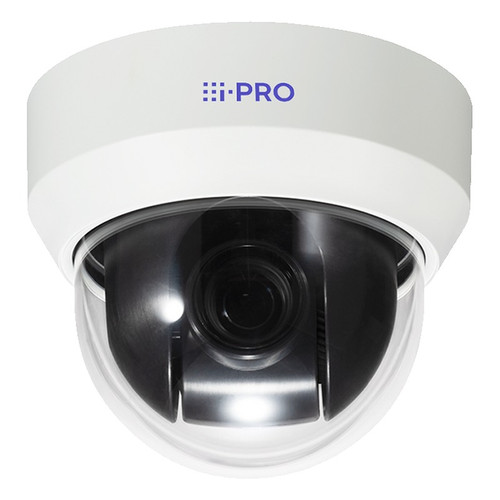
Hanwha XND-8081VZ vs i-PRO S65501-Z1: Specification Comparison
Both the Hanwha XND-8081VZ and the i-PRO WV-S65501-Z1 are 5MP dome cameras with motorized zoom and pan/tilt capability, making them genuine cross-shop candidates in the indoor/outdoor PTZ dome segment. The comparison covers imaging performance, installation and environmental suitability, and platform integration — the three axes that most directly drive a specification decision for installers and IT buyers evaluating PTZ domes at this resolution class.
In This Guide
How do the imaging specs compare?
The Hanwha XND-8081VZ uses a 1/1.8-inch 6MP CMOS sensor delivering a native 2560×1920 resolution at 30fps, with a 2.6x motorized varifocal lens covering 3.6–9.4mm and a maximum aperture of F1.2 (wide). Its Wide Dynamic Range is rated at 120dB, and minimum illumination is 0.07 Lux color / 0.007 Lux B/W. The i-PRO WV-S65501-Z1 uses an approximately 1/2.8-inch CMOS sensor outputting up to 3072×1728 at 30fps, with a 10x motorized zoom covering 4.7–47mm and a maximum aperture of F1.6 (wide). Its Super Dynamic range is rated at 132dB, and minimum illumination reaches 0.004 Lux (B/W at 16/30s shutter), 75% lower than the Hanwha figure.
The i-PRO's 10x optical zoom (versus the Hanwha's 2.6x) produces a dramatically longer reach: the spec sheet documents a Detect range of up to 945.4m in telephoto. The Hanwha does not publish pixel-density detection distances. The i-PRO also includes a built-in gyro-based image stabilizer and an Ambarella CV22 SoC explicitly identified in the spec; the Hanwha lists Digital Image Stabilization as supported but does not name its SoC. Pan range differs materially: the i-PRO delivers 360° endless pan with preset speed up to 500°/s (PoE+) and 256 preset positions; the Hanwha is limited to ±175° pan, 0–85° tilt, max 200 remote-adjustment cycles, with no preset-position count published.
What about installation and environment?
The Hanwha XND-8081VZ is rated IP52 and IK10, making it suitable for indoor installations with limited dust ingress protection and no meaningful water resistance — IP52 resists only vertically falling water drops. It accepts PoE (IEEE 802.3af, Class 3) or 12VDC and draws a maximum of 11W. Its operating temperature range spans -25°C to +60°C. The unit is aluminum-bodied, weighs 1.45kg, and measures Ø160×125mm.
The i-PRO WV-S65501-Z1 is rated IP66 and IK10, is listed as Type 4X, and carries wind-resistance certification up to 40m/s (~89 mph), along with an anti-condensation Temish element — all pointing to a genuine outdoor deployment profile. It supports DC 12V (15.4W), PoE (12.95W), or PoE+ (18.9W), with preset speeds of 500°/s on PoE+ dropping to 300°/s on DC 12V. Operating temperature range is -30°C to +55°C (-20°C power-on lower bound). The unit is aluminum die cast with polycarbonate resin and stainless steel, weighs approximately 1.6kg, and measures Ø165×139mm. NEMA TS2 compliance is also listed.
Which fits your VMS and analytics better?
Both cameras support ONVIF Profiles S, G, and T, ensuring broad VMS compatibility. The Hanwha XND-8081VZ additionally supports ONVIF Profile G and Wisenet SUNAPI (HTTP API) plus Wisenet open platform, benefiting integrators already in the Wisenet ecosystem. The i-PRO WV-S65501-Z1 supports ONVIF Profiles G, M, S, and T — Profile M adds metadata streaming for analytics — and lists FIPS 140-2 Level 3 and GlobalSign certificate-based security, which is notably absent from the Hanwha spec. The i-PRO also supports SFTP and MQTT protocols not listed for the Hanwha.
On-board analytics differ substantially. The Hanwha publishes a broad list including defocus detection, face detection, digital auto tracking, appear/disappear, enter/exit, loitering, virtual line, audio detection, sound classification, shock detection, and business intelligence functions (people counting, queue management, heatmap). The i-PRO lists AI Video Motion Detection, Face/Vehicle/People Detection, and AI Sound Classification (gunshot, yell, vehicle horn, glass break), with scene change detection (SCD) included. Both support microSD edge storage. The Hanwha specifies dual microSD slots up to 512GB total; the i-PRO lists microSDXC support but does not publish a max capacity or slot count in the provided spec. Both offer audio in/out; the i-PRO uses a 3.5mm stereo mini jack for input and a 3.5mm stereo output at -20dBV/600Ω, while the Hanwha uses a selectable mic/line input with 2.5VDC phantom and a line-out rated at max 1Vrms.
Which should you choose: the XND-8081VZ or the S65501-Z1?
Our take: The WV-S65501-Z1 is the stronger choice when the deployment is outdoor, requires long-range identification, or demands certified cybersecurity compliance. Its 10x optical zoom versus the XND-8081VZ's 2.6x provides roughly 3.8x more reach, reaching a spec-documented Detect range of 945.4m in telephoto. Its IP66/Type 4X/wind-rated enclosure makes it appropriate for exposed outdoor sites where the XND-8081VZ's IP52 rating is insufficient. Its 132dB Super Dynamic range and 0.004 Lux minimum illumination exceed the Hanwha's 120dB WDR and 0.007 Lux B/W figures, offering a measurable advantage in high-contrast or near-dark scenes. The XND-8081VZ remains relevant where the install is indoor and cost-sensitive, the integrator is in the Wisenet/SUNAPI ecosystem, broader business-intelligence analytics (people counting, heatmap, queue management) are needed at the edge, or dual SD-card redundancy matters — none of those features appear in the i-PRO spec as provided.
Side-by-Side Comparison
Spec-for-spec, from manufacturer data.
| Specification | Hanwha XND-8081VZ | i-PRO S65501-Z1 |
|---|---|---|
| Resolution | 2560×1920 (5MP native; sensor 6MP) | 3072×1728 (5MP output) |
| Image Sensor | 1/1.8" CMOS | Approx. 1/2.8" CMOS |
| Focal Length / Optical Zoom | 3.6–9.4mm, 2.6x motorized varifocal | 4.7–47mm, 10x motorized zoom |
| Max Aperture | F1.2 (wide) – F2.4 (tele) | F1.6 (wide) – F3.0 (tele) |
| Minimum Illumination | 0.07 Lux color / 0.007 Lux B/W | 0.004 Lux B/W (16/30s) |
| Wide Dynamic Range | 120dB | 132dB (limited to 15fps above level 30) |
| Max Frame Rate | 30fps | 30fps |
| Pan / Tilt Range | ±175° pan / 0–85° tilt (max 200 cycles) | 360° endless pan / -15° to +195° tilt |
| Preset Positions | Not specified | 256 |
| IP Rating | IP52 | IP66, Type 4X |
| Impact / Vandal Rating | IK10 | IK10 |
| Operating Temperature | -25°C to +60°C | -30°C to +55°C (-20°C power-on min) |
| Power Input / PoE Class | PoE 802.3af (Class 3) or 12VDC; 11W max | PoE 12.95W / PoE+ 18.9W / DC12V 15.4W |
| Video Compression | H.265, H.264, MJPEG + WiseStream II | H.265, H.264, MJPEG + Variable GOP |
| ONVIF Profiles | S, G, T | G, M, S, T |
| Edge Storage | Dual microSD/SDHC/SDXC, up to 512GB | microSDXC (max capacity not specified) |
| Audio I/O | Selectable mic/line in + line out (1Vrms max) | 3.5mm stereo mic/line in + 3.5mm stereo out (-20dBV, 600Ω) |
| Cybersecurity Certification | 802.1X (EAP-TLS, EAP-LEAP), HTTPS, IP filtering | FIPS 140-2 Level 3, GlobalSign cert, 802.1X, HTTPS |
| Dimensions | Ø160×125mm | Ø165×139mm |
| Weight | 1.45kg (3.2 lb) | Approx. 1.6kg (3.53 lb) |
| Environment | Indoor | Outdoor |
| Warranty | 3-year | 3-year |
Frequently Asked Questions
Which should you choose: the XND-8081VZ or the S65501-Z1?
The WV-S65501-Z1 is the stronger choice when the deployment is outdoor, requires long-range identification, or demands certified cybersecurity compliance. Its 10x optical zoom versus the XND-8081VZ's 2.6x provides roughly 3.8x more reach, reaching a spec-documented Detect range of 945.4m in telephoto. Its IP66/Type 4X/wind-rated enclosure makes it appropriate for exposed outdoor sites where the XND-8081VZ's IP52 rating is insufficient. Its 132dB Super Dynamic range and 0.004 Lux minimum illumination exceed the Hanwha's 120dB WDR and 0.007 Lux B/W figures, offering a measurable advantage in high-contrast or near-dark scenes. The XND-8081VZ remains relevant where the install is indoor and cost-sensitive, the integrator is in the Wisenet/SUNAPI ecosystem, broader business-intelligence analytics (people counting, heatmap, queue management) are needed at the edge, or dual SD-card redundancy matters — none of those features appear in the i-PRO spec as provided.
Is the XND-8081VZ or WV-S65501-Z1 better for low-light performance?
Based on published specs, the i-PRO WV-S65501-Z1 has a lower minimum illumination figure: 0.004 Lux (B/W at 16/30s shutter) versus the Hanwha XND-8081VZ's 0.007 Lux B/W. The i-PRO also claims a higher dynamic range at 132dB compared to the Hanwha's 120dB. On the specifications provided, the WV-S65501-Z1 has the edge in low-light and high-contrast conditions.
Can the WV-S65501-Z1 be used outdoors while the XND-8081VZ cannot?
Yes, based on published ratings. The i-PRO WV-S65501-Z1 is rated IP66 (dust-tight, jet-water resistant), Type 4X, and wind-resistant up to 40m/s, making it designed for outdoor deployment. The Hanwha XND-8081VZ is rated IP52, which protects only against limited dust ingress and vertically dripping water — the manufacturer's own spec labels it as an indoor camera. Installing the XND-8081VZ in unprotected outdoor environments would conflict with its published environmental rating.
Which camera offers more on-board edge analytics?
The Hanwha XND-8081VZ publishes a broader analytics list in its spec sheet, including loitering, enter/exit, virtual line, appear/disappear, digital auto tracking, defocus detection, fog detection, shock detection, and business-intelligence functions (people counting, queue management, heatmap). The i-PRO WV-S65501-Z1 lists AI Video Motion Detection, Face/Vehicle/People Detection, Scene Change Detection, Audio Detection, and AI Sound Classification (gunshot, yell, vehicle horn, glass break). Neither spec provides detection accuracy figures, so real-world performance cannot be compared from the data provided.
Get a Second Opinion on Your Camera Choice
Share your site layout, coverage goals, and budget. Our team will validate the camera selection, flag anything we would change, and recommend products that match the use case.