
Hanwha QND-7082R vs i-PRO X35402-F2LM: Specification Comparison
Both the Hanwha QND-7082R and the i-PRO WV-X35402-F2LM are wired, fixed-dome IP cameras delivering 4MP (2560×1440) resolution at up to 30fps, placing them squarely in the same resolution class and camera type. This comparison examines how their imaging capabilities, environmental ratings, installation requirements, and analytics integration differ so that installers and IT buyers can determine which unit better suits a given deployment scenario.
In This Guide
How do the imaging specs compare?
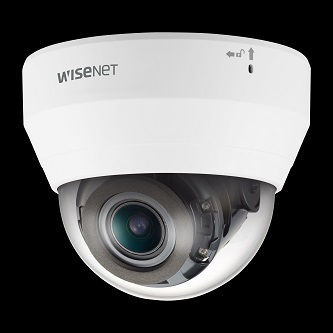
The QND-7082R uses a 1/3" CMOS sensor with a 3.2–10mm (3.1×) motorized varifocal lens (F1.6–F2.9), giving installers post-mount zoom adjustment across an angular field of 98.6°–30.8° (H). Its minimum illumination is 0.1 lux color / 0 lux with IR, and its built-in IR illuminator reaches 20m (65.6ft). WDR is rated at 120dB. The motorized lens is a meaningful operational advantage where field of view may need tuning after installation.
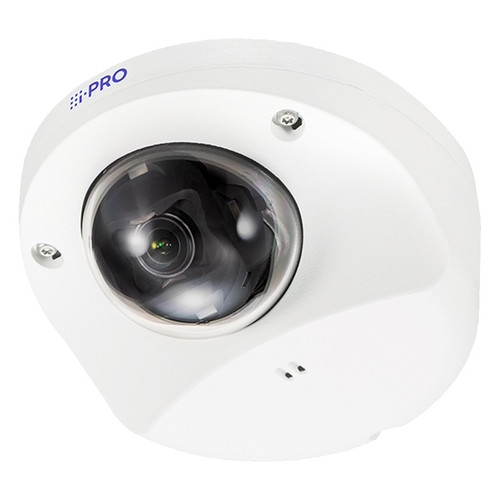
The WV-X35402-F2LM uses an approximately 1/2.8" CMOS sensor with a fixed 2.4mm lens (F2.1), yielding a wide 121° horizontal field of view but no optical zoom. Its minimum illumination is 0.07 lux color / 0 lux B&W with IR, and its IR range is 14m (46ft)—6m shorter than the QND-7082R. WDR is rated at 132dB (Super Dynamic on, Level 31), a 12dB advantage over the Hanwha. The larger sensor format (1/2.8") and lower lux floor give the i-PRO a measurable edge in native low-light sensitivity, while the QND-7082R's longer IR throw and varifocal flexibility favor adjustable-range indoor use.
What about installation and environment?
The QND-7082R is rated for indoor use only with no stated IP ingress rating and no IK impact rating. Its operating temperature range is −10°C to +55°C, and it weighs 320g with plastic housing. It accepts PoE (IEEE 802.3af, Class 3) or 12VDC and draws up to 8.6W. Mounting hardware includes an optional hanging mount (SBP-122HMW) and skin covers; conduit knockout options are noted. Pan/tilt/rotate ranges of 0°–350° / 0°–67° / 0°–355° allow broad positioning at install time.
The WV-X35402-F2LM is rated IP66 (IEC 60529), NEMA 4X, and IK10 (IEC 62262), making it suitable for outdoor and harsh-environment deployment. It withstands wind loads up to 40m/s (~89mph) and meets EN50155, JIS E 5006, IEC62236, EN50121, IEC61373, and EN45545 railway/vehicle certifications. Its operating temperature range is −40°C to +60°C (power-on from −20°C), far exceeding the QND-7082R's range. The M12 Ethernet connector (rather than a standard RJ-45) suits vibration-prone transit installations. It also draws up to 8.6W via PoE (Class 0 per the spec), and its aluminum die-cast/PC resin tamper-resistant housing weighs approximately 475g.
Which fits your VMS and analytics better?
Both cameras support ONVIF Profile S, G, T, and M, providing broad VMS compatibility. The QND-7082R adds Hanwha's SUNAPI (HTTP API) for deeper integration with Wisenet VMS platforms. Its on-board analytics include defocus detection, directional detection, motion detection (4 polygonal zones), enter/exit, tampering, and virtual line. It supports WiseStream II smart codec and up to 3 simultaneous stream profiles for 6 unicast users. Edge storage is via a single microSD/SDHC/SDXC slot (up to 128GB). Audio input is provided via built-in microphone; there is no audio output per spec.
The WV-X35402-F2LM offers i-PRO's AI video analytics covering 7 detection types, plus AI sound classification (gunshot, yell, vehicle horn, glass break) and scene change detection (SCD)—capabilities not listed for the QND-7082R. It supports up to 14 simultaneous users and adds SFTP, MQTT, and SRTP to its protocol set, along with FIPS 140-2 Level 3 certification and signed firmware for high-security environments. Edge storage supports microSD/SDHC/SDXC up to 512GB. Audio detection is a built-in analytics function. The i-PRO's security posture—FIPS 140-2 L3, brute-force protection, alteration detection—is notably more robust than what is specified for the Hanwha.
Which should you choose: the QND-7082R or the X35402-F2LM?
Our take: The QND-7082R is the stronger choice when deployment is strictly indoors, focal-length flexibility is required, and the project runs on a Wisenet VMS ecosystem. Its 3.1× motorized varifocal lens (3.2–10mm) allows field-of-view adjustment unavailable on the fixed-lens i-PRO, and its 20m IR throw (vs. 14m) covers longer indoor corridors. Conversely, the WV-X35402-F2LM is purpose-built for demanding environments: its IP66/IK10/NEMA 4X housing, −40°C to +60°C operating range, and EN50155 railway certification make it the only viable option between the two for transit vehicles, outdoor mounting, or industrial settings. The i-PRO also posts a 132dB WDR rating versus 120dB, a 0.07 lux color floor versus 0.1 lux, FIPS 140-2 Level 3 security, and up to 512GB edge storage versus 128GB. Choose the QND-7082R for flexible indoor installations on Hanwha VMS; choose the WV-X35402-F2LM for hardened, outdoor, transit, or high-security deployments.
Side-by-Side Comparison
Spec-for-spec, from manufacturer data.
| Specification | Hanwha QND-7082R | i-PRO X35402-F2LM |
|---|---|---|
| Resolution | 2560×1440 (4MP) | 2560×1440 (4MP) |
| Image Sensor | 1/3" CMOS | Approx. 1/2.8" CMOS |
| Lens / Focal Length | 3.2–10mm motorized varifocal (3.1×) | 2.4mm fixed |
| Max. Aperture | F1.6 (Wide) – F2.9 (Tele) | F2.1 |
| Horizontal Field of View | 98.6° (Wide) – 30.8° (Tele) | 121° |
| Min. Illumination (Color) | 0.1 lux | 0.07 lux |
| Min. Illumination (B&W / IR) | 0 lux (IR) | 0.06 lux B&W / 0 lux (IR) |
| IR Range | 20m (65.6ft) | 14m (46ft) |
| Wide Dynamic Range | 120dB | 132dB (Super Dynamic On, Level 31) |
| Max Frame Rate | 30fps | 25/30fps |
| Video Compression | H.265, H.264, MJPEG | H.265, H.264, JPEG |
| IP / Ingress Rating | — | IP66, NEMA 4X |
| Impact Rating (IK) | — | IK10 (IEC 62262) |
| Operating Temperature | −10°C to +55°C | −40°C to +60°C (power-on from −20°C) |
| Power Input / PoE Class | PoE IEEE 802.3af Class 3 / 12VDC, max 8.6W | PoE Class 0, max 8.6W |
| Ethernet Connector | RJ-45 (10/100BASE-T) | M12 (10BASE-T/100BASE-TX) |
| Edge Storage | microSD/SDHC/SDXC up to 128GB | microSD/SDHC/SDXC up to 512GB |
| Audio | Built-in microphone (input only) | Built-in microphone; audio detection with AI sound classification |
| ONVIF Profiles | S, G, T | G, M, S, T |
| AI / Analytics | Defocus, directional, motion, enter/exit, tampering, virtual line | 7 AI video detection types; AI sound classification; SCD |
| Security Certifications | — | FIPS 140-2 Level 3, signed firmware, alteration detection |
| Safety / EMC Certifications | — | UL 62368-1, c-UL, CE, FCC Part 15 Class A, EN55032 |
| Railway / Vehicle Certifications | — | EN50155, JIS E 5006, IEC62236, EN50121, IEC61373, EN45545 |
| Dimensions | Ø119.8 × 98.8mm | 109 × 53 × 119mm |
| Weight | 320g (0.705 lb) | approx. 475g (1.05 lb) |
| Housing Material | Plastic | Aluminum die cast / PC resin |
| Environment | Indoor | Indoor / Outdoor |
| Warranty | 3-year | 5-year |
Frequently Asked Questions
Which should you choose: the QND-7082R or the X35402-F2LM?
The QND-7082R is the stronger choice when deployment is strictly indoors, focal-length flexibility is required, and the project runs on a Wisenet VMS ecosystem. Its 3.1× motorized varifocal lens (3.2–10mm) allows field-of-view adjustment unavailable on the fixed-lens i-PRO, and its 20m IR throw (vs. 14m) covers longer indoor corridors. Conversely, the WV-X35402-F2LM is purpose-built for demanding environments: its IP66/IK10/NEMA 4X housing, −40°C to +60°C operating range, and EN50155 railway certification make it the only viable option between the two for transit vehicles, outdoor mounting, or industrial settings. The i-PRO also posts a 132dB WDR rating versus 120dB, a 0.07 lux color floor versus 0.1 lux, FIPS 140-2 Level 3 security, and up to 512GB edge storage versus 128GB. Choose the QND-7082R for flexible indoor installations on Hanwha VMS; choose the WV-X35402-F2LM for hardened, outdoor, transit, or high-security deployments.
Is the QND-7082R or WV-X35402-F2LM better for low-light performance?
The WV-X35402-F2LM has a lower specified minimum illumination—0.07 lux color versus 0.1 lux color for the QND-7082R—and its approximately 1/2.8" sensor is larger than the QND-7082R's 1/3" sensor, which generally captures more light. However, the QND-7082R's IR illuminator reaches 20m compared to 14m on the i-PRO, so it illuminates a longer scene in complete darkness. For native sensitivity in ambient low light, the i-PRO has the specified edge; for IR-lit range in total darkness, the Hanwha reaches farther.
Can the WV-X35402-F2LM be used outdoors or on a train, and can the QND-7082R?
Yes and no, respectively. The WV-X35402-F2LM carries IP66, NEMA 4X, IK10, and a full suite of railway certifications (EN50155, JIS E 5006, IEC62236, EN50121, IEC61373, EN45545), making it explicitly rated for outdoor and vehicle/transit environments down to −40°C. The QND-7082R carries no stated IP ingress or IK impact rating and is listed as an indoor camera with an operating floor of −10°C, so it is not specified for outdoor or transit use.
Which camera supports more advanced AI analytics?
The WV-X35402-F2LM specifies 7 AI video detection types plus AI sound classification (gunshot, yell, vehicle horn, glass break) and scene change detection. The QND-7082R lists defocus detection, directional detection, motion detection (4 polygonal zones), enter/exit, tampering, and virtual line—no AI sound classification or scene change detection is specified. For deployments requiring AI-based audio event detection or a broader set of AI video analytics, the i-PRO has the more extensive specified feature set.
Get a Second Opinion on Your Camera Choice
Share your site layout, coverage goals, and budget. Our team will validate the camera selection, flag anything we would change, and recommend products that match the use case.