
Hanwha QND-7082R vs i-PRO X35402-F2L: Specification Comparison
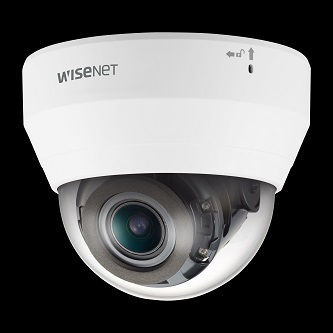
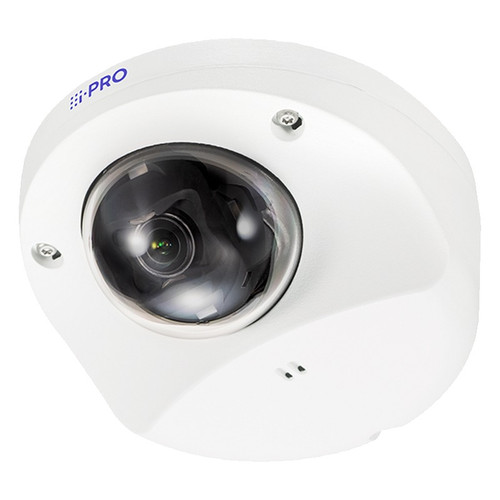
Both the Hanwha QND-7082R and the i-PRO WV-X35402-F2L are wired 4MP IP dome cameras targeting the professional security market. The QND-7082R is an indoor-rated motorized varifocal dome designed for flexible FOV adjustment post-install, while the i-PRO WV-X35402-F2L is a fixed-lens, ruggedized compact dome engineered for harsh and mobile environments including rail and vehicle applications. A buyer comparing these is typically deciding between optical zoom flexibility and indoor deployment versus fixed-wide coverage with extreme environmental resilience.
In This Guide
How do the imaging specs compare?
Both cameras output 2560×1440 (4MP) at up to 30fps. The QND-7082R uses a 1/3" CMOS sensor with a 3.2–10mm (3.1×) motorized varifocal lens, delivering a horizontal FOV range of 98.6° (wide) to 30.8° (tele) — useful when the mounting position is fixed but scene framing may need adjustment after install. Minimum color illumination is 0.1 lux with IR fallback to 0 lux over a 20m IR range. WDR is rated at 120dB. The i-PRO WV-X35402-F2L uses an approx. 1/2.8" CMOS with a fixed 2.4mm lens providing a 121° horizontal FOV (16:9) — wider but non-adjustable. Its minimum color illumination is 0.07 lux, and B&W minimum is 0.06 lux, both slightly better than the QND-7082R. WDR is rated at 132dB (Super Dynamic at level 31). IR range is 14m at 30IRE / 10m at 50IRE.
On DORI performance, the QND-7082R's tele end reaches 129m detect / 52m observe / 26m recognize / 13m identify; its wide end reaches 27m detect / 11m observe / 6m recognize / 3m identify. The i-PRO WV-X35402-F2L's fixed lens produces 29.0m detect / 11.6m observe / 5.8m recognize / 2.9m identify. The QND-7082R's motorized tele position substantially outperforms the i-PRO on DORI range, though the i-PRO edges ahead on wide-angle coverage and low-light sensitivity. The i-PRO also supports an extra digital zoom up to 4.0× at 640×360 resolution; the QND-7082R does not list a digital PTZ specification.
What about installation and environment?
The QND-7082R is rated for indoor use only with an operating temperature of -10°C to +55°C and humidity up to 95% RH non-condensing. It has no IP ingress rating listed and no IK impact rating. It weighs 320g and measures Ø119.8 × 98.8mm. Power is via PoE IEEE 802.3af (Class 3) or 12VDC; max draw is 8.6W. It accepts a Micro SD/SDHC/SDXC card (up to 128GB) and provides one alarm input and one alarm output. Optional mounts include SBP-122HMW (hanging) and a gangbox adapter SBD-120GP.
The i-PRO WV-X35402-F2L is built for demanding environments: IP66 (IEC 60529), NEMA 4X, Type 4X (UL50E), and IK10 (IEC 62262) rated, with wind resistance up to 40 m/s. Operating temperature spans -40°C to +60°C, making it viable for outdoor, transit, and cold-climate deployments. It carries EN50155, JIS E 5006, IEC62236, and EN50121 certifications for railway/vehicle use. Weight is approx. 475g at 109×53×119mm. Power is PoE IEEE 802.3af (PoE Class 0 per spec); max draw is 8.6W. Edge storage supports up to 512GB microSDXC. No alarm I/O is listed for the i-PRO.
Which fits your VMS and analytics better?
Both cameras support ONVIF Profile S, G, and T. The i-PRO additionally lists ONVIF Profile M. The QND-7082R exposes SUNAPI (HTTP API) for Hanwha/Wisenet-ecosystem VMS integration. The i-PRO lists no proprietary API in the provided specs. Protocol coverage is broad on both; the i-PRO adds SFTP and MQTT support not listed for the QND-7082R, while the QND-7082R lists PPPoE, Bonjour, and PIM-SM not listed for the i-PRO.
On analytics, the i-PRO WV-X35402-F2L runs on an Ambarella CV25M SoC and provides on-board AI analytics including motion, face, people, vehicle, mask, and occupancy detection, plus AI Sound Classification (gunshot, yell, vehicle horn, glass break) — all edge-resident. The QND-7082R offers defocus detection, directional detection, enter/exit, virtual line, and tampering as edge analytics; these are rule-based rather than AI-classified. For audio, the QND-7082R has a built-in microphone and supports G.711 and G.726 compression; the i-PRO also has audio input with G.726 and G.711 support and explicitly lists audio detection as a trigger. Security posture differs: the i-PRO includes FIPS 140-2 Level 3 hardware security (NXPR EdgeLock SE050F) and a pre-installed GlobalSign device certificate; the QND-7082R lists HTTPS, digest authentication, IP filtering, and 802.1X but no hardware-rooted certificate. Up to 14 simultaneous streams are supported on the i-PRO versus 6 unicast users on the QND-7082R. Edge storage capacity is 512GB (i-PRO) versus 128GB (QND-7082R).
Which should you choose: the QND-7082R or the X35402-F2L?
Our take: The QND-7082R is the stronger choice when the installation is indoors, scene framing may need post-install adjustment, and the VMS is Hanwha/Wisenet-native. Its 3.1× motorized varifocal lens extends DORI recognition range to 26m at tele versus 5.8m on the fixed-lens i-PRO — a decisive advantage in corridors or aisle-coverage applications. However, the i-PRO WV-X35402-F2L is the correct selection for outdoor, transit, or harsh-environment deployments: it operates from -40°C to +60°C (versus -10°C to +55°C), carries IP66/IK10/NEMA 4X certification with EN50155 rail compliance, supports up to 512GB edge storage versus 128GB, and delivers deeper on-board AI analytics including face, mask, occupancy, and sound classification on an Ambarella CV25M SoC. The i-PRO also edges out on low-light sensitivity (0.07 lux color vs 0.1 lux) and WDR headroom (132dB vs 120dB). Choose the QND-7082R for indoor/varifocal flexibility in a Hanwha ecosystem; choose the i-PRO for ruggedized fixed-wide coverage with AI analytics.
Side-by-Side Comparison
Spec-for-spec, from manufacturer data.
| Specification | Hanwha QND-7082R | i-PRO X35402-F2L |
|---|---|---|
| Resolution | 2560×1440 (4MP) | 2560×1440 (4MP) |
| Image Sensor | 1/3" CMOS | Approx. 1/2.8" CMOS |
| Lens / Focal Length | 3.2–10mm motorized varifocal (3.1×) | 2.4mm fixed |
| Horizontal FOV | 98.6° (wide) – 30.8° (tele) | 121° (16:9) |
| Min. Illumination (Color) | 0.1 lux | 0.07 lux |
| Min. Illumination (B&W / IR) | 0 lux (IR) | 0.06 lux (B&W) |
| Wide Dynamic Range | 120dB | 132dB (Super Dynamic, level 31) |
| IR Range | 20m | 14m (30IRE) / 10m (50IRE) |
| Max Frame Rate | 30fps | 25/30fps |
| Video Compression | H.265, H.264 (Main/High), MJPEG | H.265, H.264 |
| IP Rating | — | IP66 (IEC 60529), NEMA 4X, Type 4X |
| IK / Impact Rating | — | IK10 (IEC 62262) |
| Operating Temperature | -10°C to +55°C | -40°C to +60°C |
| Power Input / PoE Class | PoE IEEE 802.3af Class 3 / 12VDC | PoE IEEE 802.3af Class 0 |
| Max Power Draw | 8.6W | 8.6W |
| Edge Storage | MicroSD/SDHC/SDXC up to 128GB | MicroSDXC up to 512GB |
| Audio | Built-in mic; G.711, G.726 | Audio input; G.711, G.726, ADPCM |
| ONVIF Profiles | S / G / T | G / M / S / T |
| On-board Analytics | Defocus, directional, enter/exit, virtual line, tampering | AI face, people, vehicle, mask, occupancy, sound classification |
| Alarm I/O | 1 input / 1 output | — |
| Simultaneous Users | 6 (unicast) | Up to 14 |
| Dimensions | Ø119.8 × 98.8mm | 109 × 53 × 119mm |
| Weight | 320g (0.705 lb) | approx. 475g (1.05 lb) |
| Warranty | 3 years | 5 years |
Frequently Asked Questions
Which should you choose: the QND-7082R or the X35402-F2L?
The QND-7082R is the stronger choice when the installation is indoors, scene framing may need post-install adjustment, and the VMS is Hanwha/Wisenet-native. Its 3.1× motorized varifocal lens extends DORI recognition range to 26m at tele versus 5.8m on the fixed-lens i-PRO — a decisive advantage in corridors or aisle-coverage applications. However, the i-PRO WV-X35402-F2L is the correct selection for outdoor, transit, or harsh-environment deployments: it operates from -40°C to +60°C (versus -10°C to +55°C), carries IP66/IK10/NEMA 4X certification with EN50155 rail compliance, supports up to 512GB edge storage versus 128GB, and delivers deeper on-board AI analytics including face, mask, occupancy, and sound classification on an Ambarella CV25M SoC. The i-PRO also edges out on low-light sensitivity (0.07 lux color vs 0.1 lux) and WDR headroom (132dB vs 120dB). Choose the QND-7082R for indoor/varifocal flexibility in a Hanwha ecosystem; choose the i-PRO for ruggedized fixed-wide coverage with AI analytics.
Is the QND-7082R or WV-X35402-F2L better for low-light performance?
The i-PRO WV-X35402-F2L has a slight advantage in low light: its minimum color illumination is 0.07 lux versus 0.1 lux for the QND-7082R, and its WDR is rated at 132dB versus 120dB. Both cameras include built-in IR; the QND-7082R reaches 20m while the i-PRO reaches 14m at 30IRE / 10m at 50IRE, so the QND-7082R covers more distance under total darkness using IR.
Can either camera be used outdoors or in a vehicle?
The i-PRO WV-X35402-F2L is rated IP66, IK10, NEMA 4X, and carries EN50155/IEC62236 railway and vehicle certifications, with an operating range of -40°C to +60°C — it is purpose-built for outdoor and transit use. The QND-7082R has no IP ingress rating or IK impact rating listed in its specifications and is rated for indoor use only (-10°C to +55°C); it should not be selected for outdoor or vehicle installations.
Which camera offers better on-board analytics — the QND-7082R or the WV-X35402-F2L?
The i-PRO WV-X35402-F2L provides AI-based edge analytics including face detection, people detection, vehicle detection, mask detection, occupancy detection, and AI Sound Classification (gunshot, yell, vehicle horn, glass break), all running on an Ambarella CV25M SoC. The QND-7082R offers rule-based analytics — defocus detection, directional detection, enter/exit, virtual line, and tampering — without AI classification. For deployments requiring AI-driven event accuracy, the i-PRO has a measurably deeper analytics stack per the provided specifications.
Get a Second Opinion on Your Camera Choice
Share your site layout, coverage goals, and budget. Our team will validate the camera selection, flag anything we would change, and recommend products that match the use case.