
Hanwha QND-7082R vs i-PRO U2540LA: Specification Comparison
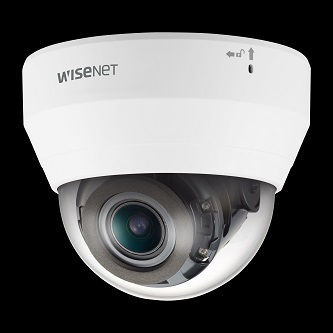
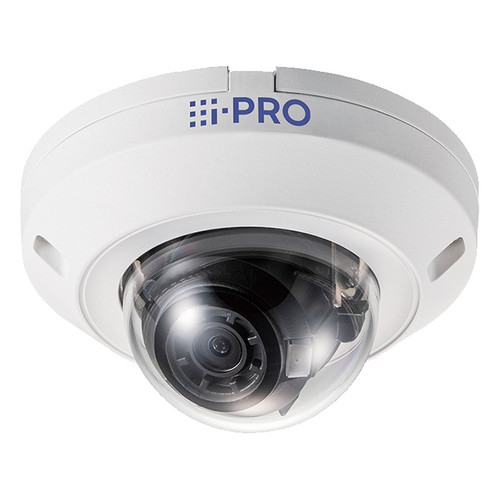
Both the Hanwha QND-7082R and the i-PRO WV-U2540LA are fixed 4MP IP dome cameras with 20m IR and PoE power, squarely in the same resolution class and form factor. The comparison is meaningful for integrators selecting between an indoor motorized-varifocal dome and an outdoor fixed-lens dome for surveillance deployments. Key decision points include lens flexibility, environmental ratings, dynamic range, analytics depth, audio support, and warranty coverage.
In This Guide
How do the imaging specs compare?
The QND-7082R uses a 1/3" CMOS sensor at 2560×1440 resolution with a 3.2–10mm (3.1×) motorized varifocal lens and a maximum aperture of F1.6 (wide) to F2.9 (tele), enabling field-of-view adjustment from 98.6° to 30.8° horizontal without physical repositioning. Its minimum illumination is 0.1 lux color / 0 lux in IR mode, and it delivers 120dB WDR via its SSDR/BLC/WDR stack. The WiseStream II smart codec reduces bandwidth without sacrificing detail.
The WV-U2540LA uses an approx. 1/2.7" CMOS sensor with effective 5.2MP pixel count, outputting at 2688×1520 for its primary 4MP stream. Its fixed 3.2mm lens provides a 100° horizontal / 54° vertical FOV with no optical zoom beyond a limited 1.0×–1.3× extra-optical zoom at 1080p crop. Minimum illumination is 0.3 lux color / 0.12 lux B&W — both higher thresholds than the Hanwha. Its Super Dynamic WDR tops at 102dB (level 31), 18dB below the QND-7082R's specified 120dB. Both cameras share 20m IR range; the i-PRO adds selectable High/Mid/Low/Off IR intensity control.
What about installation and environment?
The QND-7082R is rated for indoor use only with an operating temperature of -10°C to +55°C and no stated IP or IK rating. It draws up to 8.6W on PoE 802.3af (Class 3) or 12VDC, and its housing is white plastic. Physical adjustment range is 0°–350° pan / 0°–67° tilt / 0°–355° rotate. An CVBS video output is included for installation alignment. Compatible conduit options include single, double, and 4" octagon gang boxes (with optional SBD-120GP bracket).
The WV-U2540LA is purpose-built for outdoor deployment: IP66 (IEC 60529), NEMA 4X, and IK10 impact-rated with an aluminum die-cast and polycarbonate housing, plus stainless steel components and a Temish anti-condensation element. Operating temperature spans -30°C to +50°C — a 40°C wider cold-end range than the Hanwha. Power consumption is just 5.3W on PoE 802.3af (Class 2), and the unit weighs 270g vs the QND-7082R's 320g. Wind resistance is rated to 40 m/s (~89 mph). Pan adjustment is ±175°, tilt -30° to +80°, yaw ±100°.
Which fits your VMS and analytics better?
Both cameras support ONVIF Profile S, G, and T, ensuring broad VMS compatibility. The QND-7082R offers a deeper analytics suite: defocus detection, directional detection, motion detection, enter/exit, tampering, and virtual line — six distinct analytics types delivered from edge. It also supports up to 6 polygonal privacy zones, alarms with FTP/email/NAS/SD recording actions, and includes a built-in microphone for audio capture. On-board storage accepts microSD/SDHC/SDXC up to 128GB in one slot.
The WV-U2540LA supports VMD (4 areas) and Scene Change Detection (1 area), but its analytics set is more limited than the Hanwha's by the available specs. The i-PRO spec lists audio input as present at the product attribute level but the detailed spec sheet lists audio input/output and external I/O as '—', indicating no audio terminals per the datasheet. Privacy zone coverage is broader at up to 8 zones, and it supports up to 14 simultaneous streams vs the Hanwha's 6 unicast users (3 profiles). Edge storage scales to 512GB microSDXC. Both support SNMPv1/v2/v3, HTTPS, and 802.1X.
Which should you choose: the QND-7082R or the U2540LA?
Our take: The QND-7082R is the stronger choice when the deployment is indoors, lens flexibility is required, and deeper edge analytics or audio capture matter — its 3.1× motorized varifocal lens (3.2–10mm) enables post-install FOV tuning, its 120dB WDR exceeds the i-PRO's 102dB by 18dB, and its built-in microphone plus six-event analytic suite (enter/exit, virtual line, defocus) outpaces the WV-U2540LA's VMD/SCD-only edge processing. Conversely, the WV-U2540LA is the correct selection for any outdoor or harsh-environment installation: it is the only model with IP66/NEMA 4X/IK10 ratings, operates from -30°C (vs -10°C), carries UL/c-UL/CE/FCC safety certifications not stated for the Hanwha, consumes 3.3W less power (PoE Class 2 vs Class 3), and ships with a 5-year warranty against the Hanwha's 3-year coverage. Choose the Hanwha for flexible indoor varifocal deployments; choose the i-PRO wherever outdoor durability, lower power draw, or certified environmental compliance is required.
Side-by-Side Comparison
Spec-for-spec, from manufacturer data.
| Specification | Hanwha QND-7082R | i-PRO U2540LA |
|---|---|---|
| Resolution | 2560×1440 (4MP) | 2688×1520 (4MP, 5.2MP sensor) |
| Image Sensor | 1/3" CMOS | Approx. 1/2.7" CMOS |
| Lens / Focal Length | 3.2–10mm motorized varifocal (3.1×) | 3.2mm fixed (1.0×–1.3× extra-optical at 1080p) |
| Horizontal FOV | 98.6° (wide) – 30.8° (tele) | 100° |
| Min. Illumination | 0.1 lux color / 0 lux IR | 0.3 lux color / 0.12 lux B&W |
| IR Range | 20m (65.6 ft) | 20m (65 ft), selectable intensity |
| Wide Dynamic Range | 120dB | Max. 102dB (Super Dynamic On, Level 31) |
| Max Frame Rate | 30fps | 30fps |
| Video Compression | H.265 / H.264 / MJPEG + WiseStream II | H.265 / H.264 / JPEG |
| IP / Environmental Rating | — (indoor only) | IP66 / NEMA 4X / IK10 |
| Operating Temperature | -10°C to +55°C | -30°C to +50°C |
| Power Input / PoE Class | PoE 802.3af Class 3 / 12VDC, max 8.6W | PoE 802.3af Class 2 / DC48V, 5.3W |
| Edge Storage | microSD/SDHC/SDXC, 1 slot, up to 128GB | microSDXC/SDHC/SD, up to 512GB |
| Audio | Built-in microphone (input only) | — (not provided per datasheet) |
| Analytics | Defocus, directional, enter/exit, virtual line, tampering, motion (6 types) | VMD (4 areas), Scene Change Detection (1 area) |
| Simultaneous Streams / Users | Unicast 6 users / 3 profiles | Up to 14 users |
| Certifications | Not stated | UL (UL60950-1), c-UL, CE, IEC60950-1, FCC Part15 ClassA, EN55032 ClassB |
| Dimensions | Ø119.8 × 98.8mm | Ø109 × 62mm |
| Weight | 320g (0.705 lb) | 270g (0.60 lb) |
| Warranty | 3 years | 5 years |
Frequently Asked Questions
Which should you choose: the QND-7082R or the U2540LA?
The QND-7082R is the stronger choice when the deployment is indoors, lens flexibility is required, and deeper edge analytics or audio capture matter — its 3.1× motorized varifocal lens (3.2–10mm) enables post-install FOV tuning, its 120dB WDR exceeds the i-PRO's 102dB by 18dB, and its built-in microphone plus six-event analytic suite (enter/exit, virtual line, defocus) outpaces the WV-U2540LA's VMD/SCD-only edge processing. Conversely, the WV-U2540LA is the correct selection for any outdoor or harsh-environment installation: it is the only model with IP66/NEMA 4X/IK10 ratings, operates from -30°C (vs -10°C), carries UL/c-UL/CE/FCC safety certifications not stated for the Hanwha, consumes 3.3W less power (PoE Class 2 vs Class 3), and ships with a 5-year warranty against the Hanwha's 3-year coverage. Choose the Hanwha for flexible indoor varifocal deployments; choose the i-PRO wherever outdoor durability, lower power draw, or certified environmental compliance is required.
Is the QND-7082R or WV-U2540LA better for low-light performance?
By the specified minimums, the QND-7082R has an edge: 0.1 lux color / 0 lux IR versus the WV-U2540LA's 0.3 lux color / 0.12 lux B&W. Both share a 20m IR range, but the QND-7082R reaches 0 lux in IR mode per its spec, while the i-PRO's lowest published threshold is 0.12 lux B&W. The i-PRO does offer selectable IR intensity (High/Mid/Low/Off), which is not specified for the Hanwha.
Can the WV-U2540LA be used outdoors while the QND-7082R cannot?
Correct. The WV-U2540LA carries IP66, NEMA 4X, and IK10 ratings with an operating range of -30°C to +50°C, making it suitable for outdoor, exposed, and high-humidity environments. The QND-7082R has no stated IP or IK rating and is explicitly rated for indoor use at -10°C to +55°C. Installing the Hanwha outdoors would void environmental specifications.
Which camera is easier to integrate with third-party VMS platforms?
Both are ONVIF Profile S/G/T compliant, so either will connect to any ONVIF-conformant VMS. The QND-7082R additionally exposes Hanwha's SUNAPI (HTTP API) for deeper integration with Wisenet-compatible platforms. The i-PRO supports up to 14 simultaneous users versus the Hanwha's 6 unicast connections, which may matter in large multi-client monitoring environments. For analytics-driven VMS rules (virtual line, enter/exit), the Hanwha's native edge analytics reduce server-side processing load.
Get a Second Opinion on Your Camera Choice
Share your site layout, coverage goals, and budget. Our team will validate the camera selection, flag anything we would change, and recommend products that match the use case.