
Hanwha QND-7082R vs i-PRO S35402-F2L: Specification Comparison
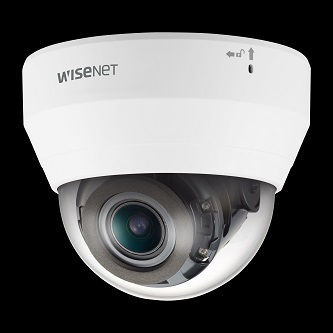
Both the Hanwha QND-7082R and the i-PRO WV-S35402-F2L are 4MP fixed IP dome cameras aimed at professional security installations. The QND-7082R is an indoor-rated motorized varifocal dome, while the S35402-F2L is an outdoor-rated fixed-lens dome with an onboard AI SoC. Buyers evaluating these two will be weighing lens flexibility and indoor coverage against outdoor environmental ratings, AI-on-chip analytics, and a wider dynamic range ceiling — all within the same 4MP resolution class and similar PoE power budget.
In This Guide
How do the imaging specs compare?
The QND-7082R uses a 1/3" CMOS sensor resolving 2560×1440, paired with a 3.2–10mm (3.1×) motorized varifocal lens (F1.6 wide, F2.9 tele) and a stated minimum illumination of 0.1 Lux color / 0 Lux IR. Its onboard IR illuminator reaches 20m (65 ft). WDR is rated at 120 dB. The S35402-F2L uses an approx. 1/2.8" CMOS sensor with a larger scanning area (5.12 mm × 3.84 mm), resolving 2688×1520 through a fixed 2.4mm lens (F2.1, 121° H FOV). Minimum illumination is specified at 0.06 Lux (B&W, 50IRE). Its IR illuminator is rated at 14m (30IRE) / 10m (50IRE). The i-PRO's Super Dynamic WDR is rated at 132 dB max (level 31).
On IR reach, the QND-7082R has a clear advantage at 20m versus the S35402-F2L's 14m. The S35402-F2L holds the edge in dynamic range (132 dB vs 120 dB) and in minimum illumination (0.06 Lux vs 0.1 Lux color), though both cameras are spec'd with zero-lux IR capability. The QND-7082R's motorized varifocal lens provides field-adjustable coverage from 98.6° down to 30.8° (H), whereas the S35402-F2L's fixed 2.4mm lens is locked at 121° H — offering a wider default FOV but no optical zoom post-installation. The S35402-F2L also provides up to 4× digital extra zoom (at 640×360), while the QND-7082R lists no digital PTZ capability in the provided specs.
What about installation and environment?
The QND-7082R is rated for indoor use only, with an operating temperature of -10°C to +55°C and humidity up to 95% RH. No IP or IK rating is listed in the provided specifications. It accepts PoE (IEEE 802.3af, Class 3) or 12VDC and draws up to 8.6W. Its physical dimensions are Ø119.8 × 98.8mm and it weighs 320g (0.705 lb). Mounting hardware sold separately includes options such as SBP-122HMW for hanging mount and SBD-120GP for gangbox; conduit compatibility is specified.
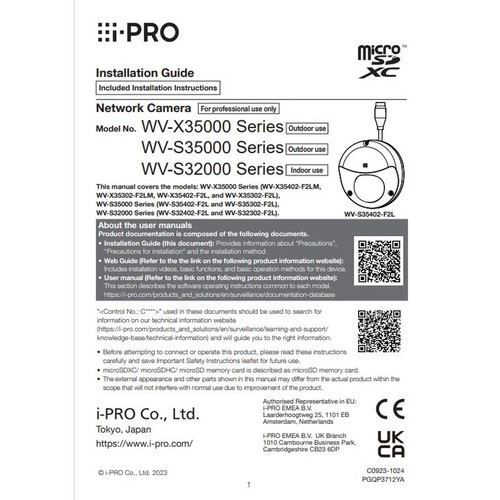
The S35402-F2L is outdoor-rated with IP66 (IEC 60529), NEMA 4X, and Type 4X (UL50E) ingress protection, plus IK10 (IEC 62262) impact resistance and a wind resistance rating up to 40 m/s (~89 mph). Its operating temperature range is -40°C to +50°C (power-on range -20°C to +50°C), substantially wider than the QND-7082R's range. It also accepts PoE (IEEE 802.3af) and draws up to 8.6W (PoE Class 0 per the provided spec). Dimensions are 109 × 53 × 119mm and weight is approximately 475g (1.05 lbs). The enclosure is aluminum die cast with tamper-resistant construction, compared to the QND-7082R's plastic housing.
Which fits your VMS and analytics better?
Both cameras support ONVIF Profile S, G, and T, ensuring broad VMS compatibility. The QND-7082R additionally declares ONVIF Profile M and Hanwha's proprietary SUNAPI (HTTP API), and supports up to 6 unicast users across up to 3 stream profiles. The S35402-F2L supports up to 14 simultaneous users and also lists ONVIF Profile M. The QND-7082R offers edge analytics including defocus detection, directional detection, enter/exit, virtual line, and tampering. The S35402-F2L, powered by an Ambarella CV25M SoC, adds AI Video Motion Detection, Face Detection, People Detection, Vehicle Detection, and AI Sound Classification (gunshot, yell, vehicle horn, glass break) — all processed on-camera.
Both cameras include a microSD/SDXC card slot (up to 128GB on the QND-7082R; up to 512GB microSDXC on the S35402-F2L). Both support audio input (built-in mic noted for both). The QND-7082R supports G.711 and G.726 audio compression; the S35402-F2L adds AAC (per spec listing of additional audio options) and also lists SFTP and MQTT in its protocol support, which the QND-7082R does not specify. Security posture differs: the S35402-F2L carries FIPS 140-2 Level 3 certification and signed firmware; the QND-7082R lists HTTPS/SSL, 802.1X, and IP filtering, but no FIPS certification is listed in the provided specifications.
Which should you choose: the QND-7082R or the S35402-F2L?
Our take: The QND-7082R is the stronger choice when the installation is indoors, lens flexibility is required, and longer IR throw matters — its 3.1× motorized varifocal (3.2–10mm) allows field adjustment from 98.6° to 30.8° H, and its 20m IR range exceeds the S35402-F2L's 14m by 43%. Conversely, the S35402-F2L is the stronger choice for any outdoor or harsh-environment deployment: it carries IP66/NEMA 4X water and dust resistance plus IK10 impact resistance that the QND-7082R does not list, operates from -40°C versus the QND-7082R's -10°C floor, and delivers a higher WDR ceiling (132 dB vs 120 dB). Its Ambarella CV25M AI SoC provides on-camera face, people, and vehicle detection plus AI sound classification — capabilities not present in the QND-7082R's spec sheet. The S35402-F2L also supports up to 14 simultaneous streams vs 6, and carries FIPS 140-2 Level 3 security certification, relevant for government or compliance-driven deployments.
Side-by-Side Comparison
Spec-for-spec, from manufacturer data.
| Specification | Hanwha QND-7082R | i-PRO S35402-F2L |
|---|---|---|
| Resolution | 2560×1440 (4MP) | 2688×1520 (4MP) |
| Image Sensor | 1/3" CMOS | Approx. 1/2.8" CMOS |
| Lens / Focal Length | 3.2–10mm motorized varifocal (3.1×) | 2.4mm fixed |
| Max Aperture | F1.6 (Wide) / F2.9 (Tele) | F2.1 |
| Horizontal FOV | 98.6° (Wide) ~ 30.8° (Tele) | 121° (16:9) |
| Min. Illumination | 0.1 Lux color / 0 Lux IR | 0.06 Lux (B&W, 50IRE) |
| IR Range | 20m (65 ft) | 14m (30IRE) / 10m (50IRE) |
| Wide Dynamic Range | 120 dB | 132 dB max (Super Dynamic On, Level 31) |
| Video Compression | H.265, H.264, MJPEG | H.265, H.264, JPEG |
| Max Frame Rate | 30fps | Not explicitly stated; spec lists up to 16/30s shutter |
| IP Rating | — | IP66 (IEC 60529), NEMA 4X, Type 4X |
| IK / Impact Rating | — | IK10 (IEC 62262) |
| Operating Temperature | -10°C to +55°C | -40°C to +50°C (power-on: -20°C to +50°C) |
| Power Input / PoE Class | PoE IEEE 802.3af Class 3 or 12VDC; 8.6W max | PoE IEEE 802.3af Class 0; 8.6W max |
| Edge Storage | microSD/SDHC/SDXC up to 128GB | microSD/SDHC/SDXC up to 512GB |
| AI Analytics | Defocus, directional, enter/exit, virtual line, tampering | AI VMD, Face, People, Vehicle Detection; AI Sound Classification |
| ONVIF Profiles | S, G, T (SUNAPI also supported) | G, M, S, T |
| Security Certification | HTTPS, 802.1X, IP filtering (no FIPS listed) | FIPS 140-2 Level 3, HTTPS, IEEE 802.1X |
| Environment Rating | Indoor | Outdoor |
| Dimensions | Ø119.8 × 98.8mm | 109 × 53 × 119mm |
| Weight | 320g (0.705 lb) | approx. 475g (1.05 lbs) |
| Warranty | 3-year | 3-year |
Frequently Asked Questions
Which should you choose: the QND-7082R or the S35402-F2L?
The QND-7082R is the stronger choice when the installation is indoors, lens flexibility is required, and longer IR throw matters — its 3.1× motorized varifocal (3.2–10mm) allows field adjustment from 98.6° to 30.8° H, and its 20m IR range exceeds the S35402-F2L's 14m by 43%. Conversely, the S35402-F2L is the stronger choice for any outdoor or harsh-environment deployment: it carries IP66/NEMA 4X water and dust resistance plus IK10 impact resistance that the QND-7082R does not list, operates from -40°C versus the QND-7082R's -10°C floor, and delivers a higher WDR ceiling (132 dB vs 120 dB). Its Ambarella CV25M AI SoC provides on-camera face, people, and vehicle detection plus AI sound classification — capabilities not present in the QND-7082R's spec sheet. The S35402-F2L also supports up to 14 simultaneous streams vs 6, and carries FIPS 140-2 Level 3 security certification, relevant for government or compliance-driven deployments.
Is the QND-7082R or S35402-F2L better for low-light performance?
Both cameras switch to zero-lux operation using IR illumination, but their daytime low-light specs differ. The S35402-F2L is specified at 0.06 Lux (B&W, 50IRE), while the QND-7082R is specified at 0.1 Lux color. The QND-7082R's IR illuminator reaches 20m versus the S35402-F2L's 14m (at 30IRE), so for longer-range IR coverage the QND-7082R has the advantage. For environments that require more sensitive color imaging before IR kicks in, the S35402-F2L's lower minimum illumination figure and higher 132 dB WDR (vs 120 dB) give it the edge.
Can the S35402-F2L be used indoors, and can the QND-7082R be used outdoors?
The S35402-F2L is rated IP66/NEMA 4X and IK10 and is specified for outdoor use with an operating range of -40°C to +50°C, so it can certainly be deployed indoors as well. The QND-7082R is listed as an indoor camera with no IP or IK rating in the provided specifications, and its operating temperature floor is -10°C — it is not specified or rated for outdoor or harsh-environment installations based on the data provided.
Which camera has better onboard AI analytics?
The S35402-F2L has the stronger AI analytics package based on the provided specifications. Its Ambarella CV25M SoC enables on-camera AI Video Motion Detection, Face Detection, People Detection, Vehicle Detection, and AI Sound Classification (gunshot, yell, vehicle horn, glass break). The QND-7082R provides defocus detection, directional detection, enter/exit, virtual line, and tampering analytics, but does not list face, people, or vehicle AI classification or sound event classification in its spec sheet.
Get a Second Opinion on Your Camera Choice
Share your site layout, coverage goals, and budget. Our team will validate the camera selection, flag anything we would change, and recommend products that match the use case.