
Hanwha QND-6082R1 vs i-PRO X35302-F2L: Specification Comparison
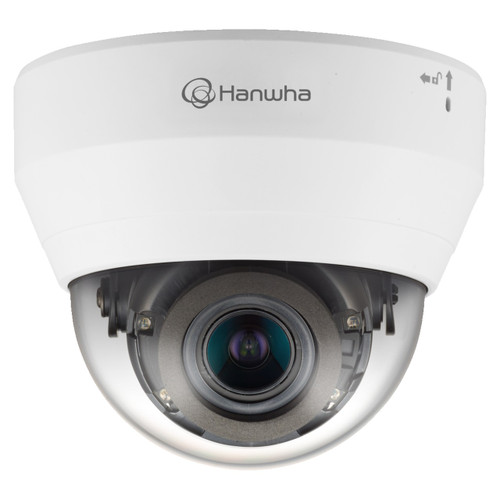
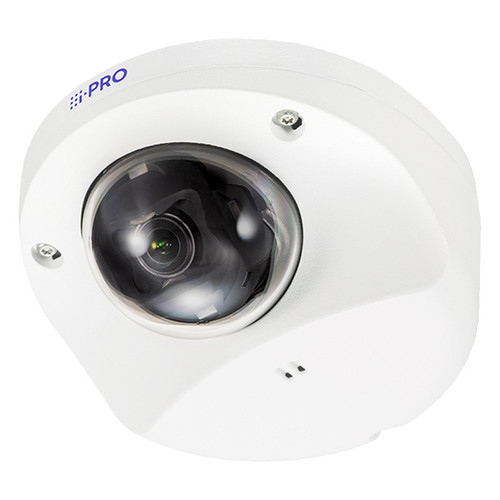
Both the Hanwha QND-6082R1 and the i-PRO WV-X35302-F2L are 2MP IP dome cameras aimed at the fixed-installation surveillance market. The Hanwha ships with a 3.1x motorized varifocal lens for flexible field-of-view adjustment during commissioning, while the i-PRO uses a fixed 2.4mm wide-angle lens backed by an Ambarella CV25M SoC and onboard AI analytics. This comparison covers imaging performance, environmental suitability, and VMS/analytics integration to help integrators and IT buyers determine which camera fits a given deployment.
In This Guide
How do the imaging specs compare?
Both cameras use a 1/2.8-inch 2MP CMOS sensor, but their lens and exposure characteristics differ meaningfully. The Hanwha QND-6082R1 offers a 3.2–10mm (3.1x) motorized varifocal lens with a maximum aperture of F1.6 (wide) to F2.9 (tele), enabling field-adjustable coverage from 109° horizontal down to a narrower tele view. Minimum illumination is 0.03 Lux color / 0 Lux IR, with a specified IR illumination reach of 20m (65.6ft). WDR is rated at 120dB. The i-PRO WV-X35302-F2L uses a fixed 2.4mm lens at F2.1, yielding a wide 132° horizontal field of view (16:9). Minimum illumination is 0.02 Lux color / 0 Lux IR, and IR reach is 21m at 30 IRE (15m at 50 IRE). WDR (Super Dynamic) is rated at 144dB maximum.
The i-PRO's 144dB Super Dynamic rating exceeds the Hanwha's 120dB by 24dB on paper, which translates to greater headroom in scenes with simultaneous deep shadow and bright highlights. The Hanwha's motorized varifocal lens is a significant commissioning advantage wherever the exact scene framing is uncertain at install time; the i-PRO's fixed 2.4mm lens requires the physical camera position to define coverage. The i-PRO also adds Fog Compensation (0–8 levels) and Adaptive Black Stretch, which are not listed in the Hanwha spec. The Hanwha's F1.6 wide-end aperture is faster than the i-PRO's fixed F2.1, partially offsetting the illumination sensitivity gap in low-light non-IR use.
What about installation and environment?
The Hanwha QND-6082R1 is rated for indoor use only; no IP or IK rating is listed in the provided specifications. Its operating temperature range is -10°C to +55°C. It accepts PoE IEEE 802.3af Class 3 or 12VDC, with a maximum power draw of 7.7W. Physical dimensions are Ø119.8×98.8mm and weight is 320g (0.71 lb).
The i-PRO WV-X35302-F2L is rated IP66 (IEC 60529), NEMA 4X, Type 4X (UL50E), and IK10 (IEC 62262), making it suitable for outdoor installation with resistance to water ingress and up to IK10 impact. Its operating temperature range is -40°C to +60°C (power-on: -20°C to +60°C), and it additionally carries EN50155/JIS E5006/IEC62236/EN50121 ratings for railway and vehicle applications. Wind resistance is specified at up to 40 m/s (~89 mph). It draws a maximum of 8.6W over PoE (IEEE 802.3af, PoE Class 0 per spec). Dimensions are 109mm (W) × 53mm (H) × 119mm (D) and weight is approximately 475g (1.05 lb). The i-PRO enclosure is aluminum die cast with a tamper-resistant design.
Which fits your VMS and analytics better?
Both cameras support ONVIF Profile S, G, T, and M, providing broad VMS compatibility. The Hanwha QND-6082R1 adds Wisenet SUNAPI (HTTP API) and Wisenet open platform support, which is relevant for deployments on Hanwha's Wisenet WAVE or partner VMS platforms. It supports up to 6 simultaneous unicast users and up to 3 concurrent stream profiles. Edge analytics include defocus detection, directional detection, motion detection (4 polygonal zones), enter/exit, tampering, and virtual line. Privacy masking supports 6 rectangular zones. On-board storage is microSD/SDHC/SDXC up to 128GB (1 slot). No audio input or output is listed in the provided specifications. Security features include HTTPS/SSL, Digest authentication, IP filtering, user access log, and 802.1X (EAP-TLS, EAP-LEAP).
The i-PRO WV-X35302-F2L is powered by an Ambarella CV25M SoC and includes AI-based analytics: AI Video Motion Detection, Face Detection, and People Detection, plus AI Sound Classification (gunshot, yell, vehicle horn, glass break). Scene Change Detection and audio detection are also available. It supports up to 14 simultaneous users and adds MQTT, SFTP, DHCPv6, and MLD to its protocol stack. Privacy zones and VIQS regions support up to 8 zones each. Edge storage is microSD up to 512GB (SDXC). The i-PRO carries FIPS 140-2 Level 3 certification and signed firmware, which are relevant for government and high-security deployments. Built-in audio (microphone) is supported with G.711 and G.726 compression. Safety certifications include UL 62368-1, c-UL, CE, and IEC 62368-1. The i-PRO does not list a proprietary VMS API beyond ONVIF in the provided specifications.
Which should you choose: the QND-6082R1 or the X35302-F2L?
Our take: The WV-X35302-F2L is the stronger choice when the deployment is outdoor, requires certified environmental protection, or demands higher AI analytics depth. It carries IP66/NEMA 4X/IK10 ratings absent from the QND-6082R1, operates across a -40°C to +60°C range versus the Hanwha's -10°C to +55°C, and delivers a 144dB Super Dynamic WDR rating compared to the Hanwha's 120dB. Its AI analytics (face detection, people detection, AI sound classification) and FIPS 140-2 Level 3 security certification extend its fit into regulated or high-security environments. The QND-6082R1 is the stronger choice for indoor installations where lens flexibility matters: its 3.1x motorized varifocal (3.2–10mm, F1.6 wide) allows on-site framing adjustment without physically repositioning the camera — a capability the i-PRO's fixed 2.4mm lens cannot provide. Buyers on Wisenet VMS infrastructure will also benefit from the QND-6082R1's native SUNAPI integration. Select the i-PRO for outdoor or harsh-environment projects; select the Hanwha for indoor deployments where adjustable field of view is the priority.
Side-by-Side Comparison
Spec-for-spec, from manufacturer data.
| Specification | Hanwha QND-6082R1 | i-PRO X35302-F2L |
|---|---|---|
| Resolution | 1920×1080 (2MP) | 2048×1536 (2MP) |
| Image Sensor | 1/2.8" 2MP CMOS | Approx. 1/2.8" CMOS |
| Lens / Focal Length | 3.2–10mm motorized varifocal (3.1x) | 2.4mm fixed |
| Max Aperture | F1.6 (wide) / F2.9 (tele) | F2.1 |
| Horizontal Field of View | 109.0° (wide end) | 132° (16:9) |
| Min. Illumination | 0.03 Lux color / 0 Lux IR | 0.02 Lux color / 0 Lux IR |
| IR Range | 20m (65.6ft) | 21m (30 IRE) / 15m (50 IRE) |
| Wide Dynamic Range | 120dB | 144dB max (Super Dynamic) |
| Max Frame Rate | 30fps | Variable (spec not stated as fixed fps) |
| Video Compression | H.265 / H.264 / MJPEG | H.265 / H.264 / JPEG |
| IP Rating | — | IP66 (IEC 60529) / NEMA 4X / Type 4X |
| IK / Impact Rating | — | IK10 (IEC 62262) |
| Operating Temperature | -10°C to +55°C | -40°C to +60°C (power-on: -20°C to +60°C) |
| Power Input / PoE Class | PoE IEEE 802.3af Class 3 / 12VDC; 7.7W max | PoE IEEE 802.3af Class 0; 8.6W max |
| Edge Storage | microSD/SDHC/SDXC up to 128GB | microSDXC up to 512GB / microSDHC up to 32GB |
| Audio | — | Built-in mic; G.711 / G.726 |
| AI Analytics | Directional, Enter/Exit, Virtual Line, Tampering, Defocus | Face Detection, People Detection, AI Sound Classification, AI VMD |
| ONVIF Profiles | S / G / T | G / M / S / T |
| Security Certifications | 802.1X (EAP-TLS, EAP-LEAP) | FIPS 140-2 Level 3, 802.1X |
| Safety Certifications | — | UL 62368-1, c-UL, CE, IEC 62368-1 |
| Environment Rating | Indoor | Outdoor |
| Dimensions | Ø119.8×98.8mm | 109mm (W) × 53mm (H) × 119mm (D) |
| Weight | 320g (0.71 lb) | ~475g (1.05 lb) |
| Warranty | 3-year | 5-year |
Frequently Asked Questions
Which should you choose: the QND-6082R1 or the X35302-F2L?
The WV-X35302-F2L is the stronger choice when the deployment is outdoor, requires certified environmental protection, or demands higher AI analytics depth. It carries IP66/NEMA 4X/IK10 ratings absent from the QND-6082R1, operates across a -40°C to +60°C range versus the Hanwha's -10°C to +55°C, and delivers a 144dB Super Dynamic WDR rating compared to the Hanwha's 120dB. Its AI analytics (face detection, people detection, AI sound classification) and FIPS 140-2 Level 3 security certification extend its fit into regulated or high-security environments. The QND-6082R1 is the stronger choice for indoor installations where lens flexibility matters: its 3.1x motorized varifocal (3.2–10mm, F1.6 wide) allows on-site framing adjustment without physically repositioning the camera — a capability the i-PRO's fixed 2.4mm lens cannot provide. Buyers on Wisenet VMS infrastructure will also benefit from the QND-6082R1's native SUNAPI integration. Select the i-PRO for outdoor or harsh-environment projects; select the Hanwha for indoor deployments where adjustable field of view is the priority.
Is the QND-6082R1 or WV-X35302-F2L better for low-light performance?
Both reach 0 Lux in IR mode. In color (non-IR) low light, the i-PRO WV-X35302-F2L is specified at 0.02 Lux versus the Hanwha QND-6082R1 at 0.03 Lux — a small advantage for the i-PRO. The Hanwha's wider maximum aperture (F1.6 vs F2.1) partially offsets this in non-IR conditions. IR reach is comparable: 20m for the Hanwha, 21m at 30 IRE for the i-PRO.
Can the WV-X35302-F2L be used outdoors where the QND-6082R1 cannot?
Yes. The i-PRO WV-X35302-F2L carries IP66, NEMA 4X, Type 4X, and IK10 ratings and is specified for outdoor use with a -40°C to +60°C operating range and wind resistance up to 40 m/s. The Hanwha QND-6082R1 has no IP or IK rating listed in its provided specifications and is classified as an indoor camera. It should not be installed in outdoor or wet environments without a separately specified protective housing.
Which camera has better onboard AI analytics?
The i-PRO WV-X35302-F2L offers more advanced AI analytics per its specifications: AI Video Motion Detection, Face Detection, People Detection, and AI Sound Classification (gunshot, yell, vehicle horn, glass break). The Hanwha QND-6082R1 provides video analytics including motion detection (4 polygonal zones), directional detection, enter/exit, virtual line, defocus detection, and tampering — but does not list face detection, people detection, or audio-based AI classification in the provided specifications.
Get a Second Opinion on Your Camera Choice
Share your site layout, coverage goals, and budget. Our team will validate the camera selection, flag anything we would change, and recommend products that match the use case.