
Hanwha QND-6082R1 vs i-PRO S35302-F2L1: Specification Comparison
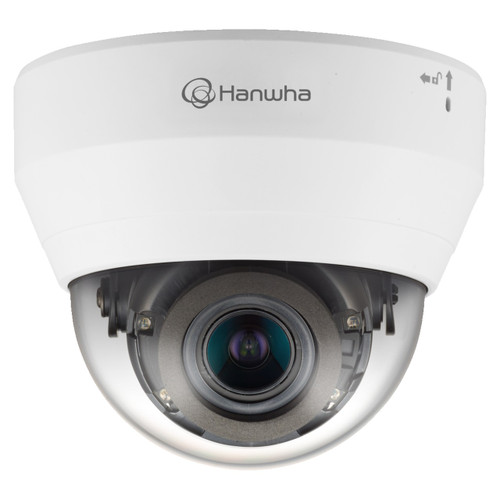
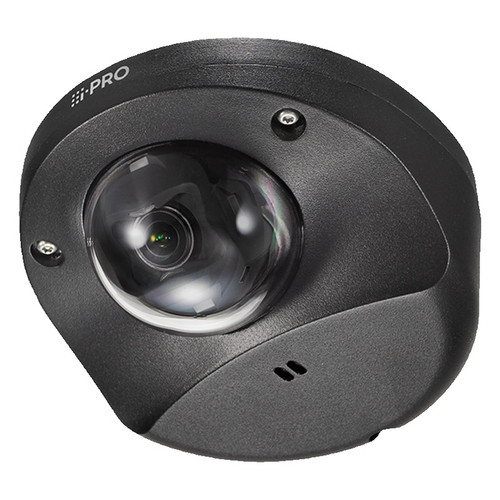
Both the Hanwha QND-6082R1 and the i-PRO WV-S35302-F2L1 are 2MP IP dome cameras targeting professional fixed-surveillance installations. The Hanwha is a motorized varifocal indoor dome rated for controlled environments, while the i-PRO is a fixed-lens outdoor dome with full IP66/IK10 weatherproofing and an onboard AI SoC. Buyers evaluating these two will be weighing lens flexibility and WDR performance against AI analytics depth, environmental hardening, and extended temperature tolerance — a classic indoor-flexible-zoom versus outdoor-hardened-fixed tradeoff.
In This Guide
How do the imaging specs compare?
Both cameras use a 1/2.8" 2MP CMOS sensor, but their lens configurations diverge significantly. The QND-6082R1 offers a 3.2–10mm motorized varifocal lens (3.1× zoom) with a DC auto iris, delivering a horizontal field of view that shifts from 109.0° at wide to a narrower tele setting, and a maximum aperture of F1.6 (wide) / F2.9 (tele). The S35302-F2L1 uses a fixed 2.4mm lens at F2.1 with a 132° horizontal FoV; it offers no optical zoom, though a digital extra-zoom up to 3.0× is available at reduced resolution (640×360). The Hanwha's motorized varifocal gives installers post-mount framing flexibility; the i-PRO's fixed lens locks coverage at installation.
On low-light and dynamic range, the i-PRO holds measurable advantages. Minimum illumination is 0.02 Lux color / 0 Lux B/W IR on the S35302-F2L1 versus 0.03 Lux color / 0 Lux IR on the QND-6082R1 — a modest but real difference in color sensitivity. WDR is more pronounced: the i-PRO specifies 144 dB maximum (Super Dynamic On, Level 31) versus 120 dB for the Hanwha. IR range is 21m (30 IRE) / 15m (50 IRE) on the i-PRO compared to 20m on the Hanwha — effectively equivalent in practice. The i-PRO adds Fog Compensation (0–8) and Adaptive Black Stretch; the Hanwha provides SSDR and SSNR as its noise-reduction and backlight tools. Frame rate is 30fps fixed on the Hanwha; the i-PRO specifies "Variable" with no explicit maximum fps stated in the provided specs.
What about installation and environment?
Environmental hardening is where these two products diverge most sharply. The i-PRO S35302-F2L1 carries IP66, NEMA 4X, and IK10 ratings with a wind resistance specification of up to 40 m/s (~89 mph), and an operating temperature range of -40°C to +50°C (-40°F to +122°F). The Hanwha QND-6082R1 has no IP, NEMA, or IK rating listed in the provided specifications and an operating temperature range of -10°C to +55°C (-14°F to +131°F), with the Environment Rating field explicitly listed as "Indoor." The i-PRO is clearly specced for exposed outdoor deployment; the Hanwha is not.
Power input is PoE for both cameras. The Hanwha specifies PoE IEEE 802.3af Class 3 (max 7.70W) and also accepts 12VDC. The i-PRO specifies PoE at max 8.6W but its PoE Class is listed as 0 in the provided specs — buyers should verify switch budget accordingly. The i-PRO's aluminum die-cast and PC clear panel construction contrasts with the Hanwha's plastic housing. Mechanical adjustment ranges also differ: the Hanwha provides pan 0°–350°, tilt 0°–67°, rotate 0°–355°; the i-PRO provides pan ±45°, tilt 0°–90°, yaw ±90°, which is a more constrained pan envelope. The i-PRO also includes a tamper-resistant enclosure per its spec sheet.
Which fits your VMS and analytics better?
Both cameras are ONVIF-compliant: the Hanwha supports ONVIF Profile S/G/T and adds SUNAPI (HTTP API) plus Wisenet Open Platform for Hanwha-ecosystem NVRs. The i-PRO supports ONVIF Profile G/M/S/T — the additional Profile M covers metadata streaming for AI events, which is relevant if the VMS supports it. The i-PRO's onboard AI (Ambarella CV25M SoC) delivers AI Video Motion Detection, Face Detection, People Detection, and Vehicle Detection, plus AI Sound Classification (gunshot, yell, vehicle horn, glass break) and Audio Detection. The Hanwha's analytics include Defocus Detection, Directional Detection, Enter/Exit, Virtual Line, and Tampering — useful event triggers, but without a dedicated AI SoC. The i-PRO also supports FIPS 140-2 Level 3, IEEE 802.1X, signed firmware, and SFTP/MQTT protocols not present in the Hanwha spec list.
On-board storage: the i-PRO supports microSD/SDHC/SDXC up to 512GB; the Hanwha supports Micro SD/SDHC/SDXC up to 128GB. Both support NAS/FTP recording on alarm. Audio: the i-PRO specifies audio compression (G.726, G.711) and Audio Detection as a listed feature; the Hanwha lists no Audio In or Audio Out in the provided specifications. The QND-6082R1's RAM is 512MB with 256MB Flash. The S35302-F2L1 does not disclose onboard RAM in the provided specs. Warranty is 3 years for the Hanwha and 5 years for the i-PRO per the provided spec data.
Which should you choose: the QND-6082R1 or the S35302-F2L1?
Our take: The QND-6082R1 is the stronger choice when installation flexibility and indoor varifocal coverage are the primary requirements — its 3.1× motorized zoom (3.2–10mm) allows framing adjustment after mounting without a lens swap, and its 120dB WDR and 0.03 Lux color sensitivity cover most controlled-environment scenarios at a lower power draw (7.70W vs 8.6W). However, the S35302-F2L1 outperforms it on every outdoor and AI metric that matters for exposed deployments: 144dB WDR (+24dB), IP66/IK10/NEMA 4X environmental certification versus no published IP rating, operating range down to -40°C versus -10°C, onboard AI face/people/vehicle detection plus AI sound classification on an Ambarella CV25M SoC, double the edge storage ceiling (512GB vs 128GB), and a 5-year versus 3-year warranty. Specify the i-PRO wherever the camera will face weather, vandalism, extreme cold, or a VMS that consumes AI metadata; specify the Hanwha for indoor scenes requiring post-mount zoom adjustment on a Hanwha/Wisenet infrastructure.
Side-by-Side Comparison
Spec-for-spec, from manufacturer data.
| Specification | Hanwha QND-6082R1 | i-PRO S35302-F2L1 |
|---|---|---|
| Resolution | 1920×1080 (2MP) | 2048×1536 (2MP) |
| Image Sensor | 1/2.8" 2MP CMOS | Approx. 1/2.8" CMOS |
| Lens / Focal Length | 3.2–10mm motorized varifocal (3.1×) | Fixed 2.4mm |
| Max Aperture | F1.6 (Wide) / F2.9 (Tele) | F2.1 |
| Horizontal FoV | 109.0° (Wide) | 132° |
| Min. Illumination (Color) | 0.03 Lux | 0.02 Lux |
| IR Range | 20m (65.6ft) | 21m at 30IRE / 15m at 50IRE |
| Wide Dynamic Range | 120dB | 144dB max |
| Max Frame Rate | 30fps | Variable (max not specified in provided specs) |
| Video Compression | H.265 / H.264 / MJPEG | H.265 / H.264 / JPEG |
| IP / Ingress Rating | — (not listed) | IP66, NEMA 4X |
| IK / Impact Rating | — (not listed) | IK10 |
| Operating Temperature | -10°C to +55°C | -40°C to +50°C |
| Power Input / PoE Class | PoE 802.3af Class 3 / 12VDC; 7.70W max | PoE; 8.6W max (PoE Class listed as 0) |
| Edge Storage | microSD up to 128GB | microSD up to 512GB |
| Audio | — (no Audio In/Out listed) | Yes (G.726, G.711; Audio Detection) |
| AI Analytics | Defocus, Directional, Enter/Exit, Virtual Line, Tampering | Face, People, Vehicle, AI VMD, AI Sound Classification |
| ONVIF Profiles | S / G / T | G / M / S / T |
| Weight | 320g (0.71 lb) | Approx. 475g (1.05 lb) |
| Warranty | 3 years | 5 years |
Frequently Asked Questions
Which should you choose: the QND-6082R1 or the S35302-F2L1?
The QND-6082R1 is the stronger choice when installation flexibility and indoor varifocal coverage are the primary requirements — its 3.1× motorized zoom (3.2–10mm) allows framing adjustment after mounting without a lens swap, and its 120dB WDR and 0.03 Lux color sensitivity cover most controlled-environment scenarios at a lower power draw (7.70W vs 8.6W). However, the S35302-F2L1 outperforms it on every outdoor and AI metric that matters for exposed deployments: 144dB WDR (+24dB), IP66/IK10/NEMA 4X environmental certification versus no published IP rating, operating range down to -40°C versus -10°C, onboard AI face/people/vehicle detection plus AI sound classification on an Ambarella CV25M SoC, double the edge storage ceiling (512GB vs 128GB), and a 5-year versus 3-year warranty. Specify the i-PRO wherever the camera will face weather, vandalism, extreme cold, or a VMS that consumes AI metadata; specify the Hanwha for indoor scenes requiring post-mount zoom adjustment on a Hanwha/Wisenet infrastructure.
Is the QND-6082R1 or S35302-F2L1 better for low-light color performance?
Per the provided specs, the i-PRO S35302-F2L1 has a slight edge: 0.02 Lux color minimum illumination versus 0.03 Lux on the Hanwha QND-6082R1. Both reach 0 Lux in IR mode. The i-PRO also specifies a higher maximum WDR of 144dB versus 120dB, which benefits high-contrast scenes more than the raw Lux figure alone.
Can the S35302-F2L1 be used outdoors where the QND-6082R1 cannot?
Yes, based on the provided specifications. The i-PRO S35302-F2L1 is rated IP66, IK10, and NEMA 4X with an operating range of -40°C to +50°C and wind resistance up to 40 m/s. The Hanwha QND-6082R1 lists no IP, IK, or NEMA rating in its provided specifications and carries an "Indoor" environment rating, making it unsuitable for exposed outdoor deployment.
Which camera offers better onboard analytics — the Hanwha QND-6082R1 or the i-PRO S35302-F2L1?
The i-PRO S35302-F2L1 provides deeper AI analytics per its spec sheet: AI Video Motion Detection, Face Detection, People Detection, Vehicle Detection, and AI Sound Classification (gunshot, yell, vehicle horn, glass break) running on an Ambarella CV25M SoC. The Hanwha QND-6082R1 offers Defocus Detection, Directional Detection, Enter/Exit, Virtual Line, Tampering, and Motion Detection, but does not list a dedicated AI SoC or object-class detection in the provided specifications.
Get a Second Opinion on Your Camera Choice
Share your site layout, coverage goals, and budget. Our team will validate the camera selection, flag anything we would change, and recommend products that match the use case.