
Hanwha QND-6012R1 vs Hanwha QNV-6082R1: Specification Comparison
Both the Hanwha QND-6012R1 and QNV-6082R1 are 2MP (1920×1080) IP dome cameras sharing the same sensor class, PoE power standard, and Wisenet analytics platform. The comparison is meaningful for integrators choosing between an indoor-only fixed-lens unit and a vandal-resistant outdoor dome with motorized varifocal optics. Key decision axes are environment rating, lens flexibility, IR range, and housing durability — areas where the two models diverge despite identical resolution and frame-rate specifications.
In This Guide
How do the imaging specs compare?
Both cameras use a 1/2.8" 2MP CMOS sensor delivering 1920×1080 at 30fps, with identical minimum illumination of 0.03 Lux color and 0 Lux in IR mode, and matching 120dB Wide Dynamic Range via BLC/WDR/SSDR. Noise reduction is SSNR on both, and each supports H.265/H.264 (Main/High) plus MJPEG with WiseStream II smart codec and CBR/VBR bitrate control.
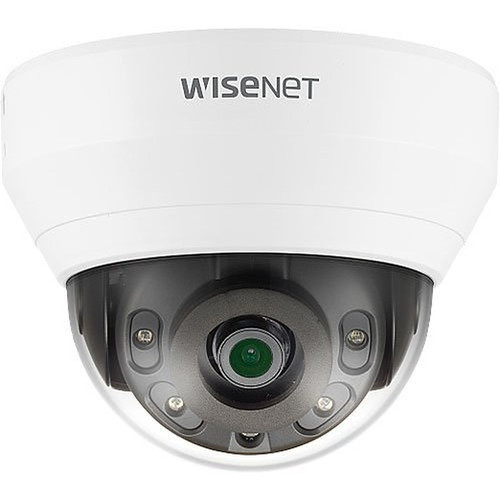
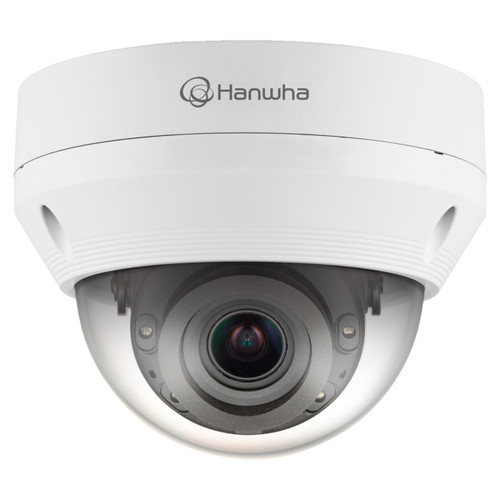
The lens is where they diverge sharply. The QND-6012R1 uses a fixed 2.8mm focal length at F2.0, providing a wide 113.7° horizontal field of view — suited to open interior spaces. The QNV-6082R1 carries a 3.2–10mm (3.1×) motorized varifocal lens with DC auto iris (F1.6 wide to F2.9 tele) and simple focus control, narrowing to a 109.0° horizontal at wide end. IR range also differs: the QND-6012R1 reaches 20m (65.62ft), while the QNV-6082R1 extends to 30m (98.42ft). The varifocal optics of the QNV-6082R1 expand its DORI envelope substantially — detect range reaches 128.8m (422.56ft) at tele versus the QND-6012R1's fixed 25.1m (82.21ft) detect distance.
What about installation and environment?
The QND-6012R1 is rated for indoor use only with no published IP or IK certification. Its operating temperature range is -10°C to +55°C. It is constructed of plastic in RAL9003 white and weighs 255g (0.56 lb) with a compact Ø110.0×86.0mm footprint. No conduit knockouts, backbox, or hanging mount accessories are specified in the provided data.
The QNV-6082R1 is rated IP66 (dust-tight, protected against strong water jets) and IK10 (vandal-resistant to 20-joule impacts), making it suitable for exposed outdoor or high-abuse indoor locations. Its operating temperature floor drops to -30°C (versus -10°C for the QND-6012R1), critical for cold-climate deployments. The housing is aluminum, not plastic, contributing to its heavier 710g (1.57 lb) mass and larger Ø137.0×106.1mm body. Conduit compatibility covers single, double, and 4" octagon gang boxes; optional accessories SBP-301HMW2 (hanging mount) and SBV-136BW (backbox) are specified. Both cameras are powered by PoE IEEE 802.3af Class 3, with the QNV-6082R1 drawing a marginally higher 7.70W versus the QND-6012R1's 7.40W. Both support 12VDC as an alternative input.
Which fits your VMS and analytics better?
The two cameras are effectively equivalent at the integration layer. Both support ONVIF Profile S/G/T, SUNAPI (HTTP API), and the Wisenet open platform. Network protocols are identical across both — IPv4/IPv6, RTSP, HTTPS/SSL, SNMPv1/v2c/v3, 802.1X (EAP-TLS, EAP-LEAP), DHCP, FTP, SMTP, DDNS, QoS, UPnP, Bonjour, and LLDP. Unicast streaming is supported for up to 6 simultaneous users with up to 3 concurrent profiles on each model.
Edge analytics capabilities are identical: both include defocus detection, directional detection, motion detection (4 polygonal zones), enter/exit, tampering, and virtual line. Privacy masking supports 6 rectangular zones on each. Neither model lists audio input or output in the provided specifications. Edge storage is Micro SD/SDHC/SDXC (1 slot, up to 128GB) on both. Alarm I/O is 1 input / 1 output each, with identical trigger and event options. RAM and flash are 512MB / 256MB respectively on both units. Both carry a 3-year warranty.
Which should you choose: the QND-6012R1 or the QNV-6082R1?
Our take: The QNV-6082R1 is the stronger choice when the installation environment is outdoor, subject to weather, vandalism, or low ambient temperature. Its IP66 and IK10 ratings address conditions the QND-6012R1 — which carries no environmental certification — cannot meet. The QNV-6082R1's cold-temperature floor of -30°C versus the QND-6012R1's -10°C represents a 20°C operational advantage in harsh climates. Its 3.2–10mm motorized varifocal lens extends the DORI detect range to 128.8m at tele, compared to the QND-6012R1's fixed 25.1m, and its IR reach is 30m versus 20m. Conversely, the QND-6012R1 is the appropriate selection for conditioned interior spaces where its fixed 2.8mm wide-angle lens, compact plastic housing, and lighter 255g weight simplify discreet ceiling mounting without the cost and bulk of a hardened outdoor enclosure. Where both cameras share a platform — resolution, analytics, VMS integration, codec, and storage — the environment rating and optics requirement are the deciding factors.
Side-by-Side Comparison
Spec-for-spec, from manufacturer data.
| Specification | Hanwha QND-6012R1 | Hanwha QNV-6082R1 |
|---|---|---|
| Resolution | 1920×1080 | 1920×1080 |
| Max Frame Rate | 30fps | 30fps |
| Image Sensor | 1/2.8" 2MP CMOS | 1/2.8" 2MP CMOS |
| Lens / Focal Length | 2.8mm fixed, F2.0 | 3.2–10mm motorized varifocal, F1.6(W)–F2.9(T) |
| Horizontal Field of View | 113.7° | 109.0° (wide end) |
| Min. Illumination | 0.03 Lux color / 0 Lux IR | 0.03 Lux color / 0 Lux IR |
| IR Range | 20m (65.62ft) | 30m (98.42ft) |
| Wide Dynamic Range | 120dB | 120dB |
| IP Rating | — | IP66 |
| IK / Impact Rating | — | IK10 |
| Operating Temperature | -10°C ~ +55°C | -30°C ~ +55°C |
| Power Input / PoE Class | PoE 802.3af Class 3 / 12VDC, 7.40W max | PoE 802.3af Class 3 / 12VDC, 7.70W max |
| Housing Material | Plastic | Aluminum |
| Dimensions | Ø110.0×86.0mm | Ø137.0×106.1mm |
| Weight | 255g (0.56 lb) | 710g (1.57 lb) |
| Edge Storage | MicroSD/SDHC/SDXC, 1 slot, 128GB max | MicroSD/SDHC/SDXC, 1 slot, 128GB max |
| Environment Rating | Indoor | Outdoor |
| Warranty | 3-year | 3-year |
Frequently Asked Questions
Which should you choose: the QND-6012R1 or the QNV-6082R1?
The QNV-6082R1 is the stronger choice when the installation environment is outdoor, subject to weather, vandalism, or low ambient temperature. Its IP66 and IK10 ratings address conditions the QND-6012R1 — which carries no environmental certification — cannot meet. The QNV-6082R1's cold-temperature floor of -30°C versus the QND-6012R1's -10°C represents a 20°C operational advantage in harsh climates. Its 3.2–10mm motorized varifocal lens extends the DORI detect range to 128.8m at tele, compared to the QND-6012R1's fixed 25.1m, and its IR reach is 30m versus 20m. Conversely, the QND-6012R1 is the appropriate selection for conditioned interior spaces where its fixed 2.8mm wide-angle lens, compact plastic housing, and lighter 255g weight simplify discreet ceiling mounting without the cost and bulk of a hardened outdoor enclosure. Where both cameras share a platform — resolution, analytics, VMS integration, codec, and storage — the environment rating and optics requirement are the deciding factors.
Is the QND-6012R1 or QNV-6082R1 better for low-light performance?
Based on the provided specifications, both cameras are equal in low-light sensitivity: each achieves 0.03 Lux in color mode and 0 Lux with IR active, and both offer 120dB WDR. The QNV-6082R1 does reach farther in darkness — its IR illuminator is rated to 30m (98.42ft) versus 20m (65.62ft) on the QND-6012R1 — so in large open outdoor areas the QNV-6082R1 covers more distance at night.
Can the QND-6012R1 be used outdoors?
The provided specifications list no IP or IK rating for the QND-6012R1, and its environment rating is stated as Indoor. Its operating temperature lower limit is -10°C. It should not be deployed outdoors or in environments exposed to moisture, dust ingress, or physical impact without an independently rated external housing — a decision that would require confirming the enclosure's own certifications.
Does the motorized lens on the QNV-6082R1 require manual adjustment on a ladder, or can it be set remotely?
The QNV-6082R1 specifies 'simple focus' as its focus control method, indicating the zoom is motorized (3.2–10mm, 3.1× range) and adjustable without a physical lens tool. However, the provided specifications do not detail whether zoom and focus are software-driven remotely through the web interface or require on-camera button actuation. Installers should confirm the remote-adjustment workflow with Hanwha's SUNAPI or ONVIF documentation before finalizing ladder access planning.
Get a Second Opinion on Your Camera Choice
Share your site layout, coverage goals, and budget. Our team will validate the camera selection, flag anything we would change, and recommend products that match the use case.