
Hanwha PNM-9085RQZ1 vs Hanwha XND-8081VZ: Specification Comparison
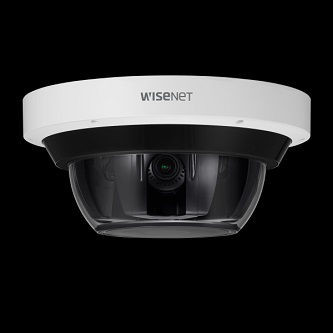
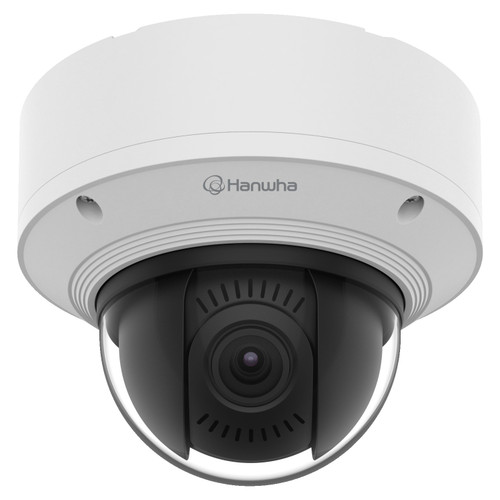
Both the Hanwha PNM-9085RQZ1 and XND-8081VZ are 5MP dome cameras sharing a 2560×1920 resolution and 30 fps ceiling, but they serve fundamentally different deployment profiles. The PNM-9085RQZ1 is a quad-sensor, four-channel outdoor PTZ dome rated IP66/IK10/NEMA4X drawing up to 45 W over HPoE, while the XND-8081VZ is a single-sensor indoor PTZ dome rated IP52/IK10 drawing only 11 W over standard PoE. Buyers cross-shopping these are typically deciding between broad outdoor multi-channel coverage and a lighter-duty interior application.
In This Guide
How do the imaging specs compare?
The PNM-9085RQZ1 uses four independent 1/1.8" 5MP CMOS sensors (four channels, 2560×1920 each) with a 4.13–9.4 mm motorized varifocal lens at 2.3× zoom and a maximum aperture of F1.92 (Wide)/F2.67 (Tele). Minimum illumination is 0.11 Lux color and 0 Lux with IR, with an IR viewable length of 30 m (98.43 ft). The XND-8081VZ uses a single 1/1.8" 6MP CMOS sensor (spec lists 6MP imaging device but outputs 2560×1920/5MP) with a slightly wider 3.6–9.4 mm motorized varifocal lens at 2.6× zoom and a notably faster aperture of F1.2 (Wide)/F2.4 (Tele). Its minimum illumination is 0.07 Lux color and 0.007 Lux B/W — substantially better in low-light conditions.
Both cameras deliver 120 dB WDR, SSNR V digital noise reduction, H.265/H.264/MJPEG compression with WiseStream II, and Auto ICR day/night switching. The PNM-9085RQZ1 provides active IR illumination to 30 m and has a wider H: 87.58°/V: 64.58° field of view at wide end. The XND-8081VZ offers a wider H: 102.5°/V: 74.2° field of view at wide end and adds hallway view rotation (90°/270°) suited to corridor installations. The PNM-9085RQZ1's pan range is 0–360° continuous; the XND-8081VZ is limited to ±175° pan and 0–85° tilt. The XND-8081VZ specs do not list an IR viewable distance metric; the IR Distance field shows 0.5 m, which appears to represent minimum object distance, not illumination range — no usable IR range figure is provided for the XND-8081VZ in the supplied specifications.
What about installation and environment?
The PNM-9085RQZ1 is rated IP66, IK10, and NEMA4X, making it fully suited to exposed outdoor installations — dust-tight, jet-water resistant, and vandal-resistant. Its operating temperature spans -40°C to +55°C (-40°F to +131°F), covering extreme cold climates. It requires HPoE (IEEE 802.3bt Class 6 Type 3) or 12 VDC, with a maximum draw of 45 W — infrastructure must support 802.3bt switches or a dedicated injector. Physical dimensions are Ø315×145.9 mm and 5.2 kg (11.5 lb); the compatible conduit hole is 3/4" and hanging mount is SBP-317HMW.
The XND-8081VZ is rated IP52 and IK10. IP52 means protection against dust ingress is not guaranteed and water resistance is limited to dripping water at 15° — this camera is explicitly indoor-only. Its operating temperature is -25°C to +60°C (-13°F to +140°F), narrower on the cold end than the PNM-9085RQZ1. Power is standard PoE (IEEE 802.3af Class 3, max 11 W) or 12 VDC — any 802.3af-capable switch port is sufficient. It is substantially more compact at Ø160×125 mm and 1.45 kg (3.2 lb). The XND-8081VZ also provides a Micro USB Type B video output (1280×720) for installation alignment.
Which fits your VMS and analytics better?
The PNM-9085RQZ1 supports ONVIF Profile S and T, while the XND-8081VZ supports ONVIF Profile S, G, and T — the additional Profile G on the XND-8081VZ enables standardized edge recording/retrieval interoperability. Both offer SUNAPI (HTTP API) and Wisenet open platform. The PNM-9085RQZ1 provides four independent edge storage slots (Micro SD/SDHC/SDXC, up to 256 GB each channel) and 5 GB RAM / 1,280 MB Flash — substantially more on-board compute and storage than the XND-8081VZ, which has a single dual-slot edge storage configuration up to 512 GB total and 1,024 MB RAM / 256 MB Flash. Network ethernet on the PNM-9085RQZ1 is metal-shielded RJ-45 supporting 10/100/1000BASE-T (Gigabit); the XND-8081VZ is RJ-45 10/100BASE-T only. The XND-8081VZ adds SRTP to its protocol stack; the PNM-9085RQZ1 spec does not list SRTP.
Analytics coverage differs: the XND-8081VZ adds Digital auto tracking, Sound classification, Shock detection, People counting, Queue management, and Heatmap (Business Intelligence) beyond the shared set. The PNM-9085RQZ1 spec does not list these BI analytics. Both cameras include 1-in/1-out alarm I/O, selectable mic/line audio input, line audio output, and the same WiseStream II smart codec. The XND-8081VZ lists a built-in microphone option (Selectable: mic in / line in / built-in mic) versus the PNM-9085RQZ1 which is external mic/line selectable only. Both support up to 10 streaming profiles and 20 unicast users.
Which should you choose: the PNM-9085RQZ1 or the XND-8081VZ?
Our take: The PNM-9085RQZ1 is the stronger choice when outdoor coverage breadth, extreme-temperature resilience, and multi-channel aggregation are the primary requirements. Its four independent 5MP sensors deliver up to 20MP aggregate coverage from a single HPoE drop, with 30 m IR illumination and IP66/NEMA4X protection rated to -40°C — none of which the XND-8081VZ can match. The XND-8081VZ, however, wins for indoor precision deployments: its F1.2 aperture and 0.007 Lux B/W sensitivity outperform the PNM-9085RQZ1's 0.11 Lux color minimum in dim interiors, its 2.6× zoom exceeds the PNM-9085RQZ1's 2.3×, and its built-in BI analytics (People Counting, Queue Management, Heatmap) and ONVIF Profile G add operational value the PNM-9085RQZ1 lacks. At 11 W on standard 802.3af PoE versus 45 W requiring 802.3bt, the XND-8081VZ also imposes far less infrastructure burden. Choose the PNM-9085RQZ1 for outdoor perimeter or multi-zone outdoor surveillance; choose the XND-8081VZ for retail, lobby, or corridor analytics indoors.
Side-by-Side Comparison
Spec-for-spec, from manufacturer data.
| Specification | Hanwha PNM-9085RQZ1 | Hanwha XND-8081VZ |
|---|---|---|
| Resolution | 2560×1920 (per channel) | 2560×1920 |
| Image Sensor | 1/1.8" 5MP CMOS ×4 channels | 1/1.8" 6MP CMOS (single sensor) |
| Max Channels | 4 | 1 |
| Lens / Focal Length | 4.13–9.4 mm, 2.3× motorized varifocal | 3.6–9.4 mm, 2.6× motorized varifocal |
| Max Aperture | F1.92 (Wide) / F2.67 (Tele) | F1.2 (Wide) / F2.4 (Tele) |
| Min Illumination | 0.11 Lux color / 0 Lux IR | 0.07 Lux color / 0.007 Lux B/W |
| IR Range | 30 m (98.43 ft) | Not specified in supplied specs |
| Wide Dynamic Range | 120 dB | 120 dB |
| Max Frame Rate | 30 fps | 30 fps |
| Video Compression | H.265 / H.264 / MJPEG + WiseStream II | H.265 / H.264 / MJPEG + WiseStream II |
| Pan / Tilt / Rotate | 0–360° / 35–80° / 0–90° | ±175° / 0–85° / ±175° |
| IP Rating | IP66 | IP52 |
| Impact Rating | IK10 | IK10 |
| Additional Certifications | NEMA4X | — |
| Operating Temperature | -40°C to +55°C | -25°C to +60°C |
| Power Input / PoE Class | HPoE IEEE 802.3bt Class 6 Type 3 / 12 VDC | PoE IEEE 802.3af Class 3 / 12 VDC |
| Power (Max) | 45 W | 11 W |
| Ethernet | RJ-45 10/100/1000BASE-T (metal shielded) | RJ-45 10/100BASE-T |
| Edge Storage | Micro SD/SDHC/SDXC × 4 slots, 256 GB each | Micro SD/SDHC/SDXC × 2 slots, 512 GB total |
| RAM / Flash | 5 GB RAM / 1,280 MB Flash | 1,024 MB RAM / 256 MB Flash |
| ONVIF Profiles | S, T | S, G, T |
| Business Intelligence Analytics | Not listed in supplied specs | People Counting, Queue Management, Heatmap |
| Audio In | Selectable: mic in / line in (external) | Selectable: mic in / line in / built-in mic |
| Environment Rating | Outdoor | Indoor |
| Dimensions | Ø315×145.9 mm (12.40"×5.74") | Ø160×125 mm (Ø6.3"×4.9") |
| Weight | 5.2 kg (11.5 lb) | 1.45 kg (3.2 lb) |
| Warranty | 3 years | 3 years |
Frequently Asked Questions
Which should you choose: the PNM-9085RQZ1 or the XND-8081VZ?
The PNM-9085RQZ1 is the stronger choice when outdoor coverage breadth, extreme-temperature resilience, and multi-channel aggregation are the primary requirements. Its four independent 5MP sensors deliver up to 20MP aggregate coverage from a single HPoE drop, with 30 m IR illumination and IP66/NEMA4X protection rated to -40°C — none of which the XND-8081VZ can match. The XND-8081VZ, however, wins for indoor precision deployments: its F1.2 aperture and 0.007 Lux B/W sensitivity outperform the PNM-9085RQZ1's 0.11 Lux color minimum in dim interiors, its 2.6× zoom exceeds the PNM-9085RQZ1's 2.3×, and its built-in BI analytics (People Counting, Queue Management, Heatmap) and ONVIF Profile G add operational value the PNM-9085RQZ1 lacks. At 11 W on standard 802.3af PoE versus 45 W requiring 802.3bt, the XND-8081VZ also imposes far less infrastructure burden. Choose the PNM-9085RQZ1 for outdoor perimeter or multi-zone outdoor surveillance; choose the XND-8081VZ for retail, lobby, or corridor analytics indoors.
Is the PNM-9085RQZ1 or XND-8081VZ better for low-light performance?
The XND-8081VZ has a lower minimum illumination — 0.07 Lux color and 0.007 Lux B/W — compared to the PNM-9085RQZ1 at 0.11 Lux color. The XND-8081VZ's F1.2 maximum aperture also gathers significantly more light than the PNM-9085RQZ1's F1.92. For artificially lit indoor low-light scenes, the XND-8081VZ is the better performer per spec. The PNM-9085RQZ1, however, includes active IR illumination rated to 30 m (98.43 ft) for complete-darkness outdoor use; no comparable IR range figure is provided for the XND-8081VZ in the supplied specifications.
Can the XND-8081VZ be used outdoors?
No. The XND-8081VZ is rated IP52, which provides limited protection against dripping water only and is not rated for dust exclusion or jet water exposure. It is designated as an indoor camera in its specifications. The PNM-9085RQZ1, rated IP66, IK10, and NEMA4X with an operating temperature floor of -40°C, is the appropriate choice for outdoor deployment.
Does either camera require a special PoE switch?
Yes — the PNM-9085RQZ1 requires HPoE per IEEE 802.3bt (Class 6, Type 3) to deliver its maximum 45 W draw, which means your switch or injector must support the higher-power 802.3bt standard. The XND-8081VZ draws only up to 11 W and operates on standard IEEE 802.3af (Class 3) PoE, compatible with the vast majority of existing PoE switch infrastructure.
Get a Second Opinion on Your Camera Choice
Share your site layout, coverage goals, and budget. Our team will validate the camera selection, flag anything we would change, and recommend products that match the use case.