
Hanwha P-3104W1-12TB vs i-PRO NX400/27000T3: Specification Comparison
Both the Hanwha WRT-P-3104W1-12TB and the i-PRO WJ-NX400/27000T3 are purpose-built 64-channel NVRs targeting mid-to-large physical security deployments. The Hanwha is a Windows 11 IoT-based mini-tower running Wisenet WAVE VMS, while the i-PRO is an embedded rack-mount appliance with native RAID support. This comparison covers recording capacity and storage, platform architecture and power, and integration and software ecosystem — the three axes most relevant to an installer or IT buyer evaluating these units side by side.
In This Guide
Which NVR delivers more recording capacity and longer retention?
The i-PRO WJ-NX400/27000T3 ships with 27TB of pre-installed HDD storage (nine 3TB drives), giving it a significant raw retention advantage over the Hanwha WRT-P-3104W1-12TB, which ships with 12TB across three drive bays and is expandable to a maximum of 16TB. For a 64-channel deployment recording continuously at high resolution, the i-PRO's 27TB will sustain meaningfully longer archive windows before footage cycles.
On throughput, the Hanwha spec sheet states 170 Mbps sustained recording throughput. The i-PRO spec lists a figure of 3 Mbps, which — if taken at face value for the full 64-channel system — would be unusually low and may represent a per-channel or per-stream figure rather than aggregate system throughput; the i-PRO spec does not provide an explicit aggregate throughput number. Buyers should verify aggregate throughput directly with i-PRO before sizing bandwidth.
The Hanwha supports RAID implicitly via its Windows OS environment, but no explicit RAID modes are listed in its specs. The i-PRO explicitly supports RAID 0, 1, 5, 6, and 10, providing defined redundancy options that are particularly important for always-on surveillance storage. The i-PRO's nine-drive configuration enables RAID 5 or 6 with usable capacity well above the Hanwha's 16TB ceiling.
How do the platform architecture, compute, and power requirements compare?
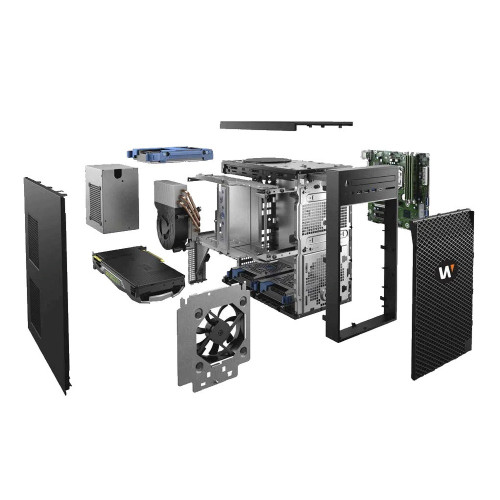
The Hanwha WRT-P-3104W1-12TB is built on a 14th-generation Intel Core i3 with 16GB DDR4 RAM and a 512GB SSD OS drive, running Windows 11 IoT Enterprise LTSC 2024 in a mini-tower form factor weighing 24 lbs. This general-purpose computing platform enables flexibility — third-party software installation, remote desktop access, and Windows-native IT management — but it also introduces a larger OS attack surface and requires Windows patch management.
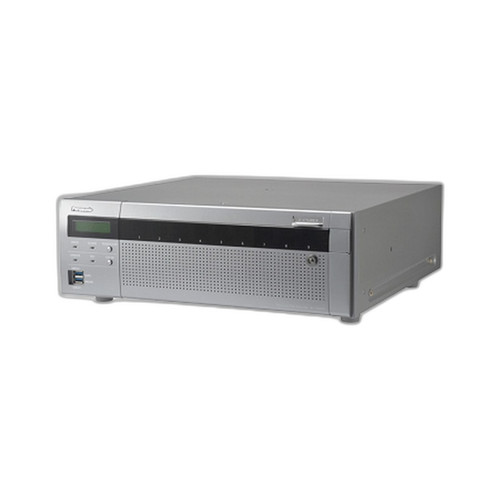
The i-PRO WJ-NX400/27000T3 is an embedded NVR in a rack-mount form factor (430mm W × 132mm H × 400mm D). CPU, RAM, and OS details are not provided in the supplied specifications. The embedded architecture typically means a hardened, appliance-style deployment with no general-purpose OS overhead, but it limits extensibility. No CPU, RAM, or SSD OS drive specs are available for the i-PRO from the provided data.
Power architecture differs substantially. The Hanwha draws from a 360W (or 500W — two values appear in the supplied specs) 80 Plus Platinum-rated AC supply operating at 110–240V, suited to standard rack or desktop power circuits. The i-PRO lists a 12V DC power input with no wattage figure provided in the supplied specs. A 12V DC requirement may necessitate an external power supply or UPS with DC output in some installation environments — installers should confirm the power delivery method with i-PRO.
Which unit offers broader integration and software ecosystem support?
The Hanwha WRT-P-3104W1-12TB ships with four Wisenet WAVE Professional VMS licenses pre-loaded and activated on Windows 11 IoT. Wisenet WAVE supports ONVIF, enabling use with third-party cameras. The Windows platform also allows installation of additional client software, analytics engines, or integrations. The four bundled Professional licenses provide immediate multi-seat VMS capability without additional software spend at deployment.
The i-PRO WJ-NX400/27000T3 operates as a standalone embedded NVR with ONVIF Profile S support and native compatibility with i-PRO IP cameras. No third-party VMS license is included or referenced in the supplied specifications. The unit supports H.265, H.264, and JPEG compression and records at up to 4K (3840×2160) resolution at 60 fps per camera. Its 32 alarm inputs and 4 alarm reset inputs provide extensive hardware I/O for integration with access control and perimeter systems — a capability not detailed in the Hanwha specs.
Both units confirm ONVIF compatibility, providing a baseline for third-party camera interoperability. The Hanwha's open Windows platform favors environments already standardized on Wisenet WAVE or requiring flexible VMS options. The i-PRO's embedded architecture and extensive alarm I/O favor purpose-built surveillance deployments, especially those with i-PRO camera fleets, where the standalone appliance model reduces IT overhead. No SDK or API details are provided in the supplied specs for either unit.
Which should you choose: the P-3104W1-12TB or the NX400/27000T3?
Our take: The WRT-P-3104W1-12TB is the stronger choice when the deployment is standardized on Wisenet WAVE VMS and requires a general-purpose Windows platform with immediate VMS licensing. It ships with four Professional WAVE licenses, runs on a 14th-gen Core i3 with 16GB RAM, and delivers a stated 170 Mbps sustained throughput — concrete figures absent from the i-PRO's supplied specs. However, the WJ-NX400/27000T3 leads on storage (27TB vs 12TB pre-installed, 16TB max on the Hanwha), supports explicit RAID 0/1/5/6/10 redundancy, records 4K/60 fps per channel, and provides 32 alarm inputs for deep I/O integration — all with no OS management burden. Choose the Hanwha for VMS-centric, Windows-managed environments; choose the i-PRO for storage-intensive, appliance-style deployments with i-PRO camera fleets or high alarm I/O requirements.
Side-by-Side Comparison
Spec-for-spec, from manufacturer data.
| Specification | Hanwha P-3104W1-12TB | i-PRO NX400/27000T3 |
|---|---|---|
| Product Type | NVR (mini-tower, Windows) | NVR (embedded, rack-mount) |
| Max Recording Channels | 64 | 64 |
| Pre-installed Storage | 12TB | 27TB (9 × 3TB HDD) |
| Max Storage Capacity | 16TB | — |
| Drive Bays | 3 | 9 (implied by 3TB × 9) |
| RAID Support | Not specified | RAID 0, 1, 5, 6, 10 |
| Recording Throughput | 170 Mbps | 3 Mbps (spec ambiguous; verify aggregate) |
| Max Resolution | Not specified | 4K (3840×2160) |
| Max FPS per Camera | Not specified | 60 fps |
| Video Compression | Not specified | H.265, H.264, JPEG |
| Processor | Intel Core i3, 14th Gen | Not specified |
| RAM | 16GB DDR4 | Not specified |
| OS Platform | Windows 11 IoT Enterprise LTSC 2024 | Embedded (no OS specified) |
| VMS Included | Wisenet WAVE (4 Professional licenses) | None specified |
| Alarm Inputs / Outputs | Not specified | 32 inputs / 4 reset inputs |
| Power | 360W–500W 80 Plus Platinum, AC 110–240V | 12V DC (wattage not specified) |
| Form Factor | Mini-tower | Rack-mount |
| Dimensions | 6.06" W × 11.54" D × 12.77" H | 430mm W × 132mm H × 400mm D |
| Weight | 24 lbs (10.68 kg) | Not specified |
| ONVIF | Yes | Yes (Profile S) |
| Video Outputs | DisplayPort, HDMI | HDMI |
| USB Ports | 6 | Not specified |
| Warranty | 5-year | Not specified |
| Housing Color | White | White |
| Local Storage | microSD | microSD |
Frequently Asked Questions
Which should you choose: the P-3104W1-12TB or the NX400/27000T3?
The WRT-P-3104W1-12TB is the stronger choice when the deployment is standardized on Wisenet WAVE VMS and requires a general-purpose Windows platform with immediate VMS licensing. It ships with four Professional WAVE licenses, runs on a 14th-gen Core i3 with 16GB RAM, and delivers a stated 170 Mbps sustained throughput — concrete figures absent from the i-PRO's supplied specs. However, the WJ-NX400/27000T3 leads on storage (27TB vs 12TB pre-installed, 16TB max on the Hanwha), supports explicit RAID 0/1/5/6/10 redundancy, records 4K/60 fps per channel, and provides 32 alarm inputs for deep I/O integration — all with no OS management burden. Choose the Hanwha for VMS-centric, Windows-managed environments; choose the i-PRO for storage-intensive, appliance-style deployments with i-PRO camera fleets or high alarm I/O requirements.
Is the WRT-P-3104W1-12TB or WJ-NX400/27000T3 better for longer video retention?
The WJ-NX400/27000T3 ships with 27TB of pre-installed storage versus the WRT-P-3104W1-12TB's 12TB (expandable to 16TB maximum). For the same 64 channels at equivalent resolution and frame rate settings, the i-PRO will retain significantly more footage before overwriting. If retention depth is a primary requirement, the i-PRO has a clear storage advantage based on supplied specifications.
Do I need to purchase VMS software separately for either unit?
The Hanwha WRT-P-3104W1-12TB includes four Wisenet WAVE Professional licenses pre-loaded on Windows 11 IoT — no separate VMS purchase is required for up to four concurrent clients at deployment. The i-PRO WJ-NX400/27000T3 operates as a standalone embedded NVR; the supplied specifications do not reference any bundled VMS license. Buyers deploying the i-PRO unit who require multi-seat VMS functionality should confirm licensing requirements directly with i-PRO.
Which NVR is easier to integrate with third-party access control or alarm systems?
The i-PRO WJ-NX400/27000T3 specifies 32 alarm inputs and 4 alarm reset outputs, providing extensive hardware-level I/O for direct integration with access control panels, door contacts, and perimeter sensors. The Hanwha WRT-P-3104W1-12TB's supplied specifications do not list alarm input/output counts. Both units confirm ONVIF support for camera interoperability. For deployments requiring extensive hardwired alarm I/O, the i-PRO's specified capabilities are more detailed in the provided data.
Get a Second Opinion on Your Camera Choice
Share your site layout, coverage goals, and budget. Our team will validate the camera selection, flag anything we would change, and recommend products that match the use case.