
Hanwha L7012R vs Hanwha QNV-7082R: Specification Comparison
Both the Hanwha ANV-L7012R and the Hanwha QNV-7082R are 4MP (2560×1440) outdoor vandal dome IP cameras powered by PoE, making them direct cross-shop candidates for perimeter and facility surveillance installations. The primary differentiators are lens type—fixed 3mm wide-angle on the L7012R versus a 3.2–10mm motorized varifocal on the QNV-7082R—along with differences in IR range, power budget, audio capability, alarm I/O, and operating temperature floor. This comparison draws exclusively from the manufacturer specifications provided.

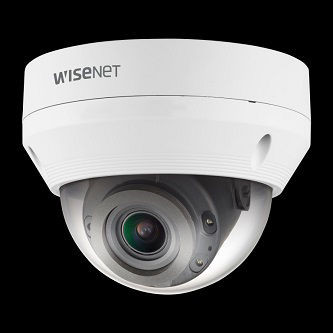
In This Guide
How do the imaging specs compare?
Both cameras share a 1/3" CMOS sensor producing 2560×1440 at 30fps with H.265/H.264 (Main/High) and MJPEG compression, 120dB WDR, SSNR digital noise reduction, Auto(ICR) day/night switching, and identical pan/tilt/rotate ranges of 0°–350° / 0°–67° / 0°–355°. Minimum illumination is close but not identical: the L7012R is rated at 0.13 Lux color / 0 Lux IR, while the QNV-7082R is rated slightly better at 0.1 Lux color / 0 Lux IR. Both claim 0 Lux performance with IR active.
The lens architecture diverges significantly. The L7012R uses a fixed 3mm focal length at F1.6, delivering a wide 99° horizontal field of view suited to open-area coverage, with a minimum object distance of 1.1m and fixed focus control. The QNV-7082R uses a 3.2–10mm motorized varifocal lens (3.1× zoom) with DC auto iris ranging from F1.6 (wide) to F2.9 (tele) and simple focus control, enabling horizontal coverage from 98.6° (wide) down to 30.8° (tele). IR illumination also differs: the L7012R is specified at 20m (65.62ft), while the QNV-7082R reaches 30m (98.42ft). DORI figures reflect this—at Tele, the QNV-7082R detects to 129m vs the L7012R's 44.3m.
What about installation and environment?
Both cameras carry IP66 and IK10 ratings. However, their power and temperature profiles differ. The L7012R is PoE-only (IEEE 802.3af, Class 3) with a maximum draw of 7.5W and a typical of 5.7W, and its operating temperature range is −30°C to +55°C. The QNV-7082R accepts both PoE (IEEE 802.3af, Class 3) and 12VDC, with a higher maximum power draw of 11.4W—attributable to the motorized varifocal mechanism and longer IR array—and a wider operating temperature range of −40°C to +55°C, making it more suitable for extreme cold climates.
Form factor and weight differ meaningfully for mounting planning. The L7012R measures ø120.3×91.7mm and weighs 410g, while the QNV-7082R is larger at ø137.0×106.1mm and heavier at 710g (1.565 lb). The QNV-7082R specifies compatible accessories including a hanging mount (SBP-301HMW2), skin cover (SPB-VAW72), and backbox (SBV-136BW), as well as conduit compatibility (3/4"/M25 single, double, 4" octagon). The L7012R spec sheet does not list equivalent accessory part numbers. Both cameras are white (RAL9003) with aluminum and plastic construction.
Which fits your VMS and analytics better?
Both cameras support ONVIF Profile S/G/T and Hanwha SUNAPI (HTTP API), making them compatible with the same range of VMS platforms. Both offer WiseStream II smart codec, up to 3 simultaneous streaming profiles, unicast (6 users) or multicast, and identical protocol stacks (IPv4/IPv6, RTSP, HTTPS, SNMPv1/v2c/v3, 802.1X EAP-TLS/LEAP/PEAP, etc.). Edge storage is identical: Micro SD/SDHC/SDXC single slot up to 128GB, with 512MB RAM and 256MB Flash.
Analytics differ in one notable entry: the QNV-7082R lists Virtual line detection while the L7012R does not; the L7012R lists Hallway view as an analytic and also includes WiseStream II explicitly in its analytics field. The QNV-7082R adds hardware-level alarm I/O (1 input / 1 output) and an audio line input with G.711/G.726 audio compression—neither alarm I/O nor audio is present on the L7012R. Alarm triggers on the QNV-7082R therefore include alarm input in addition to analytics and network disconnect. The L7012R's cybersecurity spec explicitly calls out SDcard partition encryption and a device certificate (Hanwha Private Root CA); the QNV-7082R's security section does not enumerate these fields in the provided spec data.
Which should you choose: the L7012R or the QNV-7082R?
Our take: The QNV-7082R is the stronger choice when installation geometry is variable or unknown, when the deployment site experiences temperatures below −30°C, or when audio capture and alarm dry-contact I/O are required. Its 3.2–10mm motorized varifocal lens provides 3.1× optical zoom versus the L7012R's fixed 3mm, extending IR reach to 30m versus 20m and DORI detect range to 129m (tele) versus 44.3m. Its operating floor drops to −40°C versus −30°C, and it adds a 12VDC power input alternative alongside PoE. The L7012R is the better fit where a wide, fixed 99° field of view is appropriate, where installation infrastructure is PoE-only with a tight power budget (7.5W max vs 11.4W), and where a smaller, lighter form factor (410g vs 710g) simplifies mounting. Both cameras deliver identical 4MP resolution, 120dB WDR, IP66/IK10 ratings, ONVIF S/G/T, and 128GB edge storage. Platform compatibility is equivalent.
Side-by-Side Comparison
Spec-for-spec, from manufacturer data.
| Specification | Hanwha L7012R | Hanwha QNV-7082R |
|---|---|---|
| Resolution | 4MP (2560×1440) | 4MP (2560×1440) |
| Image Sensor | 1/3" CMOS | 1/3" CMOS |
| Lens / Focal Length | 3mm fixed, F1.6 | 3.2–10mm motorized varifocal, F1.6 (W) – F2.9 (T) |
| Horizontal Field of View | 99° | 98.6° (Wide) – 30.8° (Tele) |
| Min. Illumination (Color / IR-on) | 0.13 Lux / 0 Lux | 0.1 Lux / 0 Lux |
| IR Range | 20m (65.62ft) | 30m (98.42ft) |
| Wide Dynamic Range | 120dB | 120dB |
| Max Frame Rate | 30fps @ 4MP | 30fps |
| Video Compression | H.265/H.264 (Main/High), MJPEG | H.265/H.264 (Main/High), MJPEG |
| IP Rating | IP66 | IP66 |
| IK / Impact Rating | IK10 | IK10 |
| Operating Temperature | −30°C to +55°C | −40°C to +55°C |
| Power Input | PoE IEEE 802.3af Class 3 only | PoE IEEE 802.3af Class 3 or 12VDC |
| Max Power Consumption | 7.5W | 11.4W |
| Audio | — | Line in (G.711 / G.726) |
| Alarm I/O | — | 1 input / 1 output |
| Edge Storage | MicroSD/SDHC/SDXC, 1 slot, up to 128GB | MicroSD/SDHC/SDXC, 1 slot, up to 128GB |
| Dimensions (Ø × H) | ø120.3 × 91.7mm (ø4.74 × 3.61") | ø137.0 × 106.1mm (ø5.39 × 4.18") |
| Weight | 410g | 710g (1.565 lb) |
| ONVIF Profiles | S, G, T | S, G, T |
| Warranty | 3 years | 3 years |
Frequently Asked Questions
Which should you choose: the L7012R or the QNV-7082R?
The QNV-7082R is the stronger choice when installation geometry is variable or unknown, when the deployment site experiences temperatures below −30°C, or when audio capture and alarm dry-contact I/O are required. Its 3.2–10mm motorized varifocal lens provides 3.1× optical zoom versus the L7012R's fixed 3mm, extending IR reach to 30m versus 20m and DORI detect range to 129m (tele) versus 44.3m. Its operating floor drops to −40°C versus −30°C, and it adds a 12VDC power input alternative alongside PoE. The L7012R is the better fit where a wide, fixed 99° field of view is appropriate, where installation infrastructure is PoE-only with a tight power budget (7.5W max vs 11.4W), and where a smaller, lighter form factor (410g vs 710g) simplifies mounting. Both cameras deliver identical 4MP resolution, 120dB WDR, IP66/IK10 ratings, ONVIF S/G/T, and 128GB edge storage. Platform compatibility is equivalent.
Is the L7012R or QNV-7082R better for low-light performance?
Both cameras reach 0 Lux with IR active. In color/ambient-light conditions, the QNV-7082R is specified at 0.1 Lux versus the L7012R's 0.13 Lux—a marginal difference unlikely to be decisive in practice. The QNV-7082R's IR illuminator is rated to 30m versus the L7012R's 20m, giving it a meaningful advantage in longer-distance nighttime coverage.
Which camera is better if I need to adjust the field of view after installation?
The QNV-7082R is the clear choice here. Its 3.2–10mm motorized varifocal lens with simple focus control allows remote or on-site zoom adjustment from 98.6° (wide) down to 30.8° (tele) without physically changing the lens. The L7012R has a fixed 3mm lens with a fixed 99° horizontal field of view—there is no optical zoom or remote focus adjustment available.
Does either camera support audio recording or alarm contacts for integration with an access control panel?
Only the QNV-7082R supports these features. It includes one alarm input, one alarm output, and an audio line input with G.711/G.726 compression, enabling integration with door contacts, motion sensors, or external sounders. The L7012R does not list alarm I/O or audio input/output in its provided specifications.
Get a Second Opinion on Your Camera Choice
Share your site layout, coverage goals, and budget. Our team will validate the camera selection, flag anything we would change, and recommend products that match the use case.