
Hanwha C9253 vs Hanwha XNP-9250R: Specification Comparison
Both the Hanwha XNP-C9253 and XNP-9250R are 8MP (3840×2160) outdoor PTZ cameras sharing the same 25x optical zoom lens, 360° endless pan, and IP66/IK10-rated housing—making them a genuine cross-shop pair for perimeter and wide-area surveillance deployments. The comparison centers on three meaningful differences: the C9253's higher-tier AI analytics stack and PoE+ power input versus the XNP-9250R's built-in IR illumination at up to 200m and HPoE (802.3bt) power input. Installers selecting between them should weigh ambient lighting conditions, available PoE infrastructure, and analytics requirements.
In This Guide
How do the imaging specs compare?
Both cameras use a 1/2.8" CMOS sensor at 3840×2160 (8MP) with an identical 5–125mm (25x optical, 32x digital, 800x total) DC auto-iris lens, F1.6 wide / F3.73 tele aperture, and 120dB Extreme WDR. Color low-light sensitivity is identical at 0.1 Lux for both. The critical divergence is in B&W low-light: the C9253 specifies 0.01 Lux B&W, while the XNP-9250R specifies 0 Lux IR—the latter reflecting its built-in IR illuminator (Wise IR, rated to 200m/656ft) that enables imaging in total darkness. The C9253 lists no built-in IR; its spec sheet notes an IR distance of 5m, suggesting limited or incidental IR capability, and its tagline states 'external IR illuminator required.'
The C9253 adds a meaningful frame-rate advantage: its spec lists 60fps capability (though the per-resolution spec states 30fps at 8MP, with 60fps implied at lower resolutions). The XNP-9250R is specified at 30fps maximum. Both cameras support Digital Image Stabilization via a built-in gyro sensor, Defog, and identical motion-detection zone configuration (8 zones, 8-point polygonal). The C9253 lists WiseNR II (AI-engine-based) plus SSNR V for noise reduction, while the XNP-9250R lists SSNR V only. The C9253 also supports WiseStream III in addition to WiseStream II; the XNP-9250R lists WiseStream II only.
What about installation and environment?
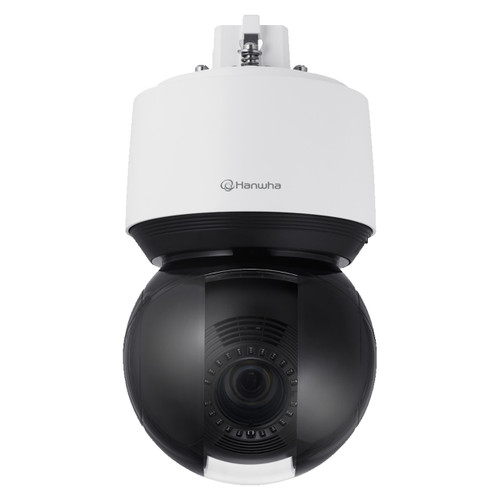
Both cameras share identical physical dimensions (ø158×293.3mm / 6.22×11.55") and weight (3.2kg / 7.05lb), the same white aluminum body with black polycarbonate dome/head, RAL9003/RAL9005 color codes, and identical environmental certifications: IP66, IK10, NEMA4X. Operating temperature range is the same at -40°C to +55°C for the C9253; the XNP-9250R spec lists -40°C to +55°C in one field but -40°C to +60°C in another field—the datasheet-primary value should be confirmed before deployment in high-heat environments. Both list -50°C to +60°C storage temperature.
Power input is a decisive installation difference. The C9253 requires PoE+ (IEEE 802.3at, Class 4), drawing a typical 24W and maximum 25.5W—compatible with any 802.3at-capable switch. The XNP-9250R requires HPoE (IEEE 802.3bt, Class 6, Type 3) and includes an injector; its maximum draw is 40W. This means the XNP-9250R cannot be powered from a standard PoE+ switch without the supplied injector or an 802.3bt switch, which is an infrastructure cost and planning consideration. Both cameras support Water Removal (spin dry); the C9253 additionally specifies a lens heater, which the XNP-9250R does not list.
Which fits your VMS and analytics better?
Both cameras support ONVIF Profile S/G/T and Hanwha's SUNAPI/Wisenet open platform. The C9253 adds ONVIF Profile M support, which provides metadata streaming for AI-driven analytics—relevant for VMS platforms that consume analytics metadata natively. The C9253's analytics list is more extensive: Person/Face/Vehicle/License Plate classification with vehicle sub-type attributes (car/bus/truck/motorcycle/bicycle), Virtual Line (crossing/direction), Virtual Area (loitering/appear/disappear), DetectionShot, and MQTT subscription/publication for alarm triggers. The XNP-9250R lists Object Auto Tracking (Person/Vehicle), Target Lock Tracking, Directional Detection, Fog Detection, Face Detection, Motion Detection, and Appear/Disappear—a meaningful but shorter analytics set without license-plate recognition or vehicle sub-type classification.
Edge storage is identical on both: dual Micro SD/SDHC/SDXC slots supporting up to 1TB (512GB×2), with 4GB RAM and 512MB Flash. Neither camera lists built-in audio I/O in the provided specifications; both support alarm I/O only via an optional external NW I/O box. The C9253 lists additional security features: Secure Boot, Signed Firmware, Firmware Encryption, TPM/HTPM, encrypted SD card, and TPM with FIPS 140-2 Level 2 certification—none of these are listed for the XNP-9250R. The C9253 also lists NTCIP 1205 protocol support (traffic management standard), which the XNP-9250R does not.
Which should you choose: the C9253 or the XNP-9250R?
Our take: The C9253 is the stronger choice when the deployment site has adequate ambient or supplemental lighting and requires advanced AI analytics, whereas the XNP-9250R is the more self-contained choice for locations where built-in IR illumination to 200m is operationally necessary. Three concrete spec deltas drive this: (1) the XNP-9250R has a built-in Wise IR illuminator rated to 200m vs. no specified built-in IR on the C9253; (2) the C9253 draws a maximum 25.5W on PoE+ (802.3at) vs. the XNP-9250R's 40W requiring HPoE (802.3bt) infrastructure; (3) the C9253 adds License Plate Recognition, vehicle sub-type classification, ONVIF Profile M, FIPS 140-2 Level 2 TPM, and WiseNR II AI noise reduction—none of which appear in the XNP-9250R spec set. Choose the XNP-9250R for IR-dependent, lower-analytics deployments with HPoE infrastructure; choose the C9253 for analytics-intensive or cybersecurity-sensitive deployments on standard PoE+ infrastructure.
Side-by-Side Comparison
Spec-for-spec, from manufacturer data.
| Specification | Hanwha C9253 | Hanwha XNP-9250R |
|---|---|---|
| Resolution | 3840×2160 (8MP) | 3840×2160 (8MP) |
| Image Sensor | 1/2.8" CMOS | 1/2.8" CMOS |
| Lens / Focal Length | 5–125mm DC auto iris, 25x optical (32x digital, 800x total) | 5–125mm DC auto iris, 25x optical (32x digital, 800x total) |
| Max Frame Rate | 30fps @ 8MP (60fps at lower res per feature list) | 30fps |
| Min. Illumination | 0.1 Lux color / 0.01 Lux B&W | 0.1 Lux color / 0 Lux IR |
| IR Illumination | Not specified (5m listed; external illuminator noted) | Built-in Wise IR, 200m (656ft) |
| Wide Dynamic Range | Extreme WDR 120dB | Extreme WDR 120dB |
| Video Compression | H.265 / H.264 (Main/Baseline/High) / MJPEG | H.265 / H.264 (Main/Baseline/High) / MJPEG |
| Smart Codec | WiseStream II, WiseStream III | WiseStream II |
| AI / Analytics | LPR, Person/Face/Vehicle (sub-type) classification, Virtual Line/Area, Auto Tracking, DetectionShot | Auto Tracking (Person/Vehicle), Target Lock, Directional, Fog, Face, Motion, Appear/Disappear |
| ONVIF Profile | S / G / T / M | S / G / T |
| IP / IK Rating | IP66 / IK10 / NEMA4X | IP66 / IK10 / NEMA4X |
| Operating Temperature | -40°C to +55°C | -40°C to +55°C (primary spec; secondary field lists +60°C) |
| Power Input / PoE Class | PoE+ (IEEE 802.3at, Class 4) | HPoE (IEEE 802.3bt, Class 6, Type 3; injector included) |
| Power Consumption (Max) | Typical 24W / Max 25.5W | Typical 20W / Max 40W |
| Edge Storage | Dual Micro SD/SDHC/SDXC, up to 1TB (512GB×2) | Dual Micro SD/SDHC/SDXC, up to 1TB |
| Cybersecurity | Secure Boot, Signed Firmware, TPM FIPS 140-2 L2, Encrypted SD, HTPM | HTTPS, Digest Auth, IP Filtering, 802.1X, Device Certificate |
| Dimensions / Weight | ø158×293.3mm / 3.2kg (7.05lb) | ø158×293.3mm / 3.2kg (7.05lb) |
| Warranty | 3-year | Not specified in provided specs |
Frequently Asked Questions
Which should you choose: the C9253 or the XNP-9250R?
The C9253 is the stronger choice when the deployment site has adequate ambient or supplemental lighting and requires advanced AI analytics, whereas the XNP-9250R is the more self-contained choice for locations where built-in IR illumination to 200m is operationally necessary. Three concrete spec deltas drive this: (1) the XNP-9250R has a built-in Wise IR illuminator rated to 200m vs. no specified built-in IR on the C9253; (2) the C9253 draws a maximum 25.5W on PoE+ (802.3at) vs. the XNP-9250R's 40W requiring HPoE (802.3bt) infrastructure; (3) the C9253 adds License Plate Recognition, vehicle sub-type classification, ONVIF Profile M, FIPS 140-2 Level 2 TPM, and WiseNR II AI noise reduction—none of which appear in the XNP-9250R spec set. Choose the XNP-9250R for IR-dependent, lower-analytics deployments with HPoE infrastructure; choose the C9253 for analytics-intensive or cybersecurity-sensitive deployments on standard PoE+ infrastructure.
Is the C9253 or XNP-9250R better for low-light and nighttime coverage?
The XNP-9250R is the better choice for true low-light and zero-light conditions because it includes a built-in Wise IR illuminator rated to 200m (656ft) and specifies 0 Lux IR sensitivity. The C9253 specifies 0.01 Lux B&W but lists no built-in IR illumination capability of meaningful range—its spec notes only 5m IR distance and its tagline references requiring an external IR illuminator. If the deployment site has no ambient lighting and no plans for external illuminators, the XNP-9250R is the more operationally self-sufficient option.
Can either camera run on a standard PoE switch?
The C9253 can run on any standard 802.3at (PoE+) switch, drawing a maximum of 25.5W under the Class 4 budget—widely available in enterprise and mid-market switch portfolios. The XNP-9250R requires HPoE (IEEE 802.3bt, Class 6, Type 3), drawing up to 40W; a standard PoE+ switch cannot power it. Hanwha includes an injector with the XNP-9250R, but installers should plan for HPoE-capable infrastructure or injector placement at each camera location, which adds deployment complexity.
Does one camera offer better analytics, and does either support license plate recognition?
The C9253 offers a broader AI analytics set. It includes License Plate Recognition, vehicle sub-type classification (car/bus/truck/motorcycle/bicycle), Virtual Line crossing/direction detection, Virtual Area analytics, DetectionShot, and ONVIF Profile M for metadata streaming—none of which appear in the XNP-9250R's listed specifications. The XNP-9250R lists Object Auto Tracking (Person/Vehicle), Target Lock Tracking, Directional Detection, Fog Detection, Face Detection, Motion Detection, and Appear/Disappear. For deployments requiring LPR or granular vehicle classification, the C9253 is the only specified option between the two.
Get a Second Opinion on Your Camera Choice
Share your site layout, coverage goals, and budget. Our team will validate the camera selection, flag anything we would change, and recommend products that match the use case.