
Hanwha C8253R vs Hanwha C8303RW: Specification Comparison
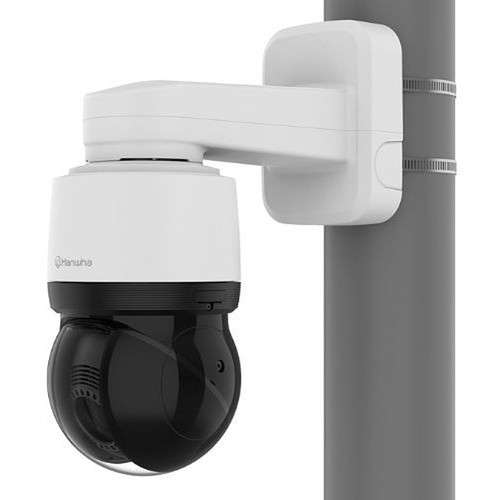
Both the Hanwha XNP-C8253R and XNP-C8303RW are outdoor 6MP (3328×1872) PTZ IP cameras sharing the same sensor class, IP66/IK10 enclosure rating, PoE++ (802.3bt Class 6) power, and Wisenet AI analytics platform. The core differentiators are optical zoom range (25x vs. 30x), water-removal method (spin-dry vs. wiper), pan/tilt speed, minimum object distance, and physical size and weight. This comparison is written for integrators choosing between the two for perimeter, traffic, or wide-area surveillance deployments.

In This Guide
How do the imaging specs compare?
Both cameras use a 1/2.8" CMOS sensor, deliver 3328×1872 at up to 30fps at full 6MP resolution, share identical minimum illumination of 0.1 Lux color / 0 Lux IR, and both offer Extreme WDR at 120dB. IR range is identical at 200m (656ft) via Wise IR on both units. Where they diverge is optical zoom: the C8253R offers 25x optical (5–125mm, F1.6–F3.73, total 800x with 32x digital), while the C8303RW steps up to 30x optical (5–150mm, F1.6–F4.56, total 960x with 32x digital). The C8303RW's longer tele focal length also extends DORI range: tele-Detect reaches 3,482m vs. 2,814m on the C8253R; tele-Identify reaches 348m vs. 281m. Minimum object distance favors the C8303RW at 3m vs. 5m on the C8253R.
Pan and tilt speeds differ meaningfully. The C8253R reaches max pan 700°/sec and max tilt 500°/sec; the C8303RW is rated max pan 500°/sec and max tilt 350°/sec. Both share manual speed range of 0.024°/sec–250°/sec on both axes. White balance options are slightly broader on the C8253R (ATW/NarrowATW/AWC/Manual/Indoor/Outdoor) versus the C8303RW (ATW/Manual/Preset Modes). Both include WiseNR II AI-based noise reduction, SSNR V, built-in gyro-based digital image stabilization, and defog. The C8253R lists AES encryption for data protection; the C8303RW specifies Authentication & ZIP encryption. The C8253R lists TPM and HTPM; the C8303RW lists TPM 2.0—both cite FIPS 140-2 Level 2.
What about installation and environment?
Both cameras carry IP66, IK10, NEMA 4X, and NEMA-TS 2 (2.2.7/2.2.8/2.2.9) ratings and share an identical operating temperature range of -40°C to +55°C and storage range of -50°C to +60°C. Both are powered by PoE++ IEEE 802.3bt Class 6 Type 3 with injector included. Power draw differs: the C8253R is rated Typical 24W / Max 40W, while the C8303RW is rated Typical 26W / Max 46W—a 6W higher maximum that integrators must account for at the switch or injector. Lens heating is included on both.
Water removal is the key installation differentiator: the C8253R uses a spin-dry mechanism; the C8303RW uses a physical wiper plus lens heater. The wiper on the C8303RW adds mechanical complexity and maintenance considerations but provides active glass clearing in heavy rain or ice conditions where centrifugal spin-dry may be less effective. Physically, the C8303RW is substantially larger and heavier: ø184.9×318.8mm / 5,600g (12.34 lb) versus ø158×293.3mm / 3,200g (7.05 lb) on the C8253R. The C8253R additionally lists an in-ceiling mount (SHP-1563FPW/FW) and a wall-bracket accessory (SPB-PTZ85W) not listed for the C8303RW. Both support the same hanging, wall, pole, parapet, corner, and cabinet mounts (SBP-156HMW, SBP-156WMW, SBP-390WMW2, SBP-300PMW2, SBP-156LMW/LMW1, SBP-300LMW, SBP-156KMW, SBP-300KMW1, SBP-300NBW).
Which fits your VMS and analytics better?
Both cameras present identical VMS integration credentials: ONVIF Profile S/G/T/M, SUNAPI, and Wisenet API. Both support H.265/H.264 (Main/Baseline/High) and MJPEG compression, CBR/VBR bitrate control, WiseStream II and III smart codec, up to 20 unicast and 128 multicast users, and up to 10 simultaneous streaming profiles. Network protocol stacks are spec-for-spec identical including IPv4/IPv6, RTSP, SRTP, MQTT, NTCIP1205, SNMPv1/v2c/v3, 802.1X (EAP-TLS/LEAP/PEAP-MSCHAPv2), and HTTPS/WSS. Edge storage is identical: dual Micro SD/SDHC/SDXC slots supporting up to 512GB each (1TB total) with SD card encryption on both. RAM and flash are identical at 4GB RAM / 512MB Flash.
AI analytics are functionally equivalent across both units: onboard classification of Person, Face, Vehicle (with sub-type: car/bus/truck/motorcycle/bicycle), and License Plate; virtual line (crossing/direction), virtual area, object detection, and DetectionShot are listed for both. Auto-tracking covers Person and Vehicle on both. Alarm I/O on both requires the optional SPM-4210 I/O box. Both support MQTT publication and NAS/SD event recording. Neither model lists a built-in microphone or speaker in the provided specifications—audio capability is not confirmed from the given spec data for either unit. Both carry a 3-year warranty.
Which should you choose: the C8253R or the C8303RW?
Our take: The C8303RW is the stronger choice when the deployment demands maximum optical reach, close-focus capability, or active lens clearing in harsh-weather environments: its 30x zoom (vs. 25x) extends tele-Identify range to 348m vs. 281m—a 24% gain—and its 3m minimum object distance vs. 5m improves tracking of nearby subjects. Its physical wiper actively clears rain, snow, and debris rather than relying on centrifugal spin-dry. Trade-offs are real: the C8303RW draws up to 46W (vs. 40W), weighs 5,600g vs. 3,200g, and its pan speed tops at 500°/sec vs. 700°/sec on the C8253R. Choose the C8253R where faster PTZ slew speed, lighter installation weight, lower PoE budget, or an in-ceiling mount option is the deciding constraint.
Side-by-Side Comparison
Spec-for-spec, from manufacturer data.
| Specification | Hanwha C8253R | Hanwha C8303RW |
|---|---|---|
| Resolution | 3328×1872 (6MP) | 3328×1872 (6MP) |
| Image Sensor | 1/2.8" CMOS | 1/2.8" CMOS |
| Optical Zoom / Focal Length | 25x / 5–125mm | 30x / 5–150mm |
| Total Zoom (optical × digital) | 800x (25x optical × 32x digital) | 960x (30x optical × 32x digital) |
| Max Aperture (Wide / Tele) | F1.6 / F3.73 | F1.6 / F4.56 |
| Min. Object Distance | 5m (16.4ft) | 3m (9.84ft) |
| Min. Illumination | 0.1 Lux color / 0 Lux IR | 0.1 Lux color / 0 Lux IR |
| IR Range | 200m (656ft) Wise IR | 200m (656ft) Wise IR |
| Wide Dynamic Range | Extreme WDR 120dB | Extreme WDR 120dB |
| Max Frame Rate | 30fps @ 6MP | 30fps @ 6MP |
| Pan Speed (max) | 700°/sec | 500°/sec |
| Tilt Speed (max) | 500°/sec | 350°/sec |
| Water Removal | Spin dry + lens heater | Wiper + lens heater |
| Power Input / PoE Class | PoE++ 802.3bt Class 6 / Typical 24W, Max 40W | PoE++ 802.3bt Class 6 / Typical 26W, Max 46W |
| IP / IK Rating | IP66 / IK10 | IP66 / IK10 |
| Operating Temperature | -40°C to +55°C | -40°C to +55°C |
| Dimensions (dia × H) | ø158 × 293.3mm (6.22 × 11.55") | ø184.9 × 318.8mm (7.28 × 12.55") |
| Weight | 3,200g (7.05 lb) | 5,600g (12.34 lb) |
| Edge Storage | 2× microSD up to 512GB each (1TB total) | 2× microSD up to 512GB each (1TB total) |
| ONVIF Profile | S/G/T/M | S/G/T/M |
| Tele-Identify Distance (DORI) | 281m (923ft) | 348m (1,142ft) |
| Warranty | 3 years | 3 years |
Frequently Asked Questions
Which should you choose: the C8253R or the C8303RW?
The C8303RW is the stronger choice when the deployment demands maximum optical reach, close-focus capability, or active lens clearing in harsh-weather environments: its 30x zoom (vs. 25x) extends tele-Identify range to 348m vs. 281m—a 24% gain—and its 3m minimum object distance vs. 5m improves tracking of nearby subjects. Its physical wiper actively clears rain, snow, and debris rather than relying on centrifugal spin-dry. Trade-offs are real: the C8303RW draws up to 46W (vs. 40W), weighs 5,600g vs. 3,200g, and its pan speed tops at 500°/sec vs. 700°/sec on the C8253R. Choose the C8253R where faster PTZ slew speed, lighter installation weight, lower PoE budget, or an in-ceiling mount option is the deciding constraint.
Is the C8253R or C8303RW better for reading license plates at long range?
The C8303RW has the longer reach. Its 30x optical zoom and 150mm tele focal length push tele-Identify distance to 348m (1,142ft) vs. 281m (923ft) on the 25x C8253R—a roughly 24% advantage at the tele end. Both cameras detect objects at the same wide-angle distances (121.5m wide-Detect), so the advantage is exclusive to maximum zoom situations.
Which camera handles rain and outdoor weather better?
Both are rated IP66, IK10, NEMA 4X, and NEMA-TS 2, and both include a lens heater. The difference is water removal: the C8303RW uses a physical wiper to actively clear the lens; the C8253R uses a spin-dry (centrifugal) mechanism. For sustained heavy rain or environments prone to film buildup, the wiper provides active clearing. The spin-dry on the C8253R requires no mechanical wiper maintenance.
Do both cameras work with the same VMS platforms?
Yes. Both the C8253R and C8303RW support ONVIF Profile S/G/T/M, SUNAPI, and the Wisenet API. Their protocol stacks are identical, including MQTT, NTCIP1205, and SRTP. Any VMS with ONVIF Profile S or T compatibility—or native Wisenet/SUNAPI integration—will work with either camera without differentiation.
Get a Second Opinion on Your Camera Choice
Share your site layout, coverage goals, and budget. Our team will validate the camera selection, flag anything we would change, and recommend products that match the use case.