
Hanwha C8083R vs i-PRO S22500-F6L: Specification Comparison
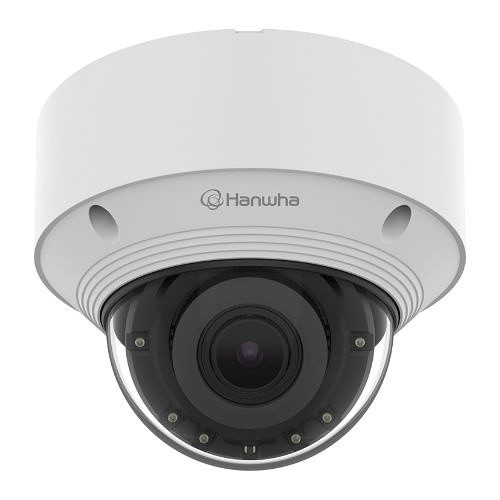
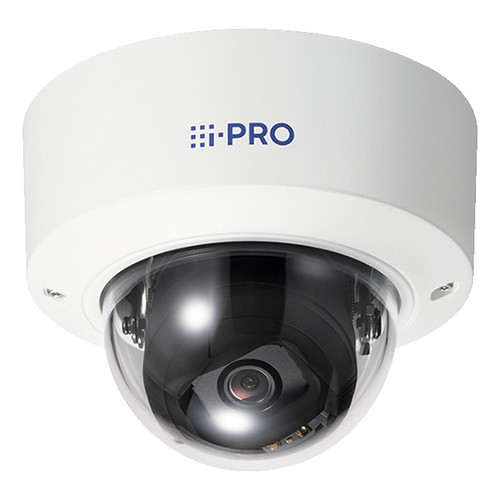
Both the Hanwha QNV-C8083R and the i-PRO WV-S22500-F6L are 5MP fixed dome IP cameras sharing a 1/2.8" CMOS sensor, IK10 vandal resistance, PoE power, onboard IR, H.265 compression, and ONVIF compliance. The key differentiators are deployment environment (outdoor vs. indoor), lens type (motorized varifocal vs. fixed), WDR performance, AI analytics depth, security certification level, and warranty length—factors that matter to integrators sizing cameras for specific site conditions.
In This Guide
How do the imaging specs compare?
The C8083R delivers a native 2592×1944 (5MP 4:3) output at 30fps through a 3.2–10.2mm motorized varifocal lens (3.2× zoom, F1.6–F3.1), giving installers adjustable horizontal fields of view from roughly 95° wide to a narrower tele position without a ladder return. Its WDR is rated at 120dB. Minimum color illumination is 0.07 lux, dropping to 0 lux with its 850nm IR LED rated to 30m. DORI detect range reaches 186.9m at tele. The S22500-F6L outputs up to 3072×2304 (5MP 4:3) or 3072×1728 (16:9) at 30fps through a fixed 3.2mm lens (F1.6, 48° horizontal in 16:9). Its Super Dynamic WDR tops out at 132dB at level 31—12dB above the C8083R. Minimum color illumination is 0.08 lux; B&W drops to 0.07 lux, and 0 lux with IR. IR reach is listed at 25m (30IRE) / 20m (50IRE).
In summary: the S22500-F6L edges the C8083R on peak WDR (132dB vs. 120dB) and maximum native pixel array (3072×2304 vs. 2592×1944), while the C8083R's varifocal lens and longer 30m IR range provide more flexibility on scene coverage distance. The C8083R's DORI performance at tele significantly outranges the fixed-lens S22500-F6L for detection and identification tasks at depth.
What about installation and environment?
The C8083R carries an IP66 weatherproof rating alongside IK10 impact resistance, making it suitable for outdoor perimeter, parking, and facade applications. Operating temperature is −30°C to +55°C, a wide range that covers most North American climates including cold-storage adjacent deployments. It is powered by PoE IEEE 802.3af Class 3 (max 12.95W / typical 5.3W). Physical dimensions are ø140×110.2mm, weight 875g. It includes conduit-compatible gangbox mounting (single, double, 4" octagon) and an optional hanging mount SBP-140HMW.
The S22500-F6L is rated IK10 but carries no IP ingress-protection rating per the provided specs—it is specified as an indoor camera. Operating temperature is −10°C to +50°C (power-on lower limit 0°C), a significantly narrower envelope. It accepts DC 12V or PoE IEEE 802.3af, but is listed as PoE Class 0, meaning it does not advertise a specific class wattage negotiation. Dimensions are ø129.5×102.5mm, weight 800g. The S22500-F6L also provides a BNC composite video output (VBS 1.0V 75Ω) for alignment during installation—a feature absent from the C8083R spec.
Which fits your VMS and analytics better?
Both cameras support ONVIF Profiles S, G, T, and M, ensuring broad VMS compatibility. The C8083R exposes Hanwha's SUNAPI (HTTP API) in addition to ONVIF, integrating natively with Wisenet WAVE and partner platforms. Its edge analytics include AI-classified person and vehicle detection (with vehicle sub-type: car, bus, truck, motorcycle, bicycle), virtual line crossing with direction, virtual area intrusion, loitering, appear/disappear, and business intelligence functions (people counting, queue, heatmap). Smart codec WiseStream III (AI-driven) plus manual ROI coding (5 areas) reduce bandwidth. SD storage supports up to 256GB microSDXC. Security posture includes secure boot, signed firmware, firmware encryption, 802.1X (EAP-TLS/LEAP/PEAP), SRTP, device certificate via Hanwha Private Root CA, and SD card partition encryption.
The S22500-F6L is built on an Ambarella CV22 SoC and adds AI sound classification (gunshot, yell, vehicle horn, glass break) to its AI video analytics (motion, face, vehicle detection). It supports up to 14 simultaneous users vs. the C8083R's 20. Its audio I/O is more fully specified—3.5mm stereo mic input and line output jacks plus half/full-duplex modes, versus the C8083R's optional cable-dependent audio input. The S22500-F6L's security headline is FIPS 140-2 Level 3 certification with NXP SE050F hardware secure element—a hard requirement for some federal and regulated-industry deployments. Edge storage extends to 512GB microSDXC. Protocol support adds SFTP and MQTT, which the C8083R spec does not list.
Which should you choose: the C8083R or the S22500-F6L?
Our take: The C8083R is the stronger choice when the deployment is outdoor, requires a flexible field of view, or needs broader operating temperature coverage. Its motorized 3.2–10.2mm varifocal lens eliminates the fixed-angle constraint of the S22500-F6L's 3.2mm fixed optic, its IP66 rating handles rain and wash-down, and its −30°C lower operating limit covers environments the S22500-F6L's −10°C floor cannot. The S22500-F6L is the stronger choice for indoor high-security or regulated environments: its 132dB Super Dynamic WDR outperforms the C8083R's 120dB by 12dB, it holds a FIPS 140-2 Level 3 hardware security certification the C8083R does not claim, it supports SD cards up to 512GB vs. 256GB, and it carries a 5-year warranty vs. the C8083R's 3-year. Choose the C8083R for outdoor flexibility; choose the S22500-F6L for indoor regulated or mixed-light fixed-angle installations.
Side-by-Side Comparison
Spec-for-spec, from manufacturer data.
| Specification | Hanwha C8083R | i-PRO S22500-F6L |
|---|---|---|
| Resolution (max) | 2592×1944 (5MP 4:3) | 3072×2304 (5MP 4:3) |
| Image Sensor | 1/2.8" CMOS | Approx. 1/2.8" CMOS |
| Lens / Focal Length | 3.2–10.2mm motorized varifocal (3.2×) | 3.2mm fixed |
| Max Aperture | F1.6 (wide) / F3.1 (tele) | F1.6 |
| Horizontal Field of View | 95° (wide) – tele (not specified) | 48° (16:9) |
| Min Illumination (Color) | 0.07 lux | 0.08 lux |
| Min Illumination (IR / B&W) | 0 lux (IR) | 0 lux (IR) |
| IR Range | 30m (850nm) | 25m / 30IRE; 20m / 50IRE (850nm) |
| WDR | 120dB | 132dB (Super Dynamic, level 31) |
| IP / Ingress Rating | IP66 | Not rated (indoor) |
| IK / Impact Rating | IK10 | IK10 |
| Operating Temperature | −30°C to +55°C | −10°C to +50°C (power-on: 0°C min) |
| Power Input / PoE Class | PoE IEEE 802.3af, Class 3 (max 12.95W) | DC 12V or PoE IEEE 802.3af, Class 0 |
| Edge Storage | microSD/SDHC/SDXC up to 256GB | microSDXC up to 512GB |
| Security Certification | Secure boot, signed firmware, 802.1X, device cert | FIPS 140-2 Level 3, NXP SE050F |
| Audio I/O | Mic/line in (optional cable SPP-C7400); line out 0.5Vrms | 3.5mm stereo mic in; 3.5mm stereo line out; half/full duplex |
| AI Analytics | Person/vehicle detection, attributes, line/area events, heatmap, queue, people count | Motion, face, vehicle detection; AI sound classification (gunshot, yell, horn, glass break) |
| ONVIF Profiles | S / G / T / M | G / M / S / T |
| Dimensions | ø140×110.2mm | ø129.5×102.5mm |
| Weight | 875g (1.93 lb) | 800g (1.77 lb) |
| Warranty | 3 years | 5 years |
Frequently Asked Questions
Which should you choose: the C8083R or the S22500-F6L?
The C8083R is the stronger choice when the deployment is outdoor, requires a flexible field of view, or needs broader operating temperature coverage. Its motorized 3.2–10.2mm varifocal lens eliminates the fixed-angle constraint of the S22500-F6L's 3.2mm fixed optic, its IP66 rating handles rain and wash-down, and its −30°C lower operating limit covers environments the S22500-F6L's −10°C floor cannot. The S22500-F6L is the stronger choice for indoor high-security or regulated environments: its 132dB Super Dynamic WDR outperforms the C8083R's 120dB by 12dB, it holds a FIPS 140-2 Level 3 hardware security certification the C8083R does not claim, it supports SD cards up to 512GB vs. 256GB, and it carries a 5-year warranty vs. the C8083R's 3-year. Choose the C8083R for outdoor flexibility; choose the S22500-F6L for indoor regulated or mixed-light fixed-angle installations.
Is the C8083R or S22500-F6L better for low-light outdoor use?
For outdoor low-light, the C8083R is the appropriate choice. It carries an IP66 weatherproof rating and an operating range down to −30°C, neither of which the S22500-F6L provides. Both reach 0 lux with IR active, and their color minimum illumination figures are within 0.01 lux of each other (0.07 vs. 0.08 lux). The C8083R's IR is rated to 30m vs. the S22500-F6L's 25m (30IRE), giving slightly longer reach in darkness.
Which camera has better WDR for lobbies or entry points with mixed sunlight and shadow?
The S22500-F6L's Super Dynamic WDR reaches 132dB (at level 31), compared to the C8083R's 120dB—a 12dB advantage on paper. For a fixed indoor entry point with harsh backlight, the S22500-F6L's WDR ceiling is higher per the provided specifications.
Can either camera be used on a federal government or regulated-industry network requiring FIPS compliance?
Only the S22500-F6L lists FIPS 140-2 Level 3 certification and an NXP SE050F hardware secure element in its specifications. The C8083R's spec sheet does not reference FIPS certification. If FIPS 140-2 compliance is a stated procurement requirement, the S22500-F6L is the only option of these two that addresses it per available spec data.
Get a Second Opinion on Your Camera Choice
Share your site layout, coverage goals, and budget. Our team will validate the camera selection, flag anything we would change, and recommend products that match the use case.