
Hanwha C8083R vs Hanwha XNB-8000: Specification Comparison
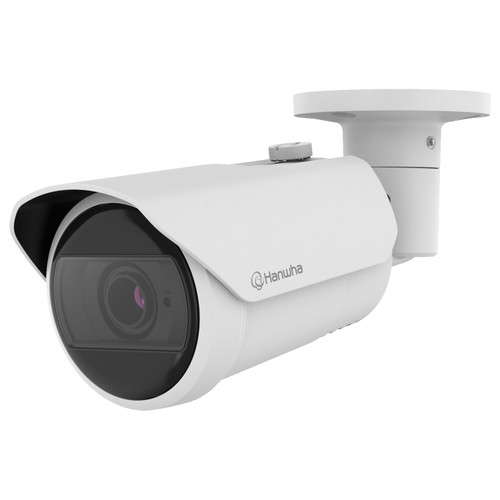
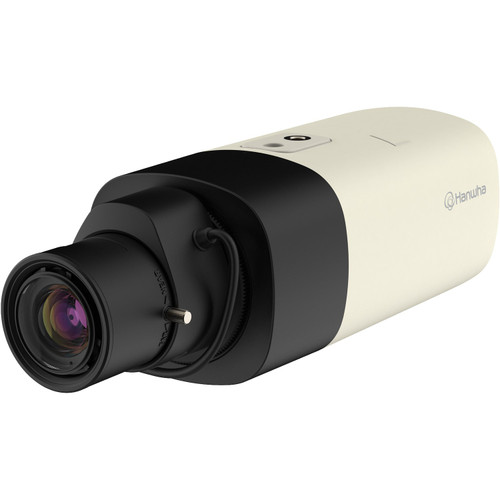
Both the Hanwha QNO-C8083R and the Hanwha XNB-8000 are 5MP outdoor fixed bullet IP cameras built on the Wisenet platform. This comparison examines their sensor size and optics, low-light and IR performance, installation flexibility, operating environment ratings, edge analytics depth, VMS integration, and on-board storage — giving installers and IT buyers the spec-level detail needed to match the right camera to a specific deployment requirement.
In This Guide
How do the imaging specs compare?
The QNO-C8083R uses a 1/2.8" CMOS sensor delivering 2592×1944 at 30fps, paired with a 3.2–10.2mm (3.2×) motorized varifocal lens with a maximum aperture of F1.6 (wide) to F3.1 (tele) and a 95° horizontal field of view at its widest setting. Its built-in 850nm IR illuminators reach 30m (98ft), and minimum illumination is rated at 0.07 lux color / 0 lux IR, meaning it can operate in complete darkness using IR. The XNB-8000 uses a physically larger 1/1.8" 6MP CMOS sensor — a meaningful light-collection advantage — but is specified at 5MP output (2560×1920). It carries no integrated lens (C/CS-mount box form factor), no IR illuminators, and the same 0.07 lux color minimum illumination, dropping to 0.007 lux B/W with IR support dependent on a separately specified lens and illuminator.
WDR performance is identical at 120dB on both cameras. Noise reduction differs: the C8083R adds WiseNRII powered by its onboard AI engine alongside SSNRV, while the XNB-8000 uses SSNRV only. The C8083R also supports SSDR backlight compensation; the XNB-8000 adds HLC (highlight compensation) and includes a built-in gyro sensor for digital image stabilization and a built-in optical defog filter — features absent on the C8083R. The XNB-8000's larger sensor and defog capability make it better suited to wide-area or fog-prone scenes, while the C8083R's integrated motorized varifocal lens and IR make it a self-contained unit requiring no additional optics or illuminators.
What about installation and environment?
The QNO-C8083R is rated IP66 and IK10, confirming dust-tight and waterproof ingress protection plus resistance to 20-joule mechanical impacts — relevant for exposed or vandal-prone mounting positions. It accepts only PoE (IEEE 802.3af, Class 3) with a maximum draw of 12W and typical 5.3W. Operating temperature spans -30°C to +55°C, making it suitable for cold-climate deployments. The camera weighs 930g and measures 93.4×245.8mm in aluminum housing.
The XNB-8000 is described as 'outdoor certified' but no explicit IP or IK rating is stated in the provided specifications. It is significantly lighter at 420g and more compact at 73.1×66.6×147.8mm in a plastic body. Power options are broader: PoE (IEEE 802.3af, Class 3), 24VAC, or 12VDC, with a maximum draw of 8.5W — useful where PoE infrastructure is unavailable. Operating temperature is -10°C to +55°C, a narrower cold-side range than the C8083R. It also adds an RS-485 serial interface for PTZ or accessory control, and a CVBS analog video output for installation alignment alongside the shared Micro USB output. The C8083R's confirmed IP66/IK10 rating and lower cold-limit give it a measurable environmental durability advantage.
Which fits your VMS and analytics better?
The QNO-C8083R supports ONVIF Profile S/G/T/M — the addition of Profile M enables metadata streaming for AI-driven analytics events within conformant VMS platforms. Its analytics engine, built on an onboard AI processor, classifies objects as Person or Vehicle (with vehicle sub-types: car, bus, truck, motorcycle, bicycle), and supports virtual line crossing with direction, virtual area loitering/intrusion/enter/exit, people counting, vehicle counting, queue management, and heatmap. Smart codec uses WiseStreamIII. The XNB-8000 supports ONVIF Profile S/G/T (no Profile M) and analytics are limited to motion detection, loitering, directional detection, fog detection, digital auto-tracking, sound classification, and handover — no AI-based object classification or business intelligence functions. Smart codec uses WiseStreamII. The C8083R also adds CDP network protocol; the XNB-8000 explicitly lists Wisenet open platform support, which is absent from the C8083R's listed APIs.
On-board storage: the XNB-8000 offers two Micro SD slots supporting up to 512GB total, versus a single slot and 256GB on the C8083R — a practical advantage for extended edge recording without NAS. The C8083R carries 2GB RAM and 1GB flash; the XNB-8000 has 1GB RAM and 256MB flash, reflecting the AI processing headroom on the C8083R. Audio output maximum level is 1Vrms on the XNB-8000 versus 0.5Vrms on the C8083R. The XNB-8000 supports up to 10 streaming profiles versus 5 on the C8083R. Security hardening on the C8083R is more extensive, adding secure boot, signed/encrypted firmware, AES data encryption, SD card partition encryption, device certificate (Hanwha Private Root CA), and SRTP with WSS — versus the XNB-8000's standard HTTPS, digest auth, IP filtering, and 802.1X.
Which should you choose: the C8083R or the XNB-8000?
Our take: The C8083R is the stronger choice when a self-contained, AI-analytics-capable outdoor bullet is required — particularly in cold climates, vandal-exposed sites, or deployments running a Profile-M VMS. Key spec deltas: the C8083R adds IK10 impact rating and a confirmed IP66 seal versus no stated IK/IP rating on the XNB-8000; its operating temperature floor is -30°C versus -10°C; and its AI engine delivers full object classification (Person/Vehicle sub-types), virtual line/area events, people counting, and queue management that the XNB-8000 does not support. The XNB-8000 is the stronger choice when optics flexibility matters — its C/CS-mount accepts specialty lenses, its larger 1/1.8" sensor gathers more light, dual SD slots extend edge recording to 512GB, and multi-voltage power (PoE/24VAC/12VDC) simplifies retrofit sites. Choose the C8083R for integrated AI analytics and harsh environments; choose the XNB-8000 for lens-flexible, high-capacity edge recording deployments.
Side-by-Side Comparison
Spec-for-spec, from manufacturer data.
| Specification | Hanwha C8083R | Hanwha XNB-8000 |
|---|---|---|
| Sensor Size | 1/2.8" CMOS | 1/1.8" CMOS |
| Resolution | 2592×1944 (5MP) | 2560×1920 (5MP) |
| Max Framerate | 30fps @ 5MP | 30fps |
| Lens Type | 3.2–10.2mm motorized varifocal (3.2×), built-in | C/CS-mount, no lens included |
| Max Aperture | F1.6 (wide) / F3.1 (tele) | — |
| IR Illumination | 850nm, 30m (98ft) | — |
| Min. Illumination | 0.07 lux color / 0 lux IR | 0.07 lux color / 0.007 lux B/W |
| Wide Dynamic Range | 120dB | 120dB |
| AI Analytics | Person/Vehicle classification, virtual line/area, people counting, queue mgmt, heatmap | Motion, loitering, directional, fog detection, auto-tracking, sound classification |
| ONVIF Profiles | S/G/T/M | S/G/T |
| Edge Storage | 1× Micro SD, max 256GB | 2× Micro SD, max 512GB |
| RAM / Flash | 2GB RAM / 1GB Flash | 1GB RAM / 256MB Flash |
| Power Input | PoE IEEE 802.3af (Class 3) only | PoE IEEE 802.3af (Class 3), 24VAC, 12VDC |
| Max Power Draw | 12W (typical 5.3W) | 8.5W |
| Operating Temperature | -30°C to +55°C | -10°C to +55°C |
| Ingress / Impact Rating | IP66, IK10 | Outdoor certified (IP/IK not specified) |
Frequently Asked Questions
Which should you choose: the C8083R or the XNB-8000?
The C8083R is the stronger choice when a self-contained, AI-analytics-capable outdoor bullet is required — particularly in cold climates, vandal-exposed sites, or deployments running a Profile-M VMS. Key spec deltas: the C8083R adds IK10 impact rating and a confirmed IP66 seal versus no stated IK/IP rating on the XNB-8000; its operating temperature floor is -30°C versus -10°C; and its AI engine delivers full object classification (Person/Vehicle sub-types), virtual line/area events, people counting, and queue management that the XNB-8000 does not support. The XNB-8000 is the stronger choice when optics flexibility matters — its C/CS-mount accepts specialty lenses, its larger 1/1.8" sensor gathers more light, dual SD slots extend edge recording to 512GB, and multi-voltage power (PoE/24VAC/12VDC) simplifies retrofit sites. Choose the C8083R for integrated AI analytics and harsh environments; choose the XNB-8000 for lens-flexible, high-capacity edge recording deployments.
Can the QNO-C8083R work in complete darkness without adding external lights?
Yes. The C8083R has built-in 850nm IR LEDs rated to 30m (98ft) and a minimum illumination of 0 lux in IR mode, so it can produce a usable image in total darkness without any external illumination. The XNB-8000 has no integrated IR; low-light performance depends entirely on the lens and any external illuminators installed.
Does either camera support ONVIF metadata streaming for AI events to a VMS?
Only the QNO-C8083R supports ONVIF Profile M, which is the profile that carries structured metadata (object classifications, event attributes) to a compatible VMS. The XNB-8000 supports Profile S, G, and T but not Profile M, so its analytics events cannot be consumed as structured ONVIF metadata.
Which camera gives more edge recording capacity, and does it matter for failover?
The XNB-8000 supports two Micro SD/SDHC/SDXC slots with a combined maximum of 512GB, versus a single slot capped at 256GB on the QNO-C8083R. For sites where NAS is unavailable or network failover recording depth is a priority, the XNB-8000's dual-slot design provides up to twice the on-camera buffer capacity.
Get a Second Opinion on Your Camera Choice
Share your site layout, coverage goals, and budget. Our team will validate the camera selection, flag anything we would change, and recommend products that match the use case.