
Hanwha C8083R vs Hanwha QNO-8010R: Specification Comparison
Both the Hanwha QNO-C8083R and QNO-8010R are 5MP outdoor IP bullet cameras sharing the same 1/2.8" CMOS sensor, 2592×1944 resolution, and IP66/IK10-rated aluminum housings — a pairing installers genuinely cross-shop for perimeter and parking-lot applications. The key differentiators are the C8083R's motorized varifocal lens and AI-engine analytics versus the QNO-8010R's simpler fixed lens and conventional analytics, along with meaningful differences in IR range, streaming capacity, edge storage, and on-board memory.
In This Guide
How do the imaging specs compare?
Both cameras share a 1/2.8" CMOS sensor outputting 2592×1944 at 30fps, and both deliver 120dB WDR. Low-light performance diverges: the QNO-C8083R specifies a minimum color illumination of 0.07 Lux versus 0.15 Lux for the QNO-8010R, giving the C8083R a measurable edge in dim-light color imaging before IR kicks in. IR range also differs significantly — the C8083R illuminates to 30m (98.4ft) while the QNO-8010R reaches 20m (65.6ft), a 50% advantage for the C8083R in longer corridors or deeper parking rows.
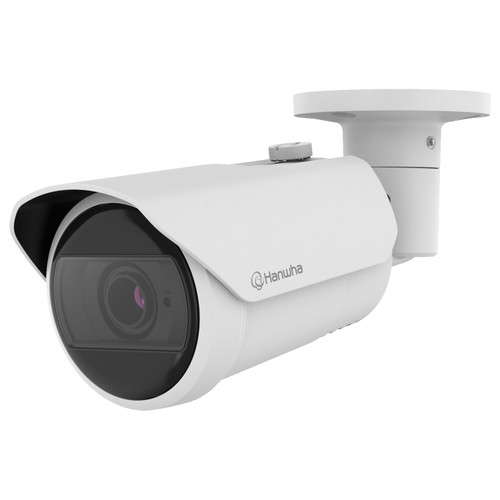
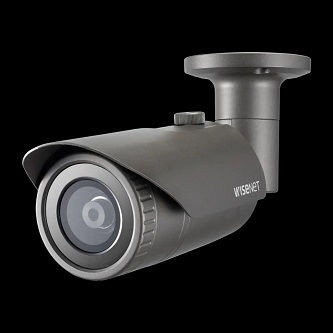
The lens architectures are fundamentally different. The QNO-C8083R uses a 3.2–10.2mm (3.2×) motorized varifocal lens with a maximum aperture of F1.6 at wide end, allowing remote zoom adjustment and a horizontal field of view that spans 95° (wide) down to approximately 29° (tele). The QNO-8010R uses a fixed 2.8mm lens at F2.0 with a fixed 105° horizontal field of view. The C8083R's wider maximum aperture (F1.6 vs F2.0) also contributes to its lower minimum illumination. Digital noise reduction differs as well: the C8083R specifies SSNRⅤ plus AI-based WiseNRⅡ, while the QNO-8010R specifies SSNR only.
What about installation and environment?
Both cameras carry IP66 and IK10 ratings and are powered by PoE IEEE 802.3af Class 3, making them compatible with standard PoE switches. Power budgets differ: the QNO-C8083R draws a maximum of 12W (typical 5.3W) versus the QNO-8010R's maximum 7.5W (typical 6.1W) — the C8083R's motorized lens accounts for the higher ceiling. Operating temperature range is identical at -30°C to +55°C for both. Storage temperature differs slightly: the C8083R is rated to -50°C storage versus -30°C for the QNO-8010R, relevant for shipment or warehouse storage in cold climates.
The two cameras differ in physical footprint. The QNO-C8083R measures ø93.4×245.8mm and weighs 930g (2.05 lb), while the QNO-8010R is more compact at ø70.0×246.0mm and lighter at 680g (1.50 lb). The C8083R ships in RAL9003 white aluminum; the QNO-8010R spec lists dark grey aluminum (though its product-level Housing Color field reads 'White' — installers should verify the shipping unit color with the vendor). The C8083R adds a Micro USB Type B video-out port for on-site focus verification at 1280×720; the QNO-8010R uses a CVBS composite output (720×480/576) for the same purpose. Each model has its own recommended backbox (SBO-140BW for the C8083R; SBO-100B1 for the QNO-8010R).
Which fits your VMS and analytics better?
Both cameras support ONVIF Profile S/G/T and Hanwha's SUNAPI HTTP API. The QNO-8010R additionally lists Wisenet Open Platform support in its spec sheet, which the C8083R spec does not explicitly mention. The QNO-C8083R supports ONVIF Profile M (metadata), which the QNO-8010R does not list — Profile M is required for standardized AI metadata streaming to compatible VMS platforms. Streaming capacity also differs: the C8083R supports up to 20 unicast users and 5 simultaneous stream profiles, versus 6 unicast users and 3 profiles for the QNO-8010R — a meaningful difference in multi-VMS or multi-client deployments.
Analytics depth is a major differentiator. The QNO-C8083R runs an AI engine that classifies objects as Person or Vehicle (with vehicle sub-type: car/bus/truck/motorcycle/bicycle), supports virtual line and virtual area events, and adds business intelligence functions including people counting, vehicle counting, queue management, and heatmap. Motion detection covers 8 polygonal zones (8-point) and privacy masking supports 32 zones. The QNO-8010R provides conventional analytics — motion detection (4 polygonal zones), tampering, defocus detection, virtual area (intrusion/enter/exit), and virtual line — with no AI classification or business intelligence. Audio support is present on the C8083R (selectable mic/line in; line out at 0.5Vrms max) but is not listed in the QNO-8010R's spec sheet. Edge storage also differs: the C8083R supports up to 256GB microSD versus 128GB for the QNO-8010R, and on-board RAM is 2GB (C8083R) versus 512MB (QNO-8010R). Security posture differs at firmware level: the C8083R adds Secure Boot and Signed Firmware on top of the firmware encryption both cameras share.
Which should you choose: the C8083R or the QNO-8010R?
Our take: The QNO-C8083R is the stronger choice when lens flexibility, AI analytics, or extended IR reach are project requirements. Concretely: its motorized 3.2–10.2mm varifocal lens eliminates the need for a site revisit to adjust field of view, a fixed-install advantage over the QNO-8010R's 2.8mm fixed lens. Its IR range of 30m versus 20m covers 50% more depth, and its minimum color illumination of 0.07 Lux versus 0.15 Lux improves pre-IR color imaging in marginal light. AI-based Person/Vehicle classification with business-intelligence overlays (people counting, queue management, heatmap) and ONVIF Profile M metadata streaming are available on the C8083R only. The QNO-8010R is appropriate where field of view is fixed at wide-angle, analytics needs are basic, power budgets are tighter (7.5W max vs 12W max), or a smaller, lighter housing (680g vs 930g) is required. Both carry a 3-year warranty and identical IP66/IK10/PoE Class 3 infrastructure requirements.
Side-by-Side Comparison
Spec-for-spec, from manufacturer data.
| Specification | Hanwha C8083R | Hanwha QNO-8010R |
|---|---|---|
| Resolution | 2592×1944 (5MP) | 2592×1944 (5MP) |
| Image Sensor | 1/2.8" CMOS | 1/2.8" CMOS |
| Lens / Focal Length | 3.2–10.2mm motorized varifocal (3.2×) | 2.8mm fixed |
| Max. Aperture | F1.6 (Wide) / F3.1 (Tele) | F2.0 |
| Horizontal Field of View | 95° (Wide) to ~29° (Tele) | 105° |
| Min. Illumination (Color) | 0.07 Lux | 0.15 Lux |
| IR Range | 30m (98.4ft) / 850nm | 20m (65.6ft) / 850nm |
| Wide Dynamic Range | 120dB | 120dB |
| Max. Frame Rate | 30fps @ 5MP | 30fps @ 5MP |
| Video Compression | H.265 / H.264 / MJPEG | H.265 / H.264 / MJPEG |
| Smart Codec | WiseStreamⅢ (AI-based) | WiseStreamⅡ |
| Simultaneous Streams / Unicast Users | 5 profiles / 20 users | 3 profiles / 6 users |
| AI / Analytics | AI Person/Vehicle classification; virtual line/area; people counting; vehicle counting; queue management; heatmap | Motion; tampering; defocus; virtual line/area (no AI classification) |
| ONVIF Profiles | S / G / T / M | S / G / T |
| Audio | Mic/line in; line out (0.5Vrms) | Not specified |
| Edge Storage | microSD up to 256GB | microSD up to 128GB |
| On-board RAM / Flash | 2GB RAM / 1GB Flash | 512MB RAM / 256MB Flash |
| IP Rating | IP66 | IP66 |
| Impact Rating | IK10 | IK10 |
| Operating Temperature | -30°C to +55°C | -30°C to +55°C |
| Storage Temperature | -50°C to +60°C | -30°C to +60°C |
| Power Input / PoE Class | PoE IEEE 802.3af / Class 3 | PoE IEEE 802.3af / Class 3 |
| Max. Power Draw | 12W | 7.5W |
| Alarm I/O | 1 input / 1 output | 1 input / 1 output |
| Dimensions | ø93.4×245.8mm | ø70.0×246.0mm |
| Weight | 930g (2.05 lb) | 680g (1.50 lb) |
| Housing Color / Material | White / Aluminum (RAL9003) | Dark grey / Aluminum |
| Warranty | 3 years | 3 years |
Frequently Asked Questions
Which should you choose: the C8083R or the QNO-8010R?
The QNO-C8083R is the stronger choice when lens flexibility, AI analytics, or extended IR reach are project requirements. Concretely: its motorized 3.2–10.2mm varifocal lens eliminates the need for a site revisit to adjust field of view, a fixed-install advantage over the QNO-8010R's 2.8mm fixed lens. Its IR range of 30m versus 20m covers 50% more depth, and its minimum color illumination of 0.07 Lux versus 0.15 Lux improves pre-IR color imaging in marginal light. AI-based Person/Vehicle classification with business-intelligence overlays (people counting, queue management, heatmap) and ONVIF Profile M metadata streaming are available on the C8083R only. The QNO-8010R is appropriate where field of view is fixed at wide-angle, analytics needs are basic, power budgets are tighter (7.5W max vs 12W max), or a smaller, lighter housing (680g vs 930g) is required. Both carry a 3-year warranty and identical IP66/IK10/PoE Class 3 infrastructure requirements.
Is the QNO-C8083R or QNO-8010R better for low-light performance?
The QNO-C8083R specifies a lower minimum color illumination — 0.07 Lux versus 0.15 Lux on the QNO-8010R — and extends IR illumination to 30m compared to 20m on the QNO-8010R. On both counts the C8083R has the specified advantage for dim or zero-light operation.
Can I adjust the zoom on either camera without a site visit?
Only the QNO-C8083R supports remote zoom adjustment — it uses a 3.2–10.2mm motorized varifocal lens controllable via the camera interface. The QNO-8010R has a fixed 2.8mm lens; field of view is set at installation and cannot be changed remotely.
Does either camera support audio, and which has more edge storage?
Audio input and output are specified for the QNO-C8083R (selectable mic/line in; 0.5Vrms line out). The QNO-8010R's spec sheet does not list audio capability. For edge storage, the QNO-C8083R supports up to 256GB microSD versus 128GB on the QNO-8010R.
Get a Second Opinion on Your Camera Choice
Share your site layout, coverage goals, and budget. Our team will validate the camera selection, flag anything we would change, and recommend products that match the use case.