
Hanwha C8012 vs i-PRO X25500-V3LN: Specification Comparison
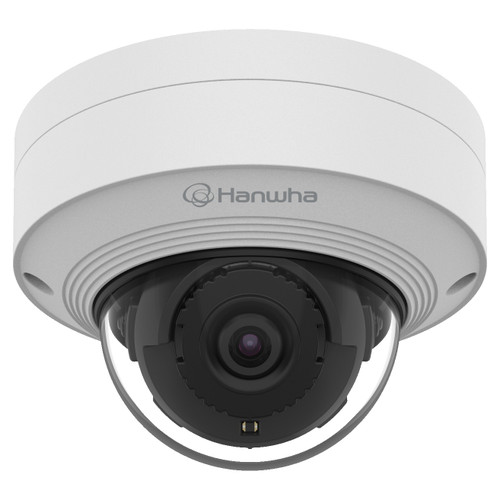
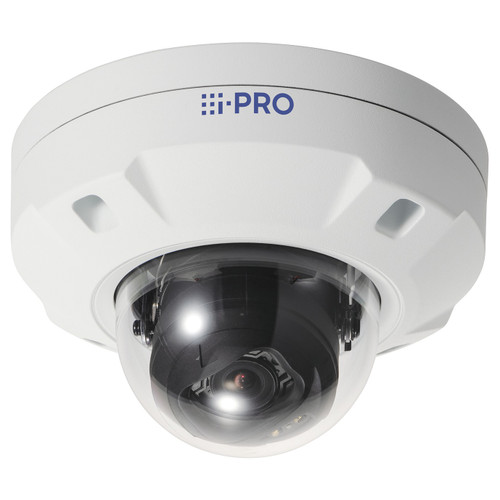
Both the Hanwha QNV-C8012 and the i-PRO WV-X25500-V3LN are 5MP outdoor AI dome cameras targeting perimeter and general-purpose surveillance. They share the same sensor class (1/2.8" CMOS), the same camera form factor, and overlap in ONVIF compatibility and edge analytics — making them a legitimate cross-shop for integrators evaluating fixed outdoor domes in the 5MP tier. The key differentiators are lens type (fixed vs. motorized varifocal), IR range, WDR depth, PoE class, and the breadth of embedded AI functions.
In This Guide
How do the imaging specs compare?
The QNV-C8012 uses a fixed 2.4mm F2.0 lens delivering a wide 123° horizontal field of view at 2592×1944 resolution (30 fps), suited to wide-area coverage without repositioning. Minimum illumination is 0.05 Lux color / 0.005 Lux B/W, and WDR is rated at 120 dB via SSDR. There is no IR range figure specified beyond a 0.5m minimum object distance with IR noted; no maximum IR throw distance is provided in the supplied specs. The WV-X25500-V3LN pairs a 3.1x motorized varifocal lens (2.9–9mm, F1.3 wide to F2.5 tele) with the same 1/2.8" CMOS sensor, offering 33–103° horizontal FOV at up to 3072×2304 (4:3) or 3072×1728 (16:9). Minimum illumination is 0.02 Lux B/W with IR active, and Super Dynamic WDR reaches a specified 132 dB at maximum level — both figures exceeding the C8012's published ratings.
DORI performance illustrates the lens advantage clearly: the C8012 achieves detection at 28.1m and identification at 2.8m from its fixed 2.4mm lens. The X25500-V3LN reaches detection at 48.9m (WIDE) / 207.4m (TELE) and identification at 4.9m (WIDE) / 20.7m (TELE), with a specified IR throw of 70m. The i-PRO unit also includes image stabilization (available in 30 fps mode) and fog compensation — neither feature is listed in the C8012's specifications. The C8012's wider fixed FOV is better suited to short-range, broad-coverage deployments; the X25500-V3LN's motorized zoom and longer DORI distances favor perimeter corridors and scenes requiring focal-length flexibility post-installation.
What about installation and environment?
Both cameras are rated IP66, IK10, and NEMA 4X, and both operate from -40°C to +55°C. The i-PRO adds IP67 and specifies wind resistance up to 40 m/s (~89 mph) — neither the IP67 rating nor a wind resistance figure appears in the Hanwha specs. The C8012 draws a maximum of 7W via PoE IEEE 802.3af (Class 3). The X25500-V3LN requires PoE+ (IEEE 802.3at, Class 4) at up to 14.2W maximum — roughly double the power budget — which affects switch port selection and budget. The C8012 is significantly more compact (ø110×77mm, 522g / 1.15 lb) versus the X25500-V3LN (ø154×105mm, 1.1kg / 2.43 lb), a practical consideration for junction-box mounting or aesthetic constraints. The C8012 lists a compatible back box (SBV-140BW) and hanging mount (SBP-120HMW) sold separately; i-PRO mounting accessories are not enumerated in the supplied spec data.
Which fits your VMS and analytics better?
Both cameras support ONVIF Profiles S, G, T, and M, and both encode H.265, H.264, and MJPEG with CBR/VBR control. The C8012 supports up to 20 unicast users across 5 simultaneous stream profiles; the X25500-V3LN supports up to 14 simultaneous users. The C8012's edge storage tops out at 256GB microSD; the X25500-V3LN supports up to 512GB microSDXC. The C8012 provides no audio input or output per the supplied specifications. The X25500-V3LN includes a 3.5mm stereo audio input, 3.5mm audio output, and supports G.726, G.711, and AAC-LC compression, plus AI sound classification (gunshot, yell, vehicle horn, glass break) — a meaningful differentiator for sites requiring audio detection.
On-camera AI differs in focus: the C8012 offers person/vehicle classification, virtual line and area crossing, people/vehicle counting, queue management, and heatmap generation — including WiseStream III AI-based codec optimization. The X25500-V3LN specifies 8 AI detection types (specific types not fully enumerated in the supplied data beyond VMD, SCD, audio detection, and AI sound classification) and lists facial recognition in the attribute data. The C8012 exposes SUNAPI (HTTP API) alongside ONVIF; the i-PRO adds MQTT and SFTP protocol support. Security hardening is present on both: secure boot and signed firmware are confirmed on both; the C8012 additionally specifies SD card partition encryption and 802.1X EAP-TLS/LEAP/PEAP.
Which should you choose: the C8012 or the X25500-V3LN?
Our take: The QNV-C8012 is the stronger choice when the deployment calls for wide-area, short-range coverage on a standard PoE (802.3af) budget with embedded business intelligence analytics such as heatmaps and queue management. Its 123° fixed FOV, 7W max draw, and compact 522g form factor reduce infrastructure cost and simplify mounting. The WV-X25500-V3LN is the stronger choice when scene geometry requires focal-length flexibility after installation: its 3.1x motorized varifocal lens (2.9–9mm) extends DORI detection to 207.4m at tele versus the C8012's 28.1m, IR throws 70m versus no rated throw on the C8012, and WDR reaches 132 dB versus 120 dB. The i-PRO also adds built-in audio I/O with AI sound classification and doubles the edge storage ceiling to 512GB. It requires PoE+ (Class 4, 14.2W) and is heavier (1.1kg vs 0.52kg). Choose the C8012 for retail or interior-perimeter wide-angle analytics; choose the X25500-V3LN for long-range perimeter or corridor applications where zoom, audio, and IR throw are priorities.
Side-by-Side Comparison
Spec-for-spec, from manufacturer data.
| Specification | Hanwha C8012 | i-PRO X25500-V3LN |
|---|---|---|
| Resolution | 2592×1944 (5MP) | 3072×2304 (4:3) / 3072×1728 (16:9) (5MP) |
| Image Sensor | 1/2.8" CMOS | Approx. 1/2.8" CMOS |
| Lens / Focal Length | 2.4mm fixed, F2.0 | 2.9–9mm motorized varifocal, F1.3 (W) – F2.5 (T) |
| Optical Zoom | — | 3.1x (motorized) |
| Horizontal FOV | 123° | 33°–103° |
| Min. Illumination (B/W) | 0.005 Lux (B/W) | 0.02 Lux (B/W, IR LED) |
| IR Range | Not specified (max throw) | 70m (230 ft) |
| WDR | 120 dB (SSDR) | 132 dB (Super Dynamic, level 31) |
| Max Frame Rate | 30 fps @ 5MP | 30 fps |
| Video Compression | H.265, H.264, MJPEG | H.265, H.264, MJPEG |
| IP Rating | IP66, NEMA 4X | IP66, IP67, NEMA 4X |
| IK / Impact Rating | IK10 | IK10 (50J, IEC 60068-2-75) |
| Operating Temperature | -40°C to +55°C | -40°C to +55°C (Power On: -30°C to +55°C) |
| Power Input / PoE Class | PoE 802.3af, Class 3, max 7W | PoE+ 802.3at, Class 4, max 14.2W |
| Edge Storage | microSD up to 256GB | microSDXC up to 512GB |
| Audio | — | 3.5mm input + 3.5mm output; G.726, G.711, AAC-LC |
| AI Analytics | Person/Vehicle, counting, heatmap, queue, virtual line/area | 8 detection types; AI sound classification (gunshot, yell, horn, glass break) |
| ONVIF Profiles | S, G, T, M | G, S, T, M |
| Simultaneous Users | 20 (unicast) | Up to 14 |
| Dimensions | ø110×77mm (ø4.33×3.03") | ø154×105mm (ø6-1/16×4-1/8") |
| Weight | 522g (1.15 lb) | 1.1 kg (2.43 lb) |
| Warranty | 3-year | 5-year |
Frequently Asked Questions
Which should you choose: the C8012 or the X25500-V3LN?
The QNV-C8012 is the stronger choice when the deployment calls for wide-area, short-range coverage on a standard PoE (802.3af) budget with embedded business intelligence analytics such as heatmaps and queue management. Its 123° fixed FOV, 7W max draw, and compact 522g form factor reduce infrastructure cost and simplify mounting. The WV-X25500-V3LN is the stronger choice when scene geometry requires focal-length flexibility after installation: its 3.1x motorized varifocal lens (2.9–9mm) extends DORI detection to 207.4m at tele versus the C8012's 28.1m, IR throws 70m versus no rated throw on the C8012, and WDR reaches 132 dB versus 120 dB. The i-PRO also adds built-in audio I/O with AI sound classification and doubles the edge storage ceiling to 512GB. It requires PoE+ (Class 4, 14.2W) and is heavier (1.1kg vs 0.52kg). Choose the C8012 for retail or interior-perimeter wide-angle analytics; choose the X25500-V3LN for long-range perimeter or corridor applications where zoom, audio, and IR throw are priorities.
Is the QNV-C8012 or WV-X25500-V3LN better for low-light performance?
Based on the provided specifications, the WV-X25500-V3LN has a lower minimum illumination figure (0.02 Lux B/W with IR) compared to the QNV-C8012 (0.005 Lux B/W). Note that these figures may reflect different measurement conditions. The X25500-V3LN also specifies a 70m IR throw distance; no maximum IR range is stated in the Hanwha spec data. The X25500-V3LN also has a wider maximum aperture at the wide end (F1.3 vs F2.0), which admits more light.
Can I power the QNV-C8012 and WV-X25500-V3LN from the same PoE switch?
Not necessarily from the same port type. The QNV-C8012 requires standard PoE (IEEE 802.3af, Class 3, max 7W), which is supported by any 802.3af or 802.3at switch port. The WV-X25500-V3LN requires PoE+ (IEEE 802.3at, Class 4, max 14.2W); it will not operate correctly on a port limited to 802.3af (15.4W budget). Verify that your switch has sufficient 802.3at ports and total power budget before deploying the X25500-V3LN.
Which camera is better suited for retail business intelligence use cases like people counting and heatmaps?
The QNV-C8012 explicitly lists People/Vehicle Counting, Queue Management, and Heatmap generation under its Business Intelligence specifications, driven by its onboard AI engine. The WV-X25500-V3LN's supplied specifications do not list heatmap or queue management functions. If those specific analytics are required at the edge without a separate VMS license, the QNV-C8012 is the documented choice based on the specs provided.
Get a Second Opinion on Your Camera Choice
Share your site layout, coverage goals, and budget. Our team will validate the camera selection, flag anything we would change, and recommend products that match the use case.