
Hanwha C8012 vs i-PRO S22500-F6L: Specification Comparison
Both the Hanwha QNV-C8012 and i-PRO WV-S22500-F6L are 5-megapixel fixed-lens IP dome cameras aimed at professional security installations. The QNV-C8012 is rated for outdoor use with wide-angle coverage, while the WV-S22500-F6L is an indoor vandal-resistant unit with a narrower field of view and AI-enhanced audio analytics. This comparison evaluates imaging performance, deployment environment, and systems-integration fit to help integrators determine which camera best suits a given project scope.
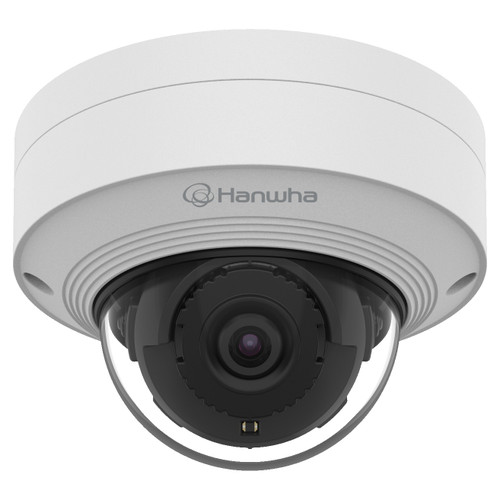
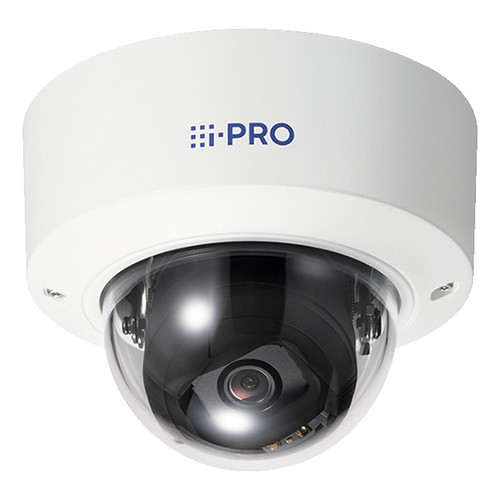
In This Guide
How do the imaging specs compare?
The QNV-C8012 delivers 2592×1944 pixels through a 2.4mm F2.0 lens, producing a 123° horizontal field of view suited to wide-area coverage. Its minimum color illumination is 0.05 Lux, dropping to 0.005 Lux in B/W mode with built-in IR, and WDR is rated at 120dB. The WV-S22500-F6L outputs a higher pixel count at 3072×2304 (4:3) or 3072×1728 (16:9) through a 3.2mm F1.6 lens, yielding a 48° horizontal FOV in 16:9 mode. Its F1.6 aperture is a full stop wider than the C8012's F2.0, and minimum color illumination is rated at 0.08 Lux (30IRE), with B/W at 0.07 Lux. Both cameras use approximately 1/2.8" CMOS sensors and run at 30fps.
WDR performance favors the WV-S22500-F6L at up to 132dB versus the C8012's 120dB, a 12dB advantage that can matter in high-contrast scenes such as entryways with bright backlighting. IR range on the WV-S22500-F6L is specified at 25m (30IRE) or 20m (50IRE), while the C8012's IR is not given a discrete range figure — only that it reaches 0.005 Lux B/W. DORI distances strongly favor the WV-S22500-F6L (Detect: 138m, Identify: 13.8m) over the C8012 (Detect: 28.1m, Identify: 2.8m), reflecting the narrower, longer-reaching 3.2mm lens versus the C8012's ultra-wide 2.4mm optic.
What about installation and environment?
The QNV-C8012 is rated IP66, IK10, and NEMA4X, with an operating temperature of −40°C to +55°C and humidity tolerance of 0–95% RH, making it suitable for exposed outdoor locations including extreme cold. It draws up to 7W over IEEE 802.3af Class 3 PoE. Its compact form factor (ø110×77mm, 522g) simplifies surface and pendant mounting. Physical pan/tilt/rotate adjustment ranges are 0–350° / −35°–70° / 0–355°.
The WV-S22500-F6L carries no outdoor IP rating; it is specified for indoor use only. Its IK10 impact rating matches the C8012. Operating temperature is −10°C to +50°C (power-on: 0 to +50°C), and humidity is 10–90% RH (no condensation), markedly narrower environmental envelopes than the C8012. It accepts IEEE 802.3af PoE (Class 0) or DC12V at 880mA. Its larger body (ø129.5×102.5mm, 800g) and aluminum die-cast housing add mass. Three hardware alarm I/O terminals and one AUX OUT, plus a composite video monitor output, provide on-site wiring options not present on the C8012.
Which fits your VMS and analytics better?
Both cameras support ONVIF Profiles G, M, S, and T, H.265/H.264/MJPEG compression, and SNMP v1/v2/v3. The WV-S22500-F6L adds MQTT and SFTP protocol support not listed for the C8012. The C8012 supports up to 20 simultaneous unicast streams versus the WV-S22500-F6L's 14, a consideration for large NVR or multi-client deployments. Edge storage capacity is 512GB SDXC on the WV-S22500-F6L versus 256GB on the C8012.
Analytics differ in scope: the C8012 offers person/vehicle detection, virtual line, virtual area, motion detection, people/vehicle counting, queue management, and heatmap — a broader suite for retail and traffic analytics. The WV-S22500-F6L includes AI motion detection, face detection, vehicle detection, and AI Sound Classification (gunshot, yell, vehicle horn, glass break), unique to the i-PRO unit and relevant to courtrooms, schools, or facilities requiring audio event detection. The WV-S22500-F6L also provides full-duplex audio I/O via dual 3.5mm jacks; the C8012 does not list audio capability. Security posture on the WV-S22500-F6L includes FIPS 140-2 Level 3 with NXP SE050F hardware security element, exceeding the C8012's secure boot, signed firmware, and 802.1X stack.
Which should you choose: the C8012 or the S22500-F6L?
Our take: The QNV-C8012 is the stronger choice when the deployment is outdoors, covers wide open areas, or must endure temperatures below −10°C, whereas the WV-S22500-F6L is the stronger choice for indoor, high-security environments requiring audio analytics or hardened cryptographic compliance. Three concrete spec deltas: the C8012's 123° HFOV versus the WV-S22500-F6L's 48° HFOV means roughly 2.5× more scene width per camera, while the WV-S22500-F6L's 132dB WDR versus 120dB and F1.6 versus F2.0 aperture give it a low-light and contrast edge in controlled interior conditions. The WV-S22500-F6L's FIPS 140-2 Level 3 certification meets federal and regulated-industry cybersecurity requirements the C8012 does not address. Choose the C8012 for outdoor perimeter and wide-area coverage; choose the WV-S22500-F6L for indoor applications where audio forensics, higher DORI reach on a narrow field, or government-grade cyber compliance are required.
Side-by-Side Comparison
Spec-for-spec, from manufacturer data.
| Specification | Hanwha C8012 | i-PRO S22500-F6L |
|---|---|---|
| Resolution | 2592×1944 (5MP) | 3072×2304 (4:3) / 3072×1728 (16:9) (5MP) |
| Image Sensor | 1/2.8" CMOS | Approx. 1/2.8" CMOS |
| Focal Length / Aperture | 2.4mm / F2.0 | 3.2mm / F1.6 |
| Horizontal FOV | 123° | 48° (16:9) |
| Min Illumination (Color) | 0.05 Lux | 0.08 Lux (30IRE, F1.6, 1/30s) |
| Min Illumination (B/W) | 0.005 Lux | 0.07 Lux; 0 Lux with IR |
| IR Range | Not specified (built-in IR; 0.005 Lux B/W) | 25m (30IRE) / 20m (50IRE) |
| WDR | 120dB | Up to 132dB |
| Max Frame Rate | 30fps @ 5MP | 30fps |
| Video Compression | H.265 / H.264 / MJPEG | H.265 / H.264 / MJPEG |
| IP Rating | IP66 / NEMA4X | Indoor only — no outdoor IP rating specified |
| IK / Impact Rating | IK10 | IK10 |
| Operating Temperature | -40°C to +55°C | -10°C to +50°C (power-on: 0 to +50°C) |
| Power Input / PoE Class | IEEE 802.3af Class 3 (max 7W) | IEEE 802.3af Class 0; DC12V 880mA also supported |
| Edge Storage | MicroSD/SDHC/SDXC up to 256GB | MicroSDXC up to 512GB |
| Audio | — | Mic in + Audio out (3.5mm jacks); half/full duplex |
| Alarm I/O | — | 3x Alarm IN/OUT; 1x AUX OUT |
| ONVIF Profiles | S / G / T / M | G / M / S / T |
| Cybersecurity Certification | Secure boot, signed firmware, 802.1X | FIPS 140-2 Level 3, NXP SE050F hardware security |
| Simultaneous Streams | 20 unicast users | 14 users |
| Dimensions | ø110×77mm | ø129.5×102.5mm |
| Weight | 522g (1.15 lb) | 800g (1.77 lb) |
| Warranty | 3 years | 5 years |
| Deployment Environment | Outdoor | Indoor |
Frequently Asked Questions
Which should you choose: the C8012 or the S22500-F6L?
The QNV-C8012 is the stronger choice when the deployment is outdoors, covers wide open areas, or must endure temperatures below −10°C, whereas the WV-S22500-F6L is the stronger choice for indoor, high-security environments requiring audio analytics or hardened cryptographic compliance. Three concrete spec deltas: the C8012's 123° HFOV versus the WV-S22500-F6L's 48° HFOV means roughly 2.5× more scene width per camera, while the WV-S22500-F6L's 132dB WDR versus 120dB and F1.6 versus F2.0 aperture give it a low-light and contrast edge in controlled interior conditions. The WV-S22500-F6L's FIPS 140-2 Level 3 certification meets federal and regulated-industry cybersecurity requirements the C8012 does not address. Choose the C8012 for outdoor perimeter and wide-area coverage; choose the WV-S22500-F6L for indoor applications where audio forensics, higher DORI reach on a narrow field, or government-grade cyber compliance are required.
Is the QNV-C8012 or WV-S22500-F6L better for low-light performance?
The WV-S22500-F6L has a wider F1.6 aperture versus the C8012's F2.0, admitting more light, and its WDR tops out at 132dB versus 120dB. However, the C8012 specifies color sensitivity to 0.05 Lux and B/W to 0.005 Lux with built-in IR; the WV-S22500-F6L lists color at 0.08 Lux and B/W at 0.07 Lux (0 Lux with IR at 25m range). For complete darkness the WV-S22500-F6L's explicit IR range specification (25m at 30IRE) is a measurable advantage indoors, while the C8012's 0.005 Lux B/W figure indicates effective performance in near-dark conditions where its IR is active.
Can the QNV-C8012 be used outdoors and the WV-S22500-F6L cannot?
Correct. The QNV-C8012 carries IP66, NEMA4X, and an operating range of −40°C to +55°C, qualifying it for exposed outdoor installation. The WV-S22500-F6L is specified for indoor use only with no outdoor IP rating and an operating range of −10°C to +50°C (power-on minimum 0°C); deploying it outdoors would place it outside its rated environmental envelope.
Which camera is better if my facility requires FIPS-compliant cybersecurity?
The WV-S22500-F6L is FIPS 140-2 Level 3 certified and incorporates an NXP SE050F hardware security element. The QNV-C8012 is not listed as FIPS 140-2 certified; it relies on secure boot, signed firmware, firmware encryption, and 802.1X. For deployments requiring FIPS 140-2 compliance — such as U.S. federal facilities or certain regulated industries — the WV-S22500-F6L meets that standard and the C8012 does not.
Get a Second Opinion on Your Camera Choice
Share your site layout, coverage goals, and budget. Our team will validate the camera selection, flag anything we would change, and recommend products that match the use case.