
Hanwha C8012 vs i-PRO S22500-F3L: Specification Comparison
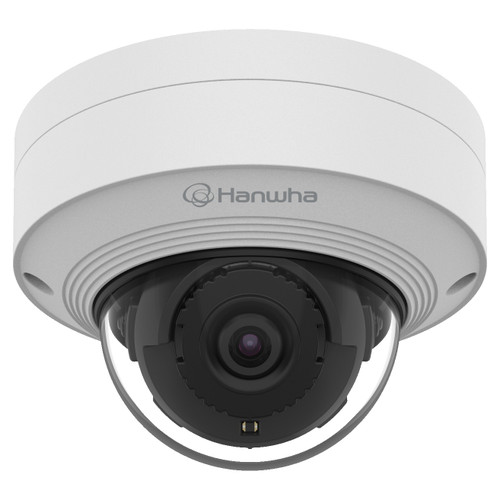
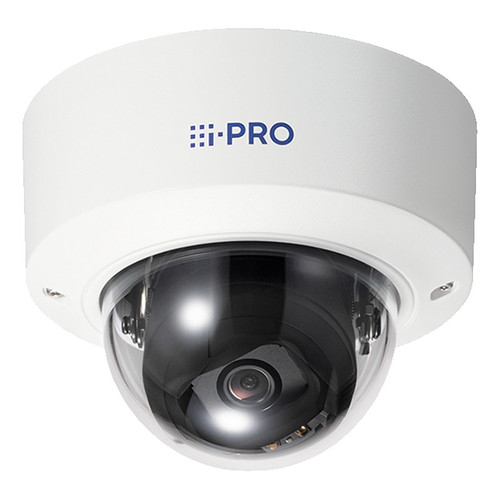
Both the Hanwha QNV-C8012 and the i-PRO WV-S22500-F3L are fixed-lens, 5MP IP dome cameras targeting commercial and light-industrial deployments where vandal resistance and onboard AI analytics matter. The Hanwha is rated for outdoor use (IP66/IK10), while the i-PRO is an indoor-only IK10 unit. Despite the environment split, integrators frequently cross-shop these at the same resolution tier when evaluating covered or semi-sheltered indoor/outdoor lobbies, parking garages, and retail spaces.
In This Guide
How do the imaging specs compare?
Both cameras use an approximately 1/2.8-inch CMOS sensor and deliver 5MP at 30 fps. The Hanwha QNV-C8012 resolves 2592×1944 (4:3 native) through a fixed 2.4 mm, f/2.0 M12 lens producing a 123° horizontal field of view, making it suited to wide-area coverage at short range. The i-PRO WV-S22500-F3L uses a 3.2 mm, f/2.0 auto-focus lens with a 95° horizontal field of view and supports a 16:9 native resolution of 3072×1728 as well as a 4:3 mode up to 3072×2304; it also offers 1×–3× digital extra zoom at reduced resolution.
In low-light performance, the Hanwha specifies 0.05 lux color / 0.005 lux B/W, with IR sensitivity down to the B/W floor. The i-PRO lists 0.12 lux color and 0.1 lux B/W, plus 0 lux with IR active, and its onboard IR illuminators are rated 25 m at 30 IRE / 20 m at 50 IRE — a stated range the Hanwha spec sheet does not provide for its IR emitters (the Hanwha lists minimum object distance as 0.5 m, not a maximum IR throw distance). On dynamic range, the i-PRO's Super Dynamic tops out at 132 dB (level 31), while the Hanwha's WDR is rated at 120 dB — a 12 dB advantage for the i-PRO in high-contrast scenes.
What about installation and environment?
The Hanwha QNV-C8012 carries IP66 weatherproofing, IK10 vandal resistance, and NEMA 4X certification, and is rated for operation from −40 °C to +55 °C. The i-PRO WV-S22500-F3L is IK10-rated but carries no IP ingress rating and is specified for indoor use only, with an operating range of −10 °C to +50 °C. The Hanwha's NEMA 4X and −40 °C cold-start rating makes it suitable for unconditioned outdoor enclosures; the i-PRO is not specified for those conditions.
Both cameras are powered via PoE 802.3af. The Hanwha is PoE Class 3 (max 7 W, typical 4.9 W); the i-PRO is PoE Class 0, which draws up to the full Class 0 budget of 15.4 W — the i-PRO spec lists DC 12 V at 880 mA as an alternative supply. The i-PRO additionally provides a composite video monitor output (VBS 1.0 V / 75 Ω) for on-site aim adjustment, plus 3.5 mm audio I/O jacks and three alarm input terminals plus one alarm output terminal. The Hanwha offers a USB Micro-B output at 1280×720 for installation alignment. The Hanwha weighs 522 g (1.15 lb) and measures ø110×77 mm; the i-PRO is larger at ø129.5×102.5 mm and 800 g (1.77 lb).
Which fits your VMS and analytics better?
Both cameras support ONVIF Profiles G, M, S, and T, ensuring broad VMS compatibility. The Hanwha exposes SUNAPI (HTTP API) in addition to ONVIF and supports up to 20 unicast users across up to 5 simultaneous stream profiles. The i-PRO supports up to 14 simultaneous users and adds SFTP and MQTT protocol support, which the Hanwha spec does not list. The i-PRO's security posture includes FIPS 140-2 Level 3 certification backed by an NXP SE050F hardware secure element — a specific federal-grade credential the Hanwha does not claim, though the Hanwha does provide signed firmware, secure boot, firmware encryption, SD card partition encryption, and a Hanwha Private Root CA device certificate.
On analytics, the Hanwha's AI engine covers object detection (person/vehicle with type attributes), virtual line and area crossing, people/vehicle counting, queue management, and heatmap generation. The i-PRO's AI analytics cover AI-based video motion detection, face detection, and vehicle detection, and adds AI sound classification (gunshot, yell, vehicle horn, glass break) — an audio-event capability the Hanwha spec does not list. The i-PRO also exposes scene change detection and fog compensation controls. Both cameras support onboard microSD/SDXC storage up to 256 GB (Hanwha) or 512 GB (i-PRO). The i-PRO includes 3.5 mm audio input and output with hardware jacks; the Hanwha spec lists no audio input hardware.
Which should you choose: the C8012 or the S22500-F3L?
Our take: The QNV-C8012 is the stronger choice when the installation site is outdoors or subject to temperature extremes, moisture, or environmental exposure: its IP66/NEMA 4X rating and −40 °C cold-start cover conditions the i-PRO WV-S22500-F3L — an indoor-only camera with no IP rating and a −10 °C floor — cannot meet. The Hanwha also delivers a wider 123° horizontal field of view versus the i-PRO's 95°, and draws less PoE power (Class 3, 7 W max vs. Class 0, up to 15.4 W), easing switch budgets. The i-PRO is the stronger choice for high-security indoor environments: its 132 dB Super Dynamic range outperforms the Hanwha's 120 dB WDR, it carries FIPS 140-2 Level 3 certification backed by a hardware secure element, supports up to 512 GB edge storage versus 256 GB, and adds AI sound classification and a 25 m rated IR range. Choose the Hanwha for outdoor or wide-FOV retail applications; choose the i-PRO for hardened indoor deployments with federal-compliance or audio-analytics requirements.
Side-by-Side Comparison
Spec-for-spec, from manufacturer data.
| Specification | Hanwha C8012 | i-PRO S22500-F3L |
|---|---|---|
| Resolution | 2592×1944 (5MP, 4:3) | 3072×2304 (5MP, 4:3) / 3072×1728 (16:9) |
| Image Sensor | 1/2.8" CMOS | Approx. 1/2.8" CMOS |
| Lens / Focal Length | 2.4 mm fixed, f/2.0, M12 | 3.2 mm fixed, f/2.0, auto-focus |
| Horizontal Field of View | 123° | 95° |
| Min. Illumination (Color) | 0.05 lux | 0.12 lux |
| Min. Illumination (B/W) | 0.005 lux | 0.1 lux (0 lux with IR) |
| IR Range | Not specified in spec | 25 m (30 IRE) / 20 m (50 IRE) |
| Wide Dynamic Range | 120 dB | 132 dB (Super Dynamic, level 31) |
| Max Frame Rate | 30 fps @ 5MP | 30 fps @ 5MP |
| Video Compression | H.265, H.264, MJPEG | H.265, H.264, MJPEG |
| IP Rating | IP66 | — (indoor only; no IP rating specified) |
| IK / Impact Rating | IK10 | IK10 |
| Operating Temperature | −40 °C to +55 °C | −10 °C to +50 °C |
| Power Input / PoE Class | PoE 802.3af, Class 3 (max 7 W) | PoE 802.3af, Class 0; or DC 12 V 880 mA |
| Edge Storage | microSD/SDHC/SDXC up to 256 GB | microSDXC up to 512 GB |
| Audio | Not specified (no audio I/O listed) | 3.5 mm mic input + 3.5 mm line output; AI sound classification |
| ONVIF Profiles | G, M, S, T | G, M, S, T |
| AI Analytics | Person/vehicle detection, counting, queue, heatmap, virtual line/area | AI VMD, face detection, vehicle detection, AI sound classification |
| Security Certification | Signed firmware, secure boot, Hanwha Private Root CA | FIPS 140-2 Level 3, NXP SE050F hardware secure element |
| Dimensions | ø110 × 77 mm | ø129.5 × 102.5 mm |
| Weight | 522 g (1.15 lb) | 800 g (1.77 lb) |
| Warranty | 3 years | 5 years |
Frequently Asked Questions
Which should you choose: the C8012 or the S22500-F3L?
The QNV-C8012 is the stronger choice when the installation site is outdoors or subject to temperature extremes, moisture, or environmental exposure: its IP66/NEMA 4X rating and −40 °C cold-start cover conditions the i-PRO WV-S22500-F3L — an indoor-only camera with no IP rating and a −10 °C floor — cannot meet. The Hanwha also delivers a wider 123° horizontal field of view versus the i-PRO's 95°, and draws less PoE power (Class 3, 7 W max vs. Class 0, up to 15.4 W), easing switch budgets. The i-PRO is the stronger choice for high-security indoor environments: its 132 dB Super Dynamic range outperforms the Hanwha's 120 dB WDR, it carries FIPS 140-2 Level 3 certification backed by a hardware secure element, supports up to 512 GB edge storage versus 256 GB, and adds AI sound classification and a 25 m rated IR range. Choose the Hanwha for outdoor or wide-FOV retail applications; choose the i-PRO for hardened indoor deployments with federal-compliance or audio-analytics requirements.
Is the QNV-C8012 or WV-S22500-F3L better for low-light performance?
The Hanwha QNV-C8012 specifies a lower minimum illumination floor: 0.005 lux in B/W mode versus the i-PRO's 0.1 lux B/W (both reach 0 lux with IR active per the i-PRO spec; the Hanwha spec does not explicitly state 0 lux). The i-PRO provides a stated IR throw distance of 25 m at 30 IRE, while the Hanwha's spec sheet does not list a maximum IR range — only a minimum object distance of 0.5 m. For large indoor spaces requiring quantified IR coverage distance, the i-PRO's rated 25 m is the documented figure.
Can I use the WV-S22500-F3L outdoors if I put it in an outdoor enclosure?
The i-PRO WV-S22500-F3L carries no IP ingress protection rating and is specified for indoor use only, with an operating temperature floor of −10 °C. The manufacturer spec does not certify it for outdoor or wet-location installation. The Hanwha QNV-C8012, rated IP66 and NEMA 4X with a −40 °C operating floor, is the specified outdoor option between these two models.
Which camera is easier to integrate with a government or compliance-driven security program?
The i-PRO WV-S22500-F3L lists FIPS 140-2 Level 3 certification backed by an NXP SE050F hardware secure element — a specific federal cryptographic credential. The Hanwha QNV-C8012 provides signed firmware, secure boot, firmware encryption, SD card partition encryption, 802.1X network authentication, and a Hanwha Private Root CA device certificate, but does not claim FIPS 140-2 Level 3 in its published spec. For programs that mandate FIPS 140-2 Level 3 by name, the i-PRO meets that requirement as documented; the Hanwha does not list it.
Get a Second Opinion on Your Camera Choice
Share your site layout, coverage goals, and budget. Our team will validate the camera selection, flag anything we would change, and recommend products that match the use case.