
Hanwha C8011R vs i-PRO S22500-V3LG: Specification Comparison
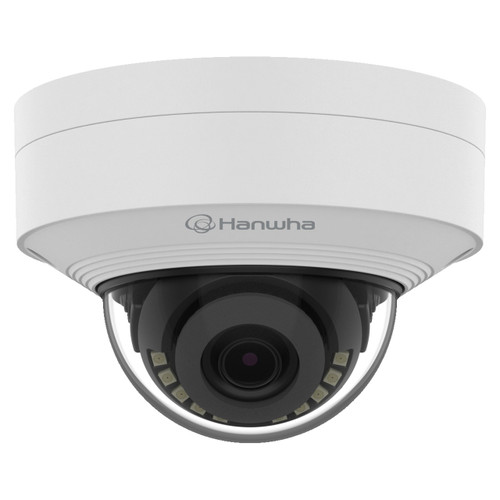
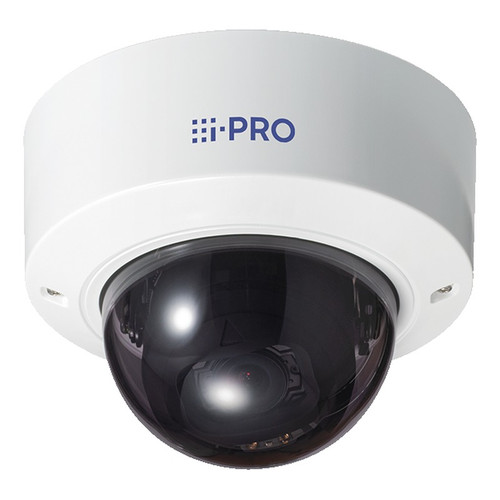
Both the Hanwha QNV-C8011R and the i-PRO WV-S22500-V3LG are 5MP IK10 vandal-resistant dome cameras powered over PoE, aimed at retail, commercial, and transit deployments where AI analytics and video quality matter. The Hanwha is rated for outdoor use; the i-PRO is specified for indoor use only. Despite that deployment difference, integrators frequently cross-shop them at the same budget tier for covered outdoor or indoor-lobby projects where both appear on the short list.
In This Guide
How do the imaging specs compare?
Both cameras use an approximately 1/2.8-inch CMOS sensor and deliver 5MP at 30 fps. The Hanwha QNV-C8011R uses a fixed 3.0 mm f/1.6 lens with a 100° horizontal field of view and no optical zoom, while the i-PRO WV-S22500-V3LG offers a 3.1× motorized zoom lens spanning 2.9–9 mm with aperture ranging from f/1.3 (wide) to f/2.5 (tele), providing a 105°–33° horizontal field of view. The i-PRO's wider maximum aperture at the wide end (f/1.3 vs. f/1.6) gives it a slight optical light-gathering advantage. The i-PRO also resolves to 3072×2304 in 4:3 mode vs. 2592×1944 on the Hanwha, though both are marketed as 5MP.
For low light, the Hanwha specifies 0.03 lux color and 0 lux with IR active, compared to the i-PRO's 0.15 lux color and 0.12 lux B&W at F1.3—giving the Hanwha a notable edge in passive low-light sensitivity. On dynamic range, the Hanwha rates its WDR at 120 dB, while i-PRO's Super Dynamic system reaches a maximum of 132 dB at level 31. IR range is 20 m (850 nm) on the Hanwha versus 25 m on the i-PRO. DORI detection distances at wide angle are comparable: Hanwha 43.5 m detect vs. i-PRO 47.1 m wide-end detect.
What about installation and environment?
The Hanwha QNV-C8011R carries IP66, IK10, and NEMA4X ratings and is explicitly rated for outdoor use, with an operating temperature range of -40°C to +55°C. The i-PRO WV-S22500-V3LG is rated IK10 for impact resistance but carries no IP ingress rating in its specifications and is designated for indoor use only, with an operating range of -10°C to +50°C (power-on: 0°C to +50°C). The Hanwha's -40°C cold-start capability makes it suitable for harsh northern climates; the i-PRO cannot be assumed weatherproof based on the provided specs.
Both cameras are PoE-powered (IEEE 802.3af). The Hanwha draws up to 8.5 W (typical 4.9 W) and is PoE Class 3; the i-PRO draws up to 12 W and is listed as PoE Class 0, also accepting DC 12 V/1 A as an alternate power source. The i-PRO is larger (ø129.5 mm × 102.5 mm, 800 g) versus the Hanwha (ø110 mm × 77 mm, 522 g). The i-PRO's motorized zoom allows remote focus adjustment post-installation; the Hanwha requires physical re-aiming to change coverage angle. The Hanwha includes a Micro USB Type B video output for installation alignment; the i-PRO provides a composite monitor output (1.0 V p-p 75Ω).
Which fits your VMS and analytics better?
Both cameras support ONVIF Profile G/M/S/T and H.265/H.264/MJPEG compression, making them broadly compatible with standard VMS platforms. The Hanwha adds SUNAPI (HTTP API) and WiseStream III AI-based smart codec, plus up to 5 concurrent stream profiles and unicast to 20 simultaneous users; the i-PRO supports up to 14 simultaneous users and adds SFTP and MQTT protocol support not listed for the Hanwha. Security posture differs meaningfully: the i-PRO is FIPS 140-2 Level 3 certified with an NXP EdgeLock SE050F secure element, while the Hanwha relies on secure boot, signed firmware, firmware encryption, device certificates, and 802.1X—robust but not FIPS-certified per the provided specs.
On analytics, the Hanwha offers AI-classified object detection (person/vehicle with sub-type attributes), virtual line/area crossing, people and vehicle counting, heatmap, and queue management at the edge. The i-PRO provides AI motion, face detection, vehicle detection, audio-based AI sound classification (gunshot, yell, vehicle horn, glass break), and scene change detection. The i-PRO includes built-in audio I/O (3.5 mm mic input and line output) plus three alarm I/O terminals and an AUX output; the Hanwha's provided specs do not list dedicated audio jacks or physical alarm terminals. Both support microSD/SDXC up to 256 GB for edge recording.
Which should you choose: the C8011R or the S22500-V3LG?
Our take: The QNV-C8011R is the stronger choice when the deployment is outdoor, subject to extreme temperatures, or requires heatmap and queue analytics at the edge. It operates from -40°C to +55°C versus the i-PRO's 0°C to +50°C power-on range, carries a full IP66/NEMA4X weatherproof rating the i-PRO lacks, and specifies a lower minimum illumination of 0.03 lux color versus 0.15 lux—a 5× passive light advantage. Conversely, the WV-S22500-V3LG is the stronger choice for indoor, access-controlled environments where lens flexibility, audio I/O, physical alarm terminals, and government-grade security certification matter: its 3.1× motorized zoom eliminates on-site refocusing visits, its 132 dB Super Dynamic WDR exceeds the Hanwha's 120 dB, it carries FIPS 140-2 Level 3 certification, and its 5-year warranty outclasses the Hanwha's 3-year coverage. Platform choice reinforces the split: Hanwha-native VMSs (Wisenet WAVE) will surface WiseStream III and full AI metadata; i-PRO cameras pair natively with i-PRO's management suite.
Side-by-Side Comparison
Spec-for-spec, from manufacturer data.
| Specification | Hanwha C8011R | i-PRO S22500-V3LG |
|---|---|---|
| Resolution | 2592×1944 (5MP) | 3072×2304 (5MP, 4:3) / 3072×1728 (16:9) |
| Image Sensor | 1/2.8" CMOS | Approx. 1/2.8" CMOS |
| Lens / Focal Length | 3.0 mm fixed, f/1.6 | 2.9–9 mm motorized zoom, f/1.3 (W)–f/2.5 (T) |
| Optical Zoom | None (fixed) | 3.1× |
| Horizontal Field of View | 100° (fixed) | 105° (wide) – 33° (tele) |
| Min. Illumination | 0.03 lux color / 0 lux IR | 0.15 lux color / 0.12 lux B&W |
| IR Range | 20 m (850 nm) | 25 m |
| Wide Dynamic Range | 120 dB | 132 dB (Super Dynamic level 31) |
| Max Frame Rate | 30 fps @ 5MP | 30 fps @ 5MP |
| Video Compression | H.265, H.264, MJPEG | H.265, H.264, MJPEG |
| IP / Ingress Rating | IP66, NEMA4X | Not specified (indoor only) |
| IK / Impact Rating | IK10 | IK10 |
| Operating Temperature | -40°C to +55°C | -10°C to +50°C (power-on: 0°C to +50°C) |
| Power Input / PoE Class | PoE 802.3af, Class 3 (max 8.5 W) | PoE 802.3af, Class 0 (12 W) or DC 12 V/1 A |
| Audio | Not listed in provided specs | 3.5 mm mic input + 3.5 mm line output |
| Alarm I/O | Not listed in provided specs | 3× alarm terminals, 1× AUX OUT |
| Edge Storage | microSD/SDXC up to 256 GB | microSDXC up to 512 GB |
| Security Certification | Secure boot, signed firmware, 802.1X; no FIPS listed | FIPS 140-2 Level 3, NXP EdgeLock SE050F |
| ONVIF Profiles | S / G / T / M | G / M / S / T |
| Simultaneous Users | Up to 20 (unicast) | Up to 14 |
| Dimensions | ø110 × 77 mm | ø129.5 × 102.5 mm |
| Weight | 522 g (1.15 lb) | 800 g (1.77 lb) |
| Environment / Use | Outdoor (IP66, NEMA4X) | Indoor only |
| Warranty | 3 years | 5 years |
Frequently Asked Questions
Which should you choose: the C8011R or the S22500-V3LG?
The QNV-C8011R is the stronger choice when the deployment is outdoor, subject to extreme temperatures, or requires heatmap and queue analytics at the edge. It operates from -40°C to +55°C versus the i-PRO's 0°C to +50°C power-on range, carries a full IP66/NEMA4X weatherproof rating the i-PRO lacks, and specifies a lower minimum illumination of 0.03 lux color versus 0.15 lux—a 5× passive light advantage. Conversely, the WV-S22500-V3LG is the stronger choice for indoor, access-controlled environments where lens flexibility, audio I/O, physical alarm terminals, and government-grade security certification matter: its 3.1× motorized zoom eliminates on-site refocusing visits, its 132 dB Super Dynamic WDR exceeds the Hanwha's 120 dB, it carries FIPS 140-2 Level 3 certification, and its 5-year warranty outclasses the Hanwha's 3-year coverage. Platform choice reinforces the split: Hanwha-native VMSs (Wisenet WAVE) will surface WiseStream III and full AI metadata; i-PRO cameras pair natively with i-PRO's management suite.
Is the C8011R or the S22500-V3LG better for low-light performance?
Based on the provided specifications, the Hanwha QNV-C8011R has a lower minimum illumination rating—0.03 lux color and 0 lux with IR active—compared to the i-PRO WV-S22500-V3LG's 0.15 lux color and 0.12 lux B&W. That said, the i-PRO has a wider maximum aperture at the wide end (f/1.3 vs. f/1.6), which improves passive light collection. The Hanwha's 0 lux IR capability gives it the edge in complete darkness when IR illumination is active.
Can I use the S22500-V3LG outdoors?
Based on the provided specifications, the i-PRO WV-S22500-V3LG is rated for indoor use only. No IP ingress protection rating is listed in its specs, and its operating temperature range starts at -10°C (power-on: 0°C). The Hanwha QNV-C8011R, by contrast, carries IP66, IK10, and NEMA4X ratings and an operating range down to -40°C, making it the appropriate choice for outdoor or exposed environments.
Which camera is better if my site requires government or compliance-grade security certification?
The i-PRO WV-S22500-V3LG specifies FIPS 140-2 Level 3 certification and an NXP EdgeLock SE050F secure element, which is a hardware-rooted security standard commonly required in federal, critical-infrastructure, and high-compliance deployments. The Hanwha QNV-C8011R's provided specifications do not list FIPS certification; its security features include secure boot, signed firmware, firmware encryption, 802.1X, and device certificates, which are strong but not FIPS-rated based on the available data.
Get a Second Opinion on Your Camera Choice
Share your site layout, coverage goals, and budget. Our team will validate the camera selection, flag anything we would change, and recommend products that match the use case.