
Hanwha C8011R vs Hanwha C8012: Specification Comparison
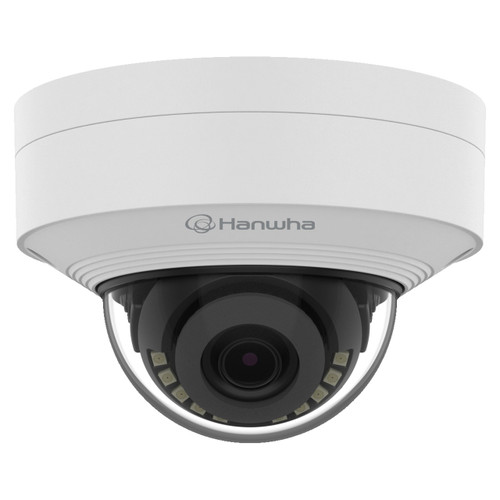
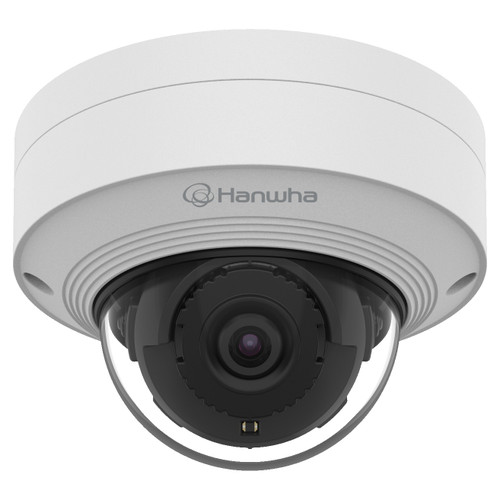
The Hanwha QNV-C8011R and QNV-C8012 are both 5MP outdoor AI dome cameras from Hanwha's Wisenet C-series, sharing the same sensor class, form factor, and PoE power standard. Both carry IP66/IK10 ratings and identical AI analytics engines. The primary differentiators a buyer must weigh are lens focal length and field of view, IR illumination capability, low-light performance floor, and maximum PoE power draw — each of which directly affects suitability for specific deployment geometries and lighting conditions.
In This Guide
How do the imaging specs compare?
Both cameras share a 1/2.8" CMOS sensor at 2592×1944 (5MP) resolution delivering 30fps, 120dB WDR, SSNR V noise reduction, and Auto ICR day/night switching. The key divergence is lens geometry: the C8011R uses a 3.0mm fixed focal length at F1.6 aperture, yielding a 100° horizontal / 73° vertical / 129° diagonal field of view, while the C8012 uses a wider 2.4mm fixed lens at F2.0, producing a notably broader 123° H / 91° V / 159° D field of view. The C8012's wider FOV covers more area per camera, but its F2.0 aperture admits less light than the C8011R's F1.6.
Low-light performance differs materially. The C8011R specifies 0.03 Lux in color mode and 0 Lux with IR active, supported by built-in 850nm IR LEDs with a stated viewable length of 20m (65.62ft). The C8012 specifies 0.05 Lux color and 0.005 Lux B/W — no IR illumination range figure is provided in the supplied specifications, and the IR Distance field lists only 0.5m (minimum object distance), not a throw distance. Buyers requiring confirmed IR throw distance data for the C8012 should consult the manufacturer datasheet directly. DORI detection distances reflect the lens difference: the C8011R reaches 43.5m detect / 4.3m identify; the C8012 reaches 28.1m detect / 2.8m identify.
What about installation and environment?
Both cameras are mechanically identical in housing: aluminum construction with a hard-coated dome bubble, RAL9003 white finish, ø110×77mm body, 522g (1.15 lb), and the same pan/tilt/rotate adjustment range of 0°–350° / -35°–70° / 0°–355°. Both carry IP66, IK10, and NEMA4X ratings and share the same operating temperature range of -40°C to +55°C with 0–95% RH humidity tolerance. Compatible accessories — conduit adapter SBD-110GP1, hanging mount SBP-120HMW, and backbox SBV-140BW — are identical across both models.
Both are powered by PoE IEEE 802.3af Class 3. The C8011R lists a maximum draw of 8.5W (typical 4.9W); the C8012 lists a lower maximum of 7W (typical 4.9W). For installers sizing PoE switch budgets across many cameras, the C8012's lower max draw is a marginal advantage. Both include a Micro USB Type B port outputting 1280×720 for on-site installation alignment.
Which fits your VMS and analytics better?
Integration capabilities are essentially equivalent. Both cameras support ONVIF Profile S/G/T/M and Hanwha SUNAPI (HTTP API), H.265/H.264 (Main/High) and MJPEG compression, WiseStream III smart codec, CBR/VBR bitrate control, unicast (up to 20 users) and multicast, and up to 5 simultaneous stream profiles. Network protocol support is identical across both. Edge storage is identical: one Micro SD/SDHC/SDXC slot supporting up to 256GB. Neither model lists an onboard microphone or audio input/output in the provided specifications.
AI analytics are identical in scope: person/vehicle classification, vehicle attribute detection (car/bus/truck/motorcycle/bicycle), virtual line crossing, virtual area, people counting, vehicle counting, queue management, and heatmap. Security hardening is functionally the same — secure boot, signed firmware, firmware encryption, 802.1X (EAP-TLS/LEAP/PEAP), HTTPS/SRTP/WSS, IP-based access control, SD card partition encryption, and Hanwha device certificate. The only noted wording difference is that the C8011R spec lists 'Authentication & ZIP encryption' for data protection while the C8012 lists 'Authentication & data encryption' — this may reflect a firmware-level difference or a documentation variance; buyers with specific encryption requirements should verify directly with Hanwha.
Which should you choose: the C8011R or the C8012?
Our take: The C8011R is the stronger choice when IR illumination range and narrow-corridor or medium-distance scene coverage are priorities. It delivers a confirmed 20m IR throw distance versus no stated IR throw figure for the C8012, a brighter F1.6 aperture versus F2.0, a lower color minimum illumination (0.03 Lux vs 0.05 Lux), and a longer DORI detect range (43.5m vs 28.1m). The C8012 is the better fit when maximum area coverage per camera is the objective: its 2.4mm lens produces a 123° horizontal FOV versus the C8011R's 100°, and its 159° diagonal coverage can reduce camera count in open retail floors or wide lobbies. Both cameras are physically identical, draw the same typical power, carry the same IP66/IK10/NEMA4X ratings, and run the same AI analytics suite — so the decision reduces to FOV breadth versus IR throw depth. Confirm the C8012's IR illuminator range in Hanwha's current datasheet before specifying it in low-ambient nighttime outdoor applications.
Side-by-Side Comparison
Spec-for-spec, from manufacturer data.
| Specification | Hanwha C8011R | Hanwha C8012 |
|---|---|---|
| Resolution | 2592×1944 (5MP) | 2592×1944 (5MP) |
| Image Sensor | 1/2.8" CMOS | 1/2.8" CMOS |
| Lens / Focal Length | 3.0mm fixed, F1.6 | 2.4mm fixed, F2.0 |
| Horizontal Field of View | 100° | 123° |
| Min. Illumination (Color) | 0.03 Lux | 0.05 Lux |
| Min. Illumination (B/W / IR) | 0 Lux (IR on) | 0.005 Lux (B/W) |
| IR Illumination Range | 20m (850nm LED) | Not specified in provided specs |
| DORI Detect Range | 43.5m (142.71ft) | 28.1m (92.35ft) |
| DORI Identify Range | 4.3m (14.27ft) | 2.8m (9.23ft) |
| Wide Dynamic Range | 120dB | 120dB |
| Max Frame Rate | 30fps @ 5MP | 30fps @ 5MP |
| Video Compression | H.265 / H.264 / MJPEG | H.265 / H.264 / MJPEG |
| IP / Impact Rating | IP66 / IK10 / NEMA4X | IP66 / IK10 / NEMA4X |
| Operating Temperature | -40°C to +55°C | -40°C to +55°C |
| Power Input / PoE Class | PoE 802.3af, Class 3 / Max 8.5W | PoE 802.3af, Class 3 / Max 7W |
| Edge Storage | MicroSD/SDHC/SDXC, 1 slot, 256GB max | MicroSD/SDHC/SDXC, 1 slot, 256GB max |
| Audio | Not specified | Not specified |
| Dimensions / Weight | ø110×77mm / 522g (1.15 lb) | ø110×77mm / 522g (1.15 lb) |
| Warranty | 3-year | 3-year |
Frequently Asked Questions
Which should you choose: the C8011R or the C8012?
The C8011R is the stronger choice when IR illumination range and narrow-corridor or medium-distance scene coverage are priorities. It delivers a confirmed 20m IR throw distance versus no stated IR throw figure for the C8012, a brighter F1.6 aperture versus F2.0, a lower color minimum illumination (0.03 Lux vs 0.05 Lux), and a longer DORI detect range (43.5m vs 28.1m). The C8012 is the better fit when maximum area coverage per camera is the objective: its 2.4mm lens produces a 123° horizontal FOV versus the C8011R's 100°, and its 159° diagonal coverage can reduce camera count in open retail floors or wide lobbies. Both cameras are physically identical, draw the same typical power, carry the same IP66/IK10/NEMA4X ratings, and run the same AI analytics suite — so the decision reduces to FOV breadth versus IR throw depth. Confirm the C8012's IR illuminator range in Hanwha's current datasheet before specifying it in low-ambient nighttime outdoor applications.
Is the C8011R or C8012 better for low-light and nighttime outdoor use?
Based on the provided specifications, the C8011R has the advantage: it specifies 0.03 Lux color / 0 Lux IR versus the C8012's 0.05 Lux color / 0.005 Lux B/W, its F1.6 aperture admits more light than the C8012's F2.0, and it lists a confirmed IR viewable length of 20m at 850nm. No IR throw distance figure is provided in the C8012 specifications supplied — verify with Hanwha before deploying the C8012 in unlit outdoor scenes.
Which camera covers more area with a single unit — the C8011R or C8012?
The C8012 covers a wider area per camera. Its 2.4mm lens produces a 123° horizontal / 91° vertical / 159° diagonal field of view, compared to the C8011R's 100° H / 73° V / 129° D from its 3.0mm lens. In open spaces such as retail floors, wide lobbies, or parking lot entrances where maximizing coverage angle is the priority, the C8012 requires fewer units for equivalent area. The tradeoff is reduced DORI identify range: 2.8m vs 4.3m for the C8011R.
Are the C8011R and C8012 compatible with the same mounts, accessories, and VMS platforms?
Yes, based on the provided specifications. Both cameras share the same physical housing dimensions (ø110×77mm), weight (522g), and list identical compatible accessories: conduit adapter SBD-110GP1, hanging dome mount SBP-120HMW, and backbox SBV-140BW. Both support ONVIF Profile S/G/T/M and Hanwha SUNAPI, making them compatible with the same ONVIF-compliant VMS platforms. PoE class (802.3af Class 3) and edge storage (256GB microSD) are also identical.
Get a Second Opinion on Your Camera Choice
Share your site layout, coverage goals, and budget. Our team will validate the camera selection, flag anything we would change, and recommend products that match the use case.