
Hanwha C6083R vs i-PRO X15300-V3L: Specification Comparison
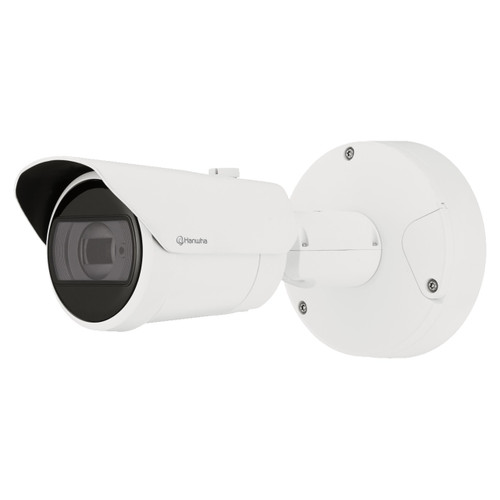
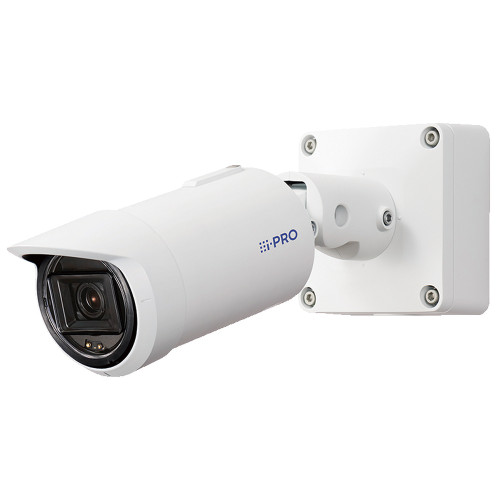
Both the Hanwha XNO-C6083R and the i-PRO WV-X15300-V3L are outdoor-rated, wired, fixed 2MP (1920×1080) bullet cameras targeting professional IP surveillance installations. They share the same resolution class, camera type, and general outdoor hardening profile, making them direct cross-shop candidates for integrators evaluating varifocal motorized-zoom bullets with built-in IR, on-board analytics, and edge storage. The comparison below is drawn entirely from the published specifications for each model.
In This Guide
How do the imaging specs compare?
Both cameras use an approximately 1/2.8-inch progressive CMOS sensor and deliver 1920×1080 at up to 60 fps. The XNO-C6083R offers a 2.8–12 mm (4.3×) motorized varifocal lens with a maximum aperture of F1.4 (wide) and a minimum color illumination of 0.01 lux, reaching 0 lux with its WiseIR system rated to 40 m. The WV-X15300-V3L uses a 2.9–9 mm (3.1×) motorized lens, a slightly faster maximum aperture of F1.3 (wide), minimum color illumination of 0.007 lux, and a wider B&W minimum of 0.005 lux; its IR illuminator is rated to 70 m—75% longer throw than the Hanwha.
On dynamic range, the XNO-C6083R specifies extremeWDR at 150 dB, while the WV-X15300-V3L specifies Super Dynamic at a maximum of 144 dB with level 31 enabled. The Hanwha therefore has the higher published WDR figure (150 dB vs. 144 dB). DORI performance at the Tele position shows comparable Detect distances (Hanwha 159.9 m; i-PRO 114.8 m), reflecting the Hanwha's longer focal length. The Hanwha also includes digital image stabilization via a built-in gyro sensor, as does the i-PRO. The i-PRO additionally specifies an Ambarella CV52 SoC, which the Hanwha spec sheet does not disclose.
What about installation and environment?
Both cameras carry IP66/IP67 and NEMA 4X environmental ratings, along with IK10 impact resistance, so the outdoor hardening baseline is identical. Operating temperature range is also identical: −40 °C to +55 °C for both. The XNO-C6083R weighs 1,640 g and measures ø93.4 × 276.6 mm; the WV-X15300-V3L is notably heavier at approximately 2,500 g and larger at 133 × 133 × 383 mm—relevant for mounting hardware and conduit sizing. The i-PRO additionally specifies a wind resistance rating of up to 40 m/s (~89 mph), a figure not present in the Hanwha spec sheet.
On power, the XNO-C6083R draws a maximum of 12.95 W and is compatible with IEEE 802.3af PoE (Class 3) or 12 VDC. The WV-X15300-V3L requires PoE+ (802.3at, up to 14 W) or DC 12 V; its higher draw is consistent with the longer-range IR illuminator. Installers must confirm PoE+ switch port availability for the i-PRO. The Hanwha ships with a backbox and conduit adapters for single/double/4-inch octagon/4-inch square boxes; the i-PRO spec sheet does not enumerate included mounting accessories.
Which fits your VMS and analytics better?
Both cameras support ONVIF Profile S/G/T/M and H.265/H.264/MJPEG compression, providing broad VMS compatibility. The XNO-C6083R supports up to 20 unicast users and 10 configurable streaming profiles with 3 virtual channels; the WV-X15300-V3L supports up to 14 simultaneous users. The Hanwha includes WiseStream II/III smart codec, while the i-PRO specifies variable GOP smart coding. Protocol depth is comparable, though the i-PRO adds SFTP and explicitly lists SRTP; the Hanwha lists SRTP as well. Both offer MQTT support and SNMPv1/v2c/v3.
On analytics, the XNO-C6083R provides AI-based object detection (person, face, vehicle, license plate), virtual line/area crossing, people counting, queue management, and heatmap. The WV-X15300-V3L includes an AI video detection suite with facial recognition, plus AI sound classification (gunshot, yell, vehicle horn, glass break), scene change detection, and audio detection—audio event classification being absent from the Hanwha spec sheet. Security posture differs: the i-PRO specifies FIPS 140-2 Level 3, secure boot, and signed firmware; the Hanwha specifies device certificates and 802.1X but does not list those three features. Both support microSD/SDHC/SDXC up to 512 GB for edge storage. Audio I/O: the XNO-C6083R uses a line/mic-selectable input and line output; the i-PRO uses 3.5 mm stereo jacks with a dedicated output impedance spec (600 Ω). The i-PRO also provides 3 alarm inputs and 1 alarm output plus 1 AUX OUT, versus the Hanwha's 2 configurable I/O ports.
Which should you choose: the C6083R or the X15300-V3L?
Our take: The WV-X15300-V3L is the stronger choice when IR throw distance, cybersecurity posture, or AI sound classification are primary requirements. Its 70 m IR range outreaches the Hanwha's 40 m by 75%, its FIPS 140-2 Level 3 certification with secure boot and signed firmware addresses hardened-network mandates, and it adds gunshot/glass-break sound classification not present in the XNO-C6083R spec sheet. Conversely, the XNO-C6083R is the better fit when installation budget constrains PoE infrastructure to 802.3af Class 3 ports, when a longer optical zoom range matters (4.3× vs. 3.1×), or when WDR headroom is decisive (150 dB vs. 144 dB). The Hanwha is also significantly lighter (1,640 g vs. ~2,500 g) and ships with a backbox included. For Wisenet VMS environments the XNO-C6083R integrates natively; for i-PRO/Panasonic VMS environments the WV-X15300-V3L is the native fit. Both carry identical IP66/IP67, IK10, and ONVIF S/G/T/M credentials.
Side-by-Side Comparison
Spec-for-spec, from manufacturer data.
| Specification | Hanwha C6083R | i-PRO X15300-V3L |
|---|---|---|
| Resolution | 1920×1080 (2MP) | 1920×1080 (2MP) |
| Image Sensor | 1/2.8" progressive CMOS | Approx. 1/2.8" CMOS |
| Focal Length / Optical Zoom | 2.8–12 mm, 4.3× motorized varifocal | 2.9–9 mm, 3.1× motorized varifocal |
| Max Aperture (Wide) | F1.4 | F1.3 |
| Min Illumination (Color) | 0.01 lux | 0.007 lux @ 30IRE |
| Min Illumination (B&W / IR) | 0 lux (IR) | 0.005 lux (B&W) / 0 lux (IR) |
| IR Range | 40 m (131 ft) WiseIR | 70 m (230 ft) |
| Wide Dynamic Range | extremeWDR 150 dB | Super Dynamic max 144 dB |
| Max Frame Rate | 60 fps | 60 fps |
| Video Compression | H.265 / H.264 / MJPEG | H.265 / H.264 / MJPEG |
| IP Rating | IP66 / IP67 / NEMA 4X | IP66 / IP67 / NEMA 4X |
| Impact Rating | IK10 | IK10 |
| Operating Temperature | -40°C to +55°C | -40°C to +55°C |
| Power Input / PoE Class | PoE 802.3af Class 3 / 12 VDC, max 12.95 W | PoE+ 802.3at / DC 12 V, max 14 W |
| Edge Storage | microSD/SDHC/SDXC up to 512 GB | microSD/SDHC/SDXC up to 512 GB |
| Alarm I/O | 2 configurable I/O | 3× Alarm IN, 1× Alarm OUT, 1× AUX OUT |
| ONVIF Profile | S / G / T / M | S / G / T / M |
| Cybersecurity Features | HTTPS, 802.1X, device certificate | FIPS 140-2 Level 3, secure boot, signed firmware, HTTPS, 802.1X |
| Dimensions | ø93.4 × 276.6 mm (ø3.68 × 10.89 in) | 133 × 133 × 383 mm (5.25 × 5.25 × 15.09 in) |
| Weight | 1,640 g (3.62 lb) | Approx. 2,500 g (5.6 lb) |
| Warranty | 3 years | 5 years |
Frequently Asked Questions
Which should you choose: the C6083R or the X15300-V3L?
The WV-X15300-V3L is the stronger choice when IR throw distance, cybersecurity posture, or AI sound classification are primary requirements. Its 70 m IR range outreaches the Hanwha's 40 m by 75%, its FIPS 140-2 Level 3 certification with secure boot and signed firmware addresses hardened-network mandates, and it adds gunshot/glass-break sound classification not present in the XNO-C6083R spec sheet. Conversely, the XNO-C6083R is the better fit when installation budget constrains PoE infrastructure to 802.3af Class 3 ports, when a longer optical zoom range matters (4.3× vs. 3.1×), or when WDR headroom is decisive (150 dB vs. 144 dB). The Hanwha is also significantly lighter (1,640 g vs. ~2,500 g) and ships with a backbox included. For Wisenet VMS environments the XNO-C6083R integrates natively; for i-PRO/Panasonic VMS environments the WV-X15300-V3L is the native fit. Both carry identical IP66/IP67, IK10, and ONVIF S/G/T/M credentials.
Is the XNO-C6083R or WV-X15300-V3L better for low-light and long-range IR?
The WV-X15300-V3L has the advantage on both counts: its IR illuminator is rated to 70 m versus the XNO-C6083R's 40 m, and its minimum B&W illumination is 0.005 lux versus 0.01 lux (color) for the Hanwha. However, the Hanwha specifies a higher extremeWDR rating (150 dB vs. 144 dB), which may benefit high-contrast scenes during daylight.
Can I power either camera from a standard 802.3af PoE switch?
The XNO-C6083R is specified for IEEE 802.3af (Class 3, max 12.95 W), so a standard PoE switch is sufficient. The WV-X15300-V3L requires PoE+ (802.3at, up to 14 W), meaning a PoE+ capable switch or injector is needed. Using a standard 802.3af port for the i-PRO may result in insufficient power delivery.
Which camera has stronger cybersecurity features?
Based on published specifications, the WV-X15300-V3L has a more explicit cybersecurity feature set: FIPS 140-2 Level 3 compliance, secure boot, and signed firmware are all listed. The XNO-C6083R specifies HTTPS/SSL, 802.1X (EAP-TLS/LEAP/PEAP), device certificates, and IP address filtering, but does not list FIPS 140-2, secure boot, or signed firmware in its specification sheet.
Get a Second Opinion on Your Camera Choice
Share your site layout, coverage goals, and budget. Our team will validate the camera selection, flag anything we would change, and recommend products that match the use case.