
Hanwha C6083R vs i-PRO S1536LA: Specification Comparison
Both the Hanwha XNO-C6083R and the i-PRO WV-S1536LA are 2MP outdoor wired bullet cameras with motorized varifocal lenses, PoE power, IR illumination, AI analytics, and IK10-rated housings — a configuration commonly cross-shopped for perimeter and area surveillance deployments. This comparison evaluates their imaging performance, physical installation requirements, and integration capabilities strictly from the published specifications supplied for each model, without reference to pricing or dealer claims.
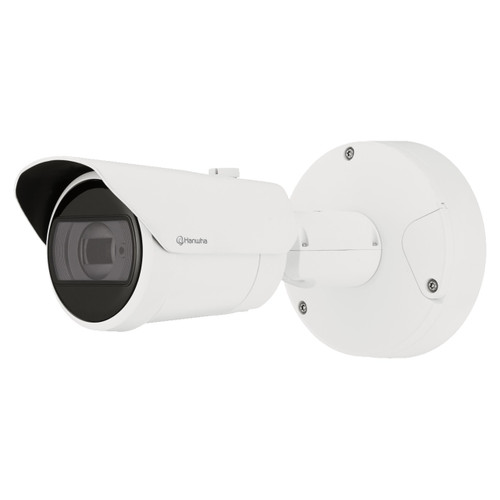
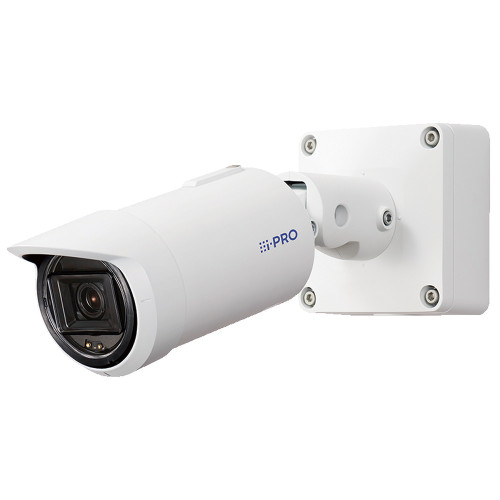
In This Guide
How do the imaging specs compare?
Both cameras use a 1/2.8-inch progressive CMOS sensor and deliver 1920×1080 at 60 fps with H.265/H.264/MJPEG compression. The XNO-C6083R features a 2.8–12 mm motorized varifocal lens (4.3× zoom, F1.4–F3.6) giving a horizontal field of view of 120° (wide) to approximately 27° (tele), while the WV-S1536LA uses a 2.9–9 mm motorized varifocal lens (3.1× optical zoom, F1.3–F2.5) with a 37–117° horizontal FOV in 16:9 mode. The C6083R therefore offers a longer tele end (12 mm vs. 9 mm), which is reflected in its DORI tele-detect figure of 159.9 m versus 114.8 m for the S1536LA.
On WDR, the XNO-C6083R is rated at 150 dB (Hanwha extremeWDR), whereas the WV-S1536LA specifies a maximum of 144 dB (Super Dynamic, level 31). For low-light, the C6083R lists 0.01 Lux color / 0 Lux IR; the S1536LA specifies 0.007 Lux color (30IRE) and 0.005 Lux B&W (50IRE, F1.3). IR illumination is 40 m (WiseIR) on the C6083R versus 70 m (30IRE) / 50 m (50IRE) on the S1536LA — a meaningful difference for deep-perimeter applications. The C6083R lists a built-in gyro-based digital image stabilization; no equivalent DIS is specified for the S1536LA.
What about installation and environment?
Both cameras carry IP66, NEMA 4X, and IK10 ratings. The XNO-C6083R adds IP67 and holds certifications under IEC/EN 60529 and IEC/EN 62262. The S1536LA adds a wind-resistance rating of up to 40 m/s (~89 mph), which is not stated for the C6083R. The S1536LA also specifies an anti-condensation system (Temish element, heater, and moisture absorption gel); no equivalent feature is listed for the C6083R.
Operating temperature for the XNO-C6083R is −40°C to +55°C; the WV-S1536LA is rated −40°C to +60°C (power-on start from −30°C). Both accept PoE IEEE 802.3af, but the C6083R is PoE Class 3 (max 12.95 W) and also accepts 12 VDC, while the S1536LA draws 9.1 W over PoE (listed as Class 0) and also accepts DC 12 V at 710 mA. Physically, the C6083R (ø93.4 × 276.6 mm, 1,640 g) is notably smaller and lighter than the S1536LA (ø133 × 133 × 383 mm, 2,400 g). The C6083R ships with a backbox and lists conduit knockout compatibility; the S1536LA spec does not detail a backbox or conduit compatibility. The C6083R also provides a Micro USB Type-B output (1280×720) for on-site alignment; the S1536LA provides a VBS 1.0 V composite BNC monitor output for the same purpose.
Which fits your VMS and analytics better?
Both cameras declare ONVIF Profile S/G/T/M compliance. The XNO-C6083R additionally exposes SUNAPI and Wisenet SDK interfaces; the S1536LA does not list equivalent proprietary SDKs but does add SFTP to its protocol stack (not listed for the C6083R). Simultaneous user limits differ: the C6083R supports up to 20 unicast users, the S1536LA up to 14 users. Edge storage is microSD/SDHC/SDXC up to 512 GB on both models. The C6083R specifies 2 configurable alarm I/O ports; the S1536LA specifies 3 alarm inputs and 1 alarm output plus 1 AUX output — giving installers more discrete trigger lines. Audio connectors differ: the C6083R uses selectable mic/line input (2.5 VDC plug-in power, 2 kΩ) and line out (1 Vrms), while the S1536LA uses a 3.5 mm stereo mini jack for both input and output. The S1536LA explicitly lists FIPS 140-2 Level 3 compliance in its security spec; this certification is not stated for the C6083R.
On analytics, the XNO-C6083R lists AI-based detection of persons, faces, vehicles (type sub-classification: car/bus/truck/motorcycle/bicycle), and license plates, plus virtual line/area events, people counting, queue management, and heatmap business intelligence. The WV-S1536LA lists 8 AI detection modes, face detection, AI sound classification (gunshot, yell, vehicle horn, glass break), scene change detection, and audio detection. The S1536LA's AI sound classification capability is not present in the C6083R spec; the C6083R's license-plate detection and business-intelligence suite (queue management, heatmap) are not listed for the S1536LA. The C6083R also specifies 32 privacy mask zones (quadrangle + mosaic + color options) versus 8 zones on the S1536LA. Warranty is 3 years for the C6083R and 5 years for the S1536LA.
Which should you choose: the C6083R or the S1536LA?
Our take: The WV-S1536LA is the stronger choice when IR range, upper operating temperature, and acoustic AI analytics are the deciding factors: it reaches 70 m IR versus 40 m, operates to +60°C versus +55°C, and adds gunshot/yell/glass-break sound classification not present in the C6083R spec. The C6083R is the stronger choice when tele reach, WDR ceiling, and analytics depth matter more: its 4.3× zoom to 12 mm achieves a DORI detect of 159.9 m (tele) versus 114.8 m, its WDR is rated 150 dB versus 144 dB, and it adds license-plate detection, people counting, queue management, and heatmap analytics not listed for the S1536LA. The C6083R is also significantly lighter (1,640 g vs. 2,400 g) and lists a SUNAPI/Wisenet SDK for Hanwha VMS environments. Teams running i-PRO/Milestone/Genetec with a need for acoustic detection or longer warranty coverage (5 vs. 3 years) will find the S1536LA better aligned.
Side-by-Side Comparison
Spec-for-spec, from manufacturer data.
| Specification | Hanwha C6083R | i-PRO S1536LA |
|---|---|---|
| Resolution | 1920×1080 (2MP) | 1920×1080 (2MP) |
| Image Sensor | 1/2.8" progressive CMOS | Approx. 1/2.8" CMOS |
| Lens / Focal Length | 2.8–12 mm motorized varifocal, 4.3× zoom | 2.9–9 mm motorized varifocal, 3.1× zoom |
| Max Aperture | F1.4 (Wide) – F3.6 (Tele) | F1.3 (Wide) – F2.5 (Tele) |
| Horizontal FOV | 120° (Wide) – ~27° (Tele) | 37°–117° (16:9 Wide–Tele) |
| Min. Illumination (Color) | 0.01 Lux | 0.007 Lux (30IRE) |
| IR Range | 40 m (WiseIR) | 70 m (30IRE) / 50 m (50IRE) |
| WDR | 150 dB (extremeWDR) | 144 dB (Super Dynamic, level 31) |
| Max Frame Rate | 60 fps | 60 fps |
| Video Compression | H.265 / H.264 / MJPEG | H.265 / H.264 / MJPEG |
| IP Rating | IP66 / IP67 / NEMA 4X | IP66 / NEMA 4X |
| Impact Rating | IK10 | IK10 |
| Operating Temperature | -40°C to +55°C | -40°C to +60°C (power-on from -30°C) |
| Power Input / PoE Class | PoE 802.3af (Class 3) / 12 VDC; 12.95 W max | PoE 802.3af (Class 0) / DC 12 V; 9.1 W |
| Alarm I/O | 2 configurable I/O ports | 3 Alarm IN / 1 Alarm OUT / 1 AUX OUT |
| Edge Storage | microSD/SDHC/SDXC up to 512 GB | microSD/SDHC/SDXC 2 GB–512 GB |
| Audio Connectors | Selectable mic/line in; line out (1 Vrms) | 3.5 mm stereo mini jack (in and out) |
| ONVIF Profiles | S / G / T / M | G / M / S / T |
| Security Certifications | HTTPS, 802.1X, Digest auth, IP filtering | FIPS 140-2 Level 3, HTTPS, 802.1X |
| Dimensions (W×D) | ø93.4 × 276.6 mm | ø133 × 133 × 383 mm |
| Weight | 1,640 g (3.62 lb) | 2,400 g (5.3 lb) |
| Warranty | 3 years | 5 years |
Frequently Asked Questions
Which should you choose: the C6083R or the S1536LA?
The WV-S1536LA is the stronger choice when IR range, upper operating temperature, and acoustic AI analytics are the deciding factors: it reaches 70 m IR versus 40 m, operates to +60°C versus +55°C, and adds gunshot/yell/glass-break sound classification not present in the C6083R spec. The C6083R is the stronger choice when tele reach, WDR ceiling, and analytics depth matter more: its 4.3× zoom to 12 mm achieves a DORI detect of 159.9 m (tele) versus 114.8 m, its WDR is rated 150 dB versus 144 dB, and it adds license-plate detection, people counting, queue management, and heatmap analytics not listed for the S1536LA. The C6083R is also significantly lighter (1,640 g vs. 2,400 g) and lists a SUNAPI/Wisenet SDK for Hanwha VMS environments. Teams running i-PRO/Milestone/Genetec with a need for acoustic detection or longer warranty coverage (5 vs. 3 years) will find the S1536LA better aligned.
Is the C6083R or S1536LA better for low-light and IR coverage?
For raw IR distance, the S1536LA reaches 70 m at 30IRE versus 40 m for the C6083R — a significant advantage for deep-perimeter or parking-lot scenes. For color low-light sensitivity, the S1536LA specifies 0.007 Lux (30IRE) compared to 0.01 Lux for the C6083R, though measurement conditions differ between manufacturers. WDR is rated higher on the C6083R at 150 dB versus 144 dB for the S1536LA.
Which camera has stronger AI analytics — the C6083R or S1536LA?
Each model covers different analytics use cases. The C6083R specifies license-plate detection, vehicle sub-type classification (car/bus/truck/motorcycle/bicycle), people counting, queue management, and heatmap analytics not listed for the S1536LA. The S1536LA specifies AI sound classification (gunshot, yell, vehicle horn, glass break) and scene change detection not present in the C6083R spec. Buyers should match the camera to their specific detection requirements rather than treating one as uniformly superior.
Can both cameras work in extreme cold or hot environments?
Both cameras are rated to −40°C at the cold end. At the high end, the S1536LA is specified to +60°C versus +55°C for the C6083R, giving it a modest advantage in high-heat enclosures or rooftop installs. Note that the S1536LA lists a power-on minimum of −30°C, meaning a cold-start below that temperature is outside its stated operating range even though storage is rated lower; no equivalent cold-start restriction is listed for the C6083R.
Get a Second Opinion on Your Camera Choice
Share your site layout, coverage goals, and budget. Our team will validate the camera selection, flag anything we would change, and recommend products that match the use case.