
Hanwha C6083R vs i-PRO S1536LA-B: Specification Comparison
Both the Hanwha XNO-C6083R and the i-PRO WV-S1536LA-B are 2MP (1920×1080) outdoor bullet cameras with motorized varifocal lenses, 60fps capability, built-in IR, IP66/IK10 ratings, and PoE power — making them directly cross-shoppable for perimeter and façade surveillance projects. This comparison covers imaging performance, physical installation requirements, and VMS/analytics integration, drawing exclusively from manufacturer-published specifications for each model.
In This Guide
How do the imaging specs compare?
Both cameras share a 1/2.8-inch progressive CMOS sensor and 1920×1080 at 60fps. The Hanwha XNO-C6083R uses a 2.8–12mm (4.3x) motorized varifocal lens with a maximum aperture of F1.4 (wide), delivering a horizontal FOV of 120° at wide end. The i-PRO WV-S1536LA-B uses a 2.9–9mm (3.1x) motorized lens with a maximum aperture of F1.3 (wide) and a horizontal FOV of 117° at wide end. The Hanwha's longer tele end extends DORI Detect reach to 159.9m versus the i-PRO's 114.8m, a roughly 39% advantage at tele.
For WDR, the Hanwha specifies extremeWDR at 150dB, while the i-PRO specifies Super Dynamic at a maximum of 144dB — a 6dB difference on paper. IR range favors the i-PRO at 70m (30IRE) versus the Hanwha's 40m WiseIR rating, a significant 75% reach advantage. Minimum illumination differs by measurement convention: Hanwha states 0.01 Lux color / 0 Lux IR; i-PRO states 0.007 Lux color (30IRE) / 0 Lux IR, giving the i-PRO a marginal edge in rated color sensitivity. The Hanwha adds digital image stabilization via a built-in gyro sensor; the i-PRO specification does not list this feature.
What about installation and environment?
Both cameras carry IP66, IK10 (IEC 62262), and NEMA 4X ratings. The Hanwha adds IP67, providing full temporary immersion protection; the i-PRO specification lists IP66 and NEMA 4X only. Operating temperature is identical at -40°C to +60°C for the i-PRO (power-on floor is -30°C), while the Hanwha is rated -40°C to +55°C — the i-PRO holds a 5°C upper-temperature advantage. The i-PRO also specifies wind resistance up to 40 m/s (~89 mph) and an anti-condensation system (Temish element + heater + moisture absorption gel); the Hanwha specification does not list equivalent features.
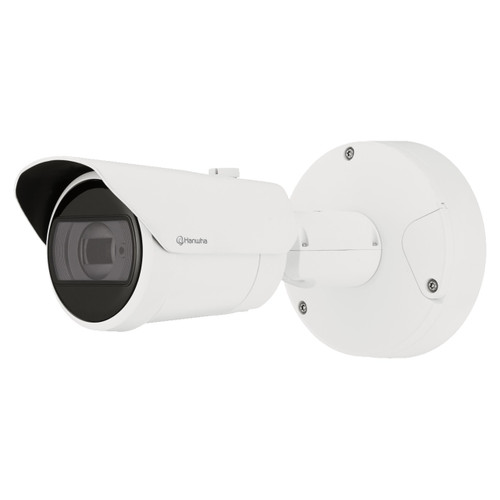
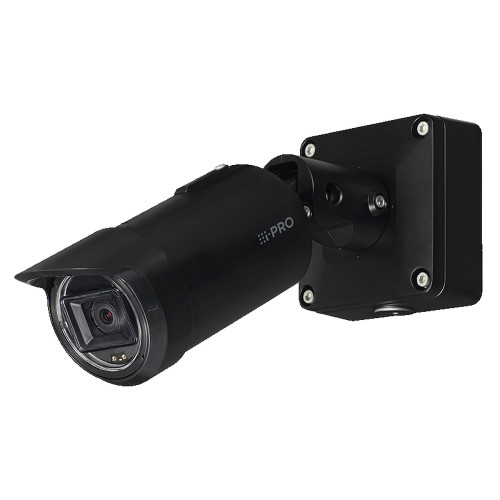
On power and form factor: the Hanwha draws up to 12.95W on PoE IEEE 802.3af Class 3, and also accepts 12VDC. The i-PRO draws 8.5–9.1W on PoE 802.3af (PoE Class 0 per listed attribute) and also accepts DC12V. The i-PRO is physically larger and heavier at ø133×383mm / 2.4kg versus the Hanwha's ø93.4×276.6mm / 1.64kg. The Hanwha includes a backbox and lists conduit hole compatibility (single/double/4" octagon/4" square); the i-PRO specification does not detail conduit options. The Hanwha ships in white (RAL9003); the i-PRO WV-S1536LA-B ships in black.
Which fits your VMS and analytics better?
Both cameras support ONVIF Profiles G/M/S/T and H.265/H.264/MJPEG compression with CBR/VBR modes and edge storage up to 512GB microSD/SDXC. The Hanwha supports up to 20 unicast users and up to 10 stream profiles; the i-PRO supports up to 14 simultaneous users. The Hanwha implements WiseStream II/III smart codec; the i-PRO implements Variable GOP (1–60s) and frame-rate control. Protocol depth is comparable: both support MQTT, LLDP, SNMPv1/v2c/v3, 802.1X, SRTP, and HTTPS/TLS. The i-PRO adds SFTP and specifies FIPS 140-2 Level 3 compliance and a monitor output (VBS composite) for local adjustment; the Hanwha specification does not list FIPS certification or a composite monitor output.
On analytics, the Hanwha XNO-C6083R specifies AI-based object detection classifying Person, Face, Vehicle (car/bus/truck/motorcycle/bicycle), and License Plate, with virtual line/area events, plus business intelligence features: people counting, queue management, and heatmap. The Hanwha also lists 8 VMD zones (8-point polygonal) and 32 privacy mask zones. The i-PRO WV-S1536LA-B lists AI Video Analytics (8 types), AI Sound Classification (gunshot, yell, vehicle horn, glass break), 4 VMD areas, Scene Change Detection, and Audio Detection, with up to 8 privacy zones. The Hanwha offers 2 configurable alarm I/O ports; the i-PRO offers 3 alarm inputs, 1 alarm output, and 1 AUX output. Both include audio in/out; the i-PRO uses 3.5mm jacks while the Hanwha uses selectable mic/line in. The Hanwha carries a 3-year warranty; the i-PRO carries a 5-year warranty.
Which should you choose: the C6083R or the S1536LA-B?
Our take: The XNO-C6083R is the stronger choice when longer tele reach, higher WDR rating, and richer AI classification — including license plate and vehicle-type detection — are the primary requirements. Its 2.8–12mm lens extends DORI Detect to 159.9m versus the i-PRO's 114.8m at tele, and its extremeWDR is rated at 150dB versus the i-PRO's 144dB Super Dynamic maximum. It also adds IP67 immersion rating, digital image stabilization (gyro), and business intelligence analytics (people counting, queue management, heatmap) not listed in the i-PRO spec. Conversely, the WV-S1536LA-B is the better fit when IR range is critical (70m versus 40m), a higher ambient operating ceiling is needed (+60°C versus +55°C), FIPS 140-2 Level 3 network security compliance is required, AI sound classification matters, or the 5-year warranty versus 3-year warranty is a procurement factor. Both share the same sensor class, resolution, and ONVIF Profile support.
Side-by-Side Comparison
Spec-for-spec, from manufacturer data.
| Specification | Hanwha C6083R | i-PRO S1536LA-B |
|---|---|---|
| Resolution | 1920×1080 (2MP) | 1920×1080 (2MP) |
| Image Sensor | 1/2.8" progressive CMOS | Approx. 1/2.8" CMOS |
| Lens / Focal Length | 2.8–12mm motorized varifocal (4.3x) | 2.9–9mm motorized varifocal (3.1x) |
| Max Aperture (Wide) | F1.4 | F1.3 |
| Horizontal FOV (Wide) | 120° | 117° |
| Min. Illumination (Color) | 0.01 Lux | 0.007 Lux @ 30IRE |
| Min. Illumination (IR) | 0 Lux | 0 Lux |
| IR Range | 40m (WiseIR) | 70m (30IRE) / 50m (50IRE) |
| WDR | extremeWDR 150dB | Super Dynamic max 144dB |
| Max Frame Rate | 60fps | 60fps |
| Video Compression | H.265 / H.264 / MJPEG | H.265 / H.264 / MJPEG |
| IP Rating | IP66 / IP67 / NEMA 4X | IP66 / NEMA 4X |
| IK / Impact Rating | IK10 | IK10 |
| Operating Temperature | -40°C to +55°C | -40°C to +60°C (power-on: -30°C) |
| Power Input / PoE Class | PoE IEEE 802.3af Class 3 / 12VDC; 12.95W max | PoE 802.3af Class 0 / DC12V; 8.5–9.1W |
| Alarm I/O | 2 configurable I/O ports | 3x Alarm IN, 1x Alarm OUT, 1x AUX OUT |
| Edge Storage | microSD/SDHC/SDXC up to 512GB | microSD/microSDHC/microSDXC up to 512GB |
| ONVIF Profiles | G / M / S / T | G / M / S / T |
| FIPS 140-2 Level 3 | — | Yes |
| Digital Image Stabilization | Yes (built-in gyro sensor) | — |
| AI Analytics | Person, Face, Vehicle type, License plate; people counting, queue mgmt, heatmap | AI Video Analytics (8 types); AI Sound Classification (gunshot, yell, vehicle horn, glass break) |
| Dimensions (approx.) | ø93.4 × 276.6mm | ø133 × 383mm |
| Weight (approx.) | 1,640g (3.62 lb) | 2,400g (5.3 lb) |
| Housing Color | White (RAL9003) | Black |
| Warranty | 3 years | 5 years |
Frequently Asked Questions
Which should you choose: the C6083R or the S1536LA-B?
The XNO-C6083R is the stronger choice when longer tele reach, higher WDR rating, and richer AI classification — including license plate and vehicle-type detection — are the primary requirements. Its 2.8–12mm lens extends DORI Detect to 159.9m versus the i-PRO's 114.8m at tele, and its extremeWDR is rated at 150dB versus the i-PRO's 144dB Super Dynamic maximum. It also adds IP67 immersion rating, digital image stabilization (gyro), and business intelligence analytics (people counting, queue management, heatmap) not listed in the i-PRO spec. Conversely, the WV-S1536LA-B is the better fit when IR range is critical (70m versus 40m), a higher ambient operating ceiling is needed (+60°C versus +55°C), FIPS 140-2 Level 3 network security compliance is required, AI sound classification matters, or the 5-year warranty versus 3-year warranty is a procurement factor. Both share the same sensor class, resolution, and ONVIF Profile support.
Is the XNO-C6083R or WV-S1536LA-B better for low-light and IR performance?
The i-PRO WV-S1536LA-B has the longer IR range at 70m (30IRE) versus the Hanwha XNO-C6083R's 40m WiseIR, a 75% reach advantage. On color minimum illumination, the i-PRO is rated 0.007 Lux (30IRE) versus 0.01 Lux for the Hanwha — a marginal edge. Both reach 0 Lux with IR active. For scenes requiring illumination of distant subjects, the i-PRO's IR range is the deciding factor.
Which camera offers better WDR for backlit or high-contrast scenes?
The Hanwha XNO-C6083R specifies extremeWDR at 150dB. The i-PRO WV-S1536LA-B specifies Super Dynamic at a maximum of 144dB (at level 31). Both are high-performance WDR implementations, but the Hanwha's published rating is 6dB higher. Neither manufacturer's specification defines identical test conditions, so this figure should be treated as a datasheet comparison rather than a guaranteed real-world delta.
Does either camera meet government or enterprise network security compliance requirements?
The i-PRO WV-S1536LA-B specifies FIPS 140-2 Level 3 compliance, which is a formal requirement in many U.S. federal and regulated-enterprise deployments. The Hanwha XNO-C6083R specification does not list FIPS certification. Both cameras support HTTPS/TLS, IEEE 802.1X, SNMPv3, and device certificates, but if FIPS 140-2 Level 3 is a hard requirement, only the i-PRO meets it per published specs.
Get a Second Opinion on Your Camera Choice
Share your site layout, coverage goals, and budget. Our team will validate the camera selection, flag anything we would change, and recommend products that match the use case.