
Geovision TDR2700-1F10 vs Geovision VD25000-001U: Specification Comparison
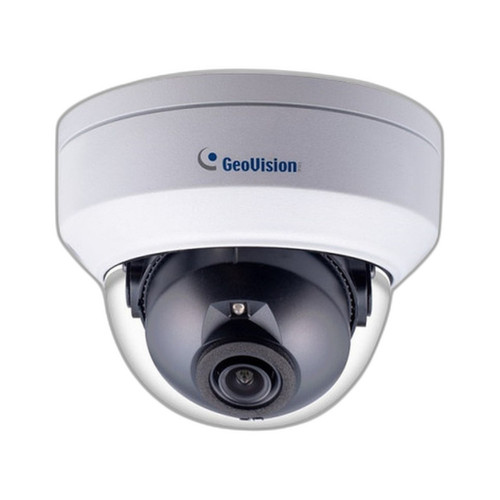
The Geovision TDR2700-1F10 and VD25000-001U are both 2MP PoE dome cameras from the same manufacturer, targeted at indoor/outdoor IP surveillance deployments. The TDR2700-1F10 is positioned as a mini rugged dome with a fixed lens and WDR, while the VD25000-001U is an IP66-rated vandal dome with a varifocal lens, extended temperature rating, and broader low-light modes. Installers evaluating both for a 2MP dome slot will find meaningful differences in lens flexibility, environmental hardening, and VMS profile support.
In This Guide
How do the imaging specs compare?
Both cameras deliver 2MP resolution and include IR night vision. The TDR2700-1F10 ships with a fixed 4mm lens, which fixes the horizontal field of view at installation and suits corridors or entry points where the angle is known in advance. It also lists WDR as a supported feature, which assists in scenes with simultaneous bright and shadowed areas such as doorways or parking structures. Minimum illumination figures and IR range in meters are not specified in the provided data for either model.
The VD25000-001U uses a varifocal 3–9mm lens, giving the installer flexibility to dial in the field of view on-site without changing optics—useful in spaces where camera placement options are limited. Its low-light capabilities are described more granularly: IR, Day/Night switching, and Super Low Lux are all listed, indicating a dedicated ICR cut filter and a sensor tuned for low-light performance. WDR is not listed in the VD25000-001U's provided specs. IR range is not specified for either unit.
What about installation and environment?
The TDR2700-1F10 supports ceiling and wall mounting in a dome form factor and is powered via PoE 802.3af. No IP ingress rating, IK impact rating, or operating temperature range is provided in the supplied specifications, which limits the ability to confirm its suitability for outdoor or harsh-environment use based on the data at hand.
The VD25000-001U carries an IP66 rating, confirming protection against high-pressure water jets and dust ingress, making it suitable for outdoor installation. It accepts PoE 802.3af/at, meaning it can draw higher wattage from an 802.3at switch if needed. Its operating temperature range of -40°C to 60°C is explicitly specified, covering extreme cold and heat environments. It also mounts on ceiling or wall. IK impact rating is not listed in the provided specs for either camera.
Which fits your VMS and analytics better?
The TDR2700-1F10 is listed as ONVIF-compliant and compatible with H.264/H.265 video management software but does not specify a particular ONVIF profile (e.g., Profile S or T). The VD25000-001U explicitly lists ONVIF Profile S/T compliance, which provides a more precise integration baseline for NVR and VMS vendors that require profile-level conformance. Both cameras support ceiling and wall mount and standard dome integration. Edge storage, audio input/output, and on-board analytics are not specified for either model in the provided data.
Which should you choose: the TDR2700-1F10 or the VD25000-001U?
Our take: The VD25000-001U is the stronger choice when the installation environment is outdoors, temperatures swing to extremes, or field-of-view adjustment at commissioning time is required. Its IP66 rating and -40°C to 60°C operating range are explicitly confirmed in the specs, where the TDR2700-1F10 provides no equivalent environmental ratings. The varifocal 3–9mm lens on the VD25000-001U offers roughly 2.25× the focal-length range versus the TDR2700-1F10's fixed 4mm, reducing the need for precise pre-planning of camera placement. The VD25000-001U also declares ONVIF Profile S/T explicitly, while the TDR2700-1F10 states only generic ONVIF compliance without a profile designation. The TDR2700-1F10 is the more relevant option when WDR performance is the primary requirement and the install is in a controlled, indoor environment with a known fixed angle, and where the simpler 802.3af-only power budget is a constraint.
Side-by-Side Comparison
Spec-for-spec, from manufacturer data.
| Specification | Geovision TDR2700-1F10 | Geovision VD25000-001U |
|---|---|---|
| Resolution | 2 MP | 2 MP |
| Camera Type | Mini Rugged Dome | Vandal Dome |
| Lens / Focal Length | 4mm fixed | Varifocal 3–9mm |
| WDR | Yes | — |
| IR Night Vision | Yes | Yes |
| Low-Light Modes | IR | IR; Day/Night; Super Low Lux |
| IP Rating | — | IP66 |
| Operating Temperature | — | -40°C to 60°C |
| Power Input / PoE Class | PoE (802.3af) | PoE (802.3af/at) |
| ONVIF | ONVIF-compliant (profile not specified) | ONVIF Profile S/T |
| Video Compression | H.264 / H.265 | — |
| Mount Type | Ceiling; Wall | Ceiling; Wall |
Frequently Asked Questions
Which should you choose: the TDR2700-1F10 or the VD25000-001U?
The VD25000-001U is the stronger choice when the installation environment is outdoors, temperatures swing to extremes, or field-of-view adjustment at commissioning time is required. Its IP66 rating and -40°C to 60°C operating range are explicitly confirmed in the specs, where the TDR2700-1F10 provides no equivalent environmental ratings. The varifocal 3–9mm lens on the VD25000-001U offers roughly 2.25× the focal-length range versus the TDR2700-1F10's fixed 4mm, reducing the need for precise pre-planning of camera placement. The VD25000-001U also declares ONVIF Profile S/T explicitly, while the TDR2700-1F10 states only generic ONVIF compliance without a profile designation. The TDR2700-1F10 is the more relevant option when WDR performance is the primary requirement and the install is in a controlled, indoor environment with a known fixed angle, and where the simpler 802.3af-only power budget is a constraint.
Is the TDR2700-1F10 or VD25000-001U better for outdoor installation?
Based on the provided specifications, the VD25000-001U is the documented outdoor-capable option: it carries an IP66 rating and a confirmed operating range of -40°C to 60°C. The TDR2700-1F10 has no IP rating or temperature range listed in the supplied specs, so its suitability for outdoor use cannot be confirmed from the data available.
Which camera gives me more flexibility if I am not sure of the exact mounting angle before install?
The VD25000-001U's varifocal 3–9mm lens allows the installer to adjust the field of view on-site within that range. The TDR2700-1F10 has a fixed 4mm lens, so the field of view is set at the factory and cannot be changed without swapping optics.
Do both cameras work with my existing ONVIF NVR?
Both cameras claim ONVIF compliance. The VD25000-001U specifies ONVIF Profile S/T, which are the most common profiles required by NVR manufacturers for device discovery and streaming interoperability. The TDR2700-1F10 is listed as ONVIF-compliant without a named profile, so you should verify profile compatibility directly with your NVR vendor before assuming full feature parity.
Get a Second Opinion on Your Camera Choice
Share your site layout, coverage goals, and budget. Our team will validate the camera selection, flag anything we would change, and recommend products that match the use case.