
Geovision MFD2700-2F10 vs Geovision TDR2700-1F10: Specification Comparison
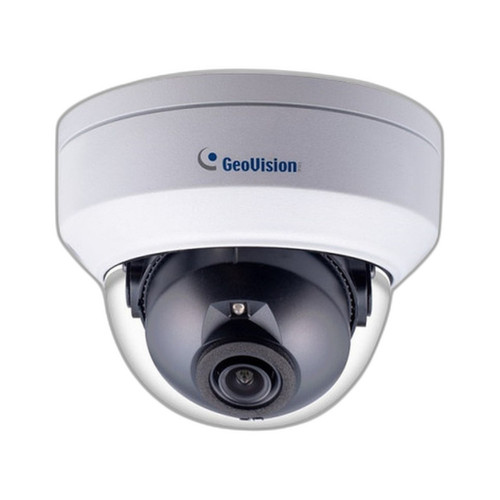
The Geovision MFD2700-2F10 and TDR2700-1F10 are both 2MP fixed-lens mini dome cameras aimed at cost-conscious IP surveillance deployments. Both share 802.3af PoE power, IR night vision, H.265 compression support, and ONVIF compliance, making them genuine cross-shop candidates for integrators evaluating indoor ceiling-mount installations. The primary differentiators lie in ruggedization designation, lens focal length, WDR implementation tier, mounting flexibility, and cable category classification—factors that drive placement decisions in lobbies, corridors, loading docks, and light-industrial environments.
In This Guide
How do the imaging specs compare?
Both cameras deliver 2MP resolution with IR-assisted night vision and WDR capability, but the MFD2700-2F10 specifies 'WDR Pro' while the TDR2700-1F10 lists only 'WDR.' This distinction suggests the MFD2700-2F10 uses a higher-grade dynamic range processing tier—relevant in scenes with simultaneous bright windows and shadowed interiors—though no numeric dB values are provided in either spec sheet to quantify the difference. Minimum illumination figures are absent for both models, so direct low-light sensitivity cannot be compared from the available data.
The lens focal lengths differ slightly: the MFD2700-2F10 ships with a 3.8mm fixed lens while the TDR2700-1F10 uses a 4mm fixed lens. Both are wide-angle, ceiling-mount orientations, but the 3.8mm provides a marginally wider field of view, which can matter in compact corridors or lobby corners. IR range specifications are not stated for either model in the provided data. The MFD2700-2F10 explicitly lists H.265 compression; the TDR2700-1F10 specifies compatibility with 'H.264/H.265 video management software,' implying dual-codec output but not confirming native H.265 encoding as a standalone spec.
What about installation and environment?
The TDR2700-1F10 carries the 'Rugged' designation in its product name and type field, suggesting enhanced environmental tolerance, but no IP or IK rating is specified in the provided data for either model—preventing a direct ingress-protection or impact-resistance comparison. Installers evaluating outdoor or semi-outdoor exposure, or locations subject to vandal risk, should request datasheet confirmation of rated protection classes before specifying either unit.
The MFD2700-2F10 is classified as ceiling-mount only, while the TDR2700-1F10 supports both ceiling and wall mounting—a meaningful advantage for corridor end-walls, stairwells, or perimeter coverage points where ceiling runs are impractical. Both cameras are powered by PoE 802.3af (Class 3, max 15.4W draw), simplifying single-cable deployment without a local power supply. Operating temperature ranges are not listed for either model in the provided specifications.
Which fits your VMS and analytics better?
The MFD2700-2F10 explicitly states ONVIF compliance and lists 'ONVIF-compliant systems' as its VMS compatibility target. It also carries a 'Connectivity: Ethernet' spec and is categorized under 'IPPTZCam' cable category, though no PTZ capability is specified in its feature set—this classification may reflect catalog taxonomy rather than functional pan-tilt-zoom. Edge analytics, on-board audio, and local storage (SD card) are not specified for this model in the provided data.
The TDR2700-1F10 lists VMS compatibility with 'ONVIF-compliant NVR; H.264/H.265 video management software,' indicating broader codec-level interoperability across legacy H.264 NVRs in addition to H.265 platforms. ONVIF conformance is implied by this compatibility statement but is not explicitly called out as a standalone spec the way the MFD2700-2F10 states it. Edge analytics, audio I/O, and on-board storage are also absent from the TDR2700-1F10's provided specifications. Neither model lists a specific ONVIF profile (S, G, T) in the available data.
Which should you choose: the MFD2700-2F10 or the TDR2700-1F10?
Our take: The MFD2700-2F10 is the stronger choice when imaging fidelity in mixed-lighting environments is the primary concern, while the TDR2700-1F10 is preferable where mounting flexibility and ruggedization are driving requirements. On imaging, the MFD2700-2F10's 'WDR Pro' tier outranks the TDR2700-1F10's standard 'WDR,' and its 3.8mm lens provides a marginally wider field of view versus the TDR2700-1F10's 4mm fixed lens. On installation, the TDR2700-1F10's ceiling-and-wall dual-mount support versus the MFD2700-2F10's ceiling-only orientation expands placement options in corridors, stairwells, and perimeter locations. Both share 802.3af PoE and ONVIF compatibility. Key specs including IP/IK ratings, IR range, minimum illumination, operating temperature, and on-board storage are absent from both datasheets as provided—confirm these with Geovision before finalizing specs for outdoor, vandal-risk, or analytics-dependent deployments.
Side-by-Side Comparison
Spec-for-spec, from manufacturer data.
| Specification | Geovision MFD2700-2F10 | Geovision TDR2700-1F10 |
|---|---|---|
| Resolution | 2 MP | 2 MP |
| Camera Type | Mini Dome | Mini Rugged Dome |
| Lens / Focal Length | 3.8mm fixed | 4mm fixed |
| WDR | WDR Pro | WDR |
| IR Night Vision | Yes | Yes |
| Video Compression | H.265 | H.264 / H.265 (VMS compatibility stated) |
| ONVIF | Yes (explicitly stated) | Implied via VMS compatibility statement |
| Power Input | PoE (802.3af) | PoE (802.3af) |
| Mount Type | Ceiling | Ceiling; Wall |
Frequently Asked Questions
Which should you choose: the MFD2700-2F10 or the TDR2700-1F10?
The MFD2700-2F10 is the stronger choice when imaging fidelity in mixed-lighting environments is the primary concern, while the TDR2700-1F10 is preferable where mounting flexibility and ruggedization are driving requirements. On imaging, the MFD2700-2F10's 'WDR Pro' tier outranks the TDR2700-1F10's standard 'WDR,' and its 3.8mm lens provides a marginally wider field of view versus the TDR2700-1F10's 4mm fixed lens. On installation, the TDR2700-1F10's ceiling-and-wall dual-mount support versus the MFD2700-2F10's ceiling-only orientation expands placement options in corridors, stairwells, and perimeter locations. Both share 802.3af PoE and ONVIF compatibility. Key specs including IP/IK ratings, IR range, minimum illumination, operating temperature, and on-board storage are absent from both datasheets as provided—confirm these with Geovision before finalizing specs for outdoor, vandal-risk, or analytics-dependent deployments.
Is the MFD2700-2F10 or TDR2700-1F10 better for low light?
Neither model provides minimum illumination figures or IR range distances in the available specifications, so a direct low-light comparison cannot be made from the data provided. Both cameras include IR night vision. The MFD2700-2F10 specifies 'WDR Pro' versus the TDR2700-1F10's standard 'WDR,' which suggests superior dynamic range processing in mixed-light scenes, but zero-lux IR performance should be confirmed against Geovision's full datasheets before selecting either unit for critical low-light applications.
Can the TDR2700-1F10 be mounted on a wall instead of a ceiling?
Yes. The TDR2700-1F10 specifies both ceiling and wall as supported mount types. The MFD2700-2F10 lists ceiling mount only. If your installation requires wall-end mounting in a corridor, stairwell, or exterior soffit, the TDR2700-1F10 offers that flexibility without an additional adapter bracket—though bracket requirements should be verified against Geovision's installation guide.
Do both cameras work with my existing H.264 NVR?
The TDR2700-1F10 explicitly lists compatibility with 'H.264/H.265 video management software,' indicating it can stream to legacy H.264 NVRs. The MFD2700-2F10's provided specs list H.265 compression and ONVIF compliance but do not explicitly confirm H.264 fallback output. If your NVR does not support H.265, verify H.264 capability with Geovision before deploying the MFD2700-2F10. Both cameras state ONVIF compatibility, which should provide a baseline interoperability path on any ONVIF-conformant NVR.
Get a Second Opinion on Your Camera Choice
Share your site layout, coverage goals, and budget. Our team will validate the camera selection, flag anything we would change, and recommend products that match the use case.