
Geovision MD520-100U vs Geovision VD57000-0020: Specification Comparison
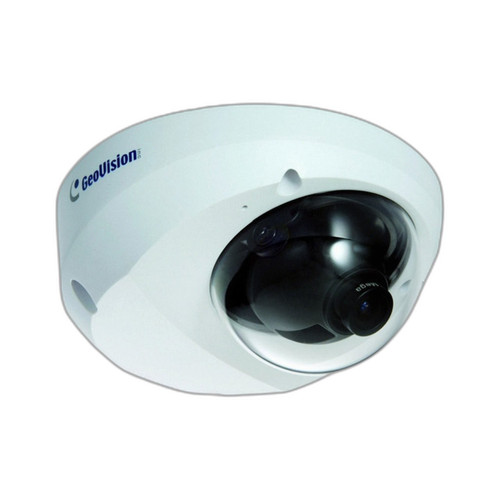
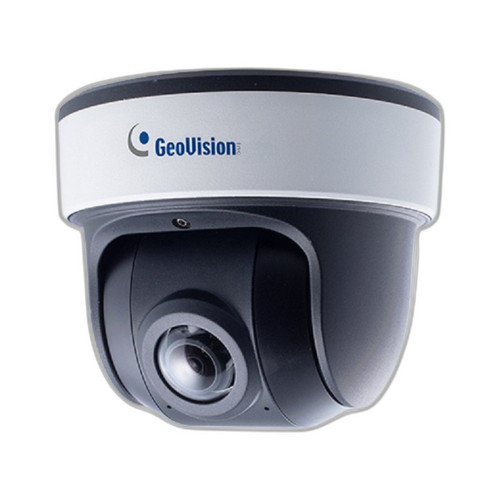
Both the Geovision MD520-100U and the VD57000-0020 are 5MP PoE dome IP cameras positioned for indoor and light-commercial surveillance deployments. They share the same resolution class and fixed-camera form factor, making them legitimate cross-shop candidates. The comparison centers on compression efficiency, low-light and vandal-resistance capabilities, lens options, VMS ecosystem fit, and audio support — practical differentiators for integrators specifying multi-camera systems on constrained bandwidth or requiring specific hardening.
In This Guide
How do the imaging specs compare?
Both cameras deliver 5MP resolution, providing equivalent pixel density for face and activity identification at comparable ranges. The VD57000-0020 specifies H.265 compression, which reduces storage and bandwidth requirements roughly in half versus H.264 at equivalent quality. The MD520-100U uses H.264; no H.265 capability is listed in its spec set.
The VD57000-0020 includes IR night vision and WDR, directly specified in its datasheet. A fixed 4.8mm lens is documented for the VD57000-0020. The MD520-100U lists no IR, no WDR, and no lens focal length in the provided specifications — buyers requiring low-light performance or high-contrast scene handling should treat those capabilities as absent for the MD520-100U based on available data.
What about installation and environment?
Both units are dome-form PoE cameras. The VD57000-0020 specifies PoE 802.3af compliance, giving installers a confirmed power budget and switch-compatibility baseline. The MD520-100U lists PoE connectivity and power but does not specify the PoE standard (802.3af vs. 802.3at), which may require verification before switch selection.
The MD520-100U supports both ceiling and wall mounting; the VD57000-0020 is listed for ceiling mounting only. The VD57000-0020 is described as a vandal dome, implying mechanical hardening, though no IK rating is explicitly provided in the supplied specs. Neither model lists an IP ingress rating, operating temperature range, or dimensions in the provided data — integrators must consult full datasheets for environmental suitability.
Which fits your VMS and analytics better?
The MD520-100U documents ONVIF compatibility alongside native Geovision GV-Center and GV-Air VMS support, giving integrators clear third-party interoperability assurance. The VD57000-0020 does not list ONVIF or any named VMS compatibility in the provided specifications — its ecosystem fit cannot be confirmed from the available data alone.
The MD520-100U includes two-way audio, useful for loss-prevention and intercept-style deployments without a separate audio device. The VD57000-0020 lists no audio capability in its spec set. Neither model lists edge storage, on-board analytics, or SD card support in the provided specifications.
Which should you choose: the MD520-100U or the VD57000-0020?
Our take: The MD520-100U is the stronger choice when two-way audio, confirmed ONVIF compatibility, and flexible wall-or-ceiling mounting are deployment priorities. Conversely, the VD57000-0020 is the stronger choice when H.265 compression, IR night vision, WDR, and vandal-resistant mechanical hardening are required. Key spec deltas: the VD57000-0020 uses H.265 versus the MD520-100U's H.264 — a meaningful storage and bandwidth advantage on large multi-camera systems. The VD57000-0020 provides IR and WDR where the MD520-100U lists neither. The MD520-100U documents ONVIF and GV-VMS compatibility where the VD57000-0020 lists none. Qualifier: VMS integrators standardized on ONVIF or Geovision GV-Center/GV-Air should verify VD57000-0020 compatibility independently before specifying it, as that data is absent from available specs.
Side-by-Side Comparison
Spec-for-spec, from manufacturer data.
| Specification | Geovision MD520-100U | Geovision VD57000-0020 |
|---|---|---|
| Resolution | 5 MP | 5 MP |
| Form Factor | Dome | Dome |
| Camera Type | Mini-Dome IP Camera | IR Vandal Dome Camera |
| Lens / Focal Length | — | 4.8mm |
| Video Compression | H.264 | H.265 |
| IR Night Vision | — | IR |
| WDR | — | WDR |
| Power Input / PoE Standard | PoE (standard not specified) | PoE (802.3af) |
| Mount Type | Ceiling; Wall | Ceiling |
| Audio | Two-way | — |
| ONVIF | Yes | — |
| VMS Compatibility | GV-Center; GV-Air; ONVIF | — |
| Vandal Resistance / IK Rating | — | Vandal Dome (IK not specified) |
Frequently Asked Questions
Which should you choose: the MD520-100U or the VD57000-0020?
The MD520-100U is the stronger choice when two-way audio, confirmed ONVIF compatibility, and flexible wall-or-ceiling mounting are deployment priorities. Conversely, the VD57000-0020 is the stronger choice when H.265 compression, IR night vision, WDR, and vandal-resistant mechanical hardening are required. Key spec deltas: the VD57000-0020 uses H.265 versus the MD520-100U's H.264 — a meaningful storage and bandwidth advantage on large multi-camera systems. The VD57000-0020 provides IR and WDR where the MD520-100U lists neither. The MD520-100U documents ONVIF and GV-VMS compatibility where the VD57000-0020 lists none. Qualifier: VMS integrators standardized on ONVIF or Geovision GV-Center/GV-Air should verify VD57000-0020 compatibility independently before specifying it, as that data is absent from available specs.
Is the MD520-100U or VD57000-0020 better for low-light or nighttime coverage?
Based on the provided specifications, the VD57000-0020 is the documented choice for low-light environments — it lists IR night vision explicitly. The MD520-100U does not list IR or any minimum illumination figure, so nighttime performance cannot be confirmed from available data.
Which camera will save more storage and bandwidth on a large multi-camera install?
The VD57000-0020 uses H.265 compression, which typically reduces bitrate roughly in half versus H.264 at equivalent quality. The MD520-100U is documented as H.264 only. On a large deployment this difference is material — H.265 can roughly halve NVR storage requirements and network load.
Does either camera support two-way audio, and which one works with third-party VMS platforms?
The MD520-100U specifies two-way audio and documents ONVIF, GV-Center, and GV-Air compatibility. The VD57000-0020 lists neither audio capability nor ONVIF or named VMS support in the available specifications. Integrators running non-Geovision VMS should verify VD57000-0020 compatibility directly with Geovision before procurement.
Get a Second Opinion on Your Camera Choice
Share your site layout, coverage goals, and budget. Our team will validate the camera selection, flag anything we would change, and recommend products that match the use case.