
Geovision ADR4701 vs Geovision EBD474W-0010: Specification Comparison
Both the Geovision GV-ADR4701 and the Geovision 84-EBD474W-0010 are 4MP fixed-lens indoor/outdoor dome cameras from the same manufacturer, targeting NVR/DVR-based IP surveillance deployments. The GV-ADR4701 is positioned as an H.265 mini dome with hardened environmental ratings, while the EBD474W-0010 is marketed as a Super Low Lux IR dome with advanced WDR. This comparison examines imaging capability, physical installation requirements, and VMS/ecosystem integration to help integrators and IT buyers determine which unit better fits a given deployment.
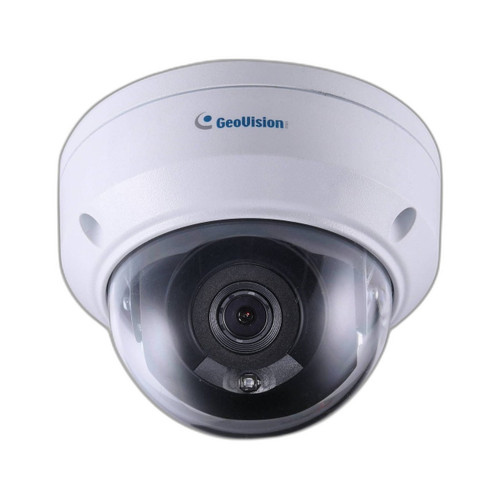
In This Guide
How do the imaging specs compare?
Both cameras share a 4MP resolution and a 2.8mm fixed lens, placing them in the same field-of-view and pixel-density class. The GV-ADR4701 specifies H.265 compression, which typically reduces storage and bandwidth consumption by roughly half compared to H.264. The EBD474W-0010's compression codec is not specified in the provided data, so a direct compression comparison cannot be made. Both units include IR night vision, and the EBD474W-0010 carries an explicit 'Super Low Lux IR' designation, indicating enhanced sensitivity in near-zero ambient light conditions. The GV-ADR4701 lists standard IR without a low-lux rating.
On dynamic range, the EBD474W-0010 specifies 'WDR Pro,' a higher-tier WDR implementation, while the GV-ADR4701 lists standard 'WDR.' WDR Pro is designed to recover both highlight and shadow detail simultaneously in mixed-lighting scenes. No minimum illumination figures, IR range distances, sensor size, frame rate, or bitrate values are provided in the specifications for either model, limiting a full low-light or motion-clarity comparison.
What about installation and environment?
The GV-ADR4701 carries IP66 and IK10 ratings, confirming dust-tight and jet-water-resistant protection alongside resistance to vandal impact equivalent to a 20-joule strike. These ratings make it suitable for exposed outdoor locations, high-traffic corridors, and areas with deliberate tampering risk. The EBD474W-0010 does not include any IP or IK rating in the provided specifications, so its environmental and vandal resistance cannot be assessed from the available data.
The GV-ADR4701 specifies a maximum power draw of 11W and an operating temperature range of 0°C to 50°C, and is PoE-compatible per the ONVIF/NVR spec context. Both cameras share ceiling and wall mount compatibility in a dome form factor. The EBD474W-0010 provides no power consumption figure, PoE class, or operating temperature range in the provided specifications.
Which fits your VMS and analytics better?
Both cameras are listed as ONVIF-compliant, enabling drop-in integration with third-party NVR/DVR platforms and standard VMS environments. The GV-ADR4701 specifies compatibility with 'NVR/DVR systems' broadly, while the EBD474W-0010 additionally calls out 'Geovision ecosystem' compatibility, which may provide deeper feature integration—such as access to Geovision-native analytics, event rules, or management software—when deployed within an all-Geovision infrastructure. The EBD474W-0010 also lists 'single-mode' under its mode specification; the meaning of this field in context is ambiguous and cannot be interpreted further from the provided data.
Neither camera lists on-board edge storage (SD card), audio input/output, or built-in video analytics in the provided specifications. No warranty period, dimensions, or weight data are supplied for either unit, preventing a physical footprint or TCO comparison.
Which should you choose: the ADR4701 or the EBD474W-0010?
Our take: The GV-ADR4701 is the stronger choice when environmental hardening and confirmed compression efficiency are the primary requirements. It is the only unit of the two with documented IP66 dust and weather resistance and IK10 vandal protection, a defined 11W power draw for PoE infrastructure planning, a specified H.265 codec for storage savings, and a confirmed operating temperature range of 0°C to 50°C. The EBD474W-0010 holds an advantage in imaging performance for low-light and mixed-lighting scenarios: its Super Low Lux IR designation and WDR Pro implementation exceed the GV-ADR4701's standard IR and standard WDR specs. Choose the EBD474W-0010 for indoor or sheltered deployments where lighting conditions are challenging and a Geovision-native VMS ecosystem is already in place; choose the GV-ADR4701 for exposed outdoor or vandal-prone installations where rated environmental protection and codec efficiency drive the specification.
Side-by-Side Comparison
Spec-for-spec, from manufacturer data.
| Specification | Geovision ADR4701 | Geovision EBD474W-0010 |
|---|---|---|
| Resolution | 4 MP | 4 MP |
| Lens / Focal Length | 2.8mm fixed | 2.8mm fixed |
| Form Factor | Dome | Dome |
| Mount Type | Ceiling; Wall | Ceiling; Wall |
| Video Compression | H.265 | — |
| WDR | WDR | WDR Pro |
| IR / Low Light | IR | Super Low Lux IR |
| IP Rating | IP66 | — |
| IK / Impact Rating | IK10 | — |
| Operating Temperature | 0°C to 50°C | — |
| Power Consumption | 11 W | — |
| PoE | Yes (implied, 11W) | — |
| VMS Compatibility | ONVIF; NVR/DVR systems | ONVIF; Geovision ecosystem |
Frequently Asked Questions
Which should you choose: the ADR4701 or the EBD474W-0010?
The GV-ADR4701 is the stronger choice when environmental hardening and confirmed compression efficiency are the primary requirements. It is the only unit of the two with documented IP66 dust and weather resistance and IK10 vandal protection, a defined 11W power draw for PoE infrastructure planning, a specified H.265 codec for storage savings, and a confirmed operating temperature range of 0°C to 50°C. The EBD474W-0010 holds an advantage in imaging performance for low-light and mixed-lighting scenarios: its Super Low Lux IR designation and WDR Pro implementation exceed the GV-ADR4701's standard IR and standard WDR specs. Choose the EBD474W-0010 for indoor or sheltered deployments where lighting conditions are challenging and a Geovision-native VMS ecosystem is already in place; choose the GV-ADR4701 for exposed outdoor or vandal-prone installations where rated environmental protection and codec efficiency drive the specification.
Is the ADR4701 or EBD474W-0010 better for low light?
Based on the provided specifications, the EBD474W-0010 has the advantage: it carries a 'Super Low Lux IR' designation, indicating enhanced sensitivity in near-zero ambient light. The GV-ADR4701 lists standard IR night vision without a low-lux rating. No minimum illumination figures in lux are provided for either model, so a precise numerical comparison cannot be made.
Which camera is rated for outdoor or vandal-resistant use?
Only the GV-ADR4701 has documented environmental and impact ratings: IP66 for dust and jet-water resistance and IK10 for vandal resistance (20-joule impact). The EBD474W-0010 has no IP or IK rating listed in its specifications, so its suitability for outdoor or vandal-prone locations cannot be confirmed from the available data.
Do both cameras work with third-party VMS platforms?
Yes. Both cameras are listed as ONVIF-compliant, which enables integration with a broad range of third-party NVR/DVR and VMS systems. The EBD474W-0010 additionally specifies Geovision ecosystem compatibility, which may enable deeper native integration when used with Geovision VMS software. Neither camera lists proprietary analytics or edge storage features in the provided specifications.
Get a Second Opinion on Your Camera Choice
Share your site layout, coverage goals, and budget. Our team will validate the camera selection, flag anything we would change, and recommend products that match the use case.