
Geovision 84-TMEB58W-0010 vs Geovision MD520-100U: Specification Comparison
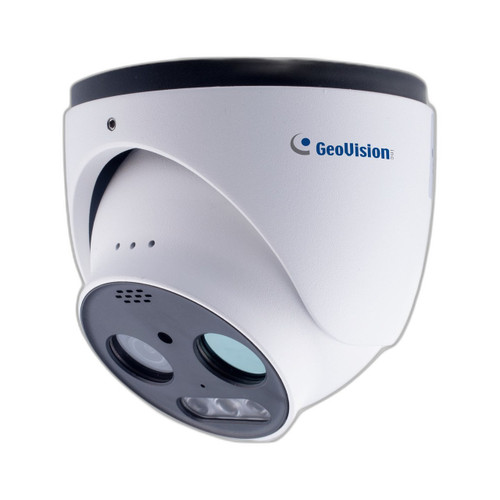
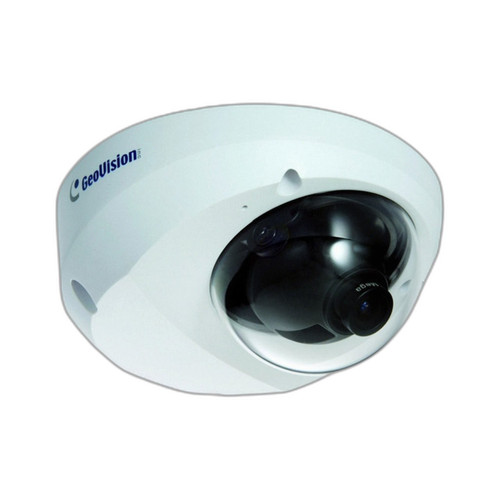
Both the Geovision 84-TMEB58W-0010 and the Geovision MD520-100U are 5MP dome-form-factor IP cameras sharing the same resolution class and ceiling/wall mounting options — a configuration that frequently lands them in the same shortlist for indoor perimeter and access-point coverage. The meaningful divergence is function: the 84-TMEB58W-0010 is a dual-sensor thermal-plus-optical unit aimed at detection in challenging lighting, while the MD520-100U is a conventional single-sensor mini-dome designed for standard video surveillance with audio.
In This Guide
How do the imaging specs compare?
Both cameras deliver 5MP optical resolution, placing them in the same pixel-count tier for detail capture. The 84-TMEB58W-0010 adds a thermal sensor alongside the optical imager, enabling detection based on heat signatures independent of visible-light conditions. It also carries WDR Pro and a Super Low Lux rating, indicating the optical channel is tuned for mixed or extreme-contrast lighting environments such as backlit entryways. No equivalent WDR or low-light specification is listed for the MD520-100U.
The MD520-100U specifies H.264 compression, which directly governs storage and bandwidth consumption — a concrete, quantifiable infrastructure factor. No compression codec is listed for the 84-TMEB58W-0010 in the provided specs. IR or illumination range figures are not provided for either model, so no numeric night-vision distance comparison can be made from the available data.
What about installation and environment?
Both cameras share the same physical form factor (dome) and support ceiling and wall mounting, so structural rough-in requirements are equivalent in that respect. Both are PoE-powered, enabling single-cable deployment without a local power supply. No IP ingress rating, IK impact rating, operating temperature range, or dimensional/weight data is provided in the specifications for either model, so environmental suitability — indoor vs. outdoor, vandal resistance, or temperature extremes — cannot be compared from the supplied data.
The 84-TMEB58W-0010 is categorized under Accessories while the MD520-100U is categorized under IPCAM; this is a catalog-classification difference and does not affect physical installation. No additional environmental or enclosure differences can be stated without further specification.
Which fits your VMS and analytics better?
The 84-TMEB58W-0010 explicitly lists ONVIF compliance and confirms interoperability with Milestone and Axis Camera Station in addition to ONVIF-generic platforms. It also carries an AI analytics designation, indicating on-camera intelligence such as object classification or intrusion detection — though specific analytic functions are not enumerated in the provided specs. No audio capability is listed for this model.
The MD520-100U supports ONVIF as well and additionally integrates with Geovision-native platforms GV-Center and GV-Air, making it a tighter fit for existing Geovision VMS deployments. It specifies two-way audio, which the 84-TMEB58W-0010 does not. Neither model lists on-board edge storage capability in the provided specifications. No AI or advanced analytics designation is listed for the MD520-100U.
Which should you choose: the 84-TMEB58W-0010 or the MD520-100U?
Our take: The 84-TMEB58W-0010 is the stronger choice when the deployment requires detection capability beyond visible-light imaging — its dual optical-plus-thermal sensor addresses scenarios where lighting cannot be controlled and conventional cameras fail. Its WDR Pro and Super Low Lux ratings reinforce its optical channel for high-contrast conditions, and its AI analytics add on-camera intelligence absent from the MD520-100U. Conversely, the MD520-100U is the pragmatic pick for standard indoor surveillance on a Geovision VMS: it specifies H.264 compression for measurable storage efficiency, two-way audio for loss-prevention or intercom use, and native compatibility with GV-Center and GV-Air that the 84-TMEB58W-0010 does not list. IP/IK ratings, temperature range, and edge storage are unspecified for both models, so environmental hardening cannot factor into this comparison without additional data from the manufacturer.
Side-by-Side Comparison
Spec-for-spec, from manufacturer data.
| Specification | Geovision 84-TMEB58W-0010 | Geovision MD520-100U |
|---|---|---|
| Resolution | 5 MP | 5 MP |
| Type | Thermal & Optical Dome Camera | Mini-Dome IP Camera |
| Thermal Sensor | Yes (dual-sensor) | — |
| WDR | WDR Pro | — |
| Min. Illumination / Low Light | Super Low Lux | — |
| Video Compression | — | H.264 |
| AI / Edge Analytics | AI | — |
| Audio | — | Two-way |
| Power | PoE | PoE |
| Connectivity | Ethernet | PoE |
| Form Factor | Dome | Dome |
| Mount Type | Ceiling; Wall | Ceiling; Wall |
| ONVIF | Yes | Yes |
| VMS Compatibility | ONVIF; Milestone; Axis Camera Station | ONVIF; Geovision GV-Center; GV-Air |
Frequently Asked Questions
Which should you choose: the 84-TMEB58W-0010 or the MD520-100U?
The 84-TMEB58W-0010 is the stronger choice when the deployment requires detection capability beyond visible-light imaging — its dual optical-plus-thermal sensor addresses scenarios where lighting cannot be controlled and conventional cameras fail. Its WDR Pro and Super Low Lux ratings reinforce its optical channel for high-contrast conditions, and its AI analytics add on-camera intelligence absent from the MD520-100U. Conversely, the MD520-100U is the pragmatic pick for standard indoor surveillance on a Geovision VMS: it specifies H.264 compression for measurable storage efficiency, two-way audio for loss-prevention or intercom use, and native compatibility with GV-Center and GV-Air that the 84-TMEB58W-0010 does not list. IP/IK ratings, temperature range, and edge storage are unspecified for both models, so environmental hardening cannot factor into this comparison without additional data from the manufacturer.
Is the 84-TMEB58W-0010 or the MD520-100U better for low-light performance?
Based on available specs, the 84-TMEB58W-0010 has the advantage: it carries both a Super Low Lux rating on its optical channel and a thermal sensor that detects heat signatures regardless of ambient light. The MD520-100U lists no low-light, IR, or WDR specification in the provided data, so a direct numeric comparison cannot be made.
Which camera works with a Geovision GV-Center VMS?
The MD520-100U explicitly lists GV-Center and GV-Air compatibility in its VMS specifications. The 84-TMEB58W-0010 lists ONVIF, Milestone, and Axis Camera Station — GV-Center is not listed for it. If your infrastructure is Geovision-native, the MD520-100U is the confirmed fit based on available specs.
Does either camera support two-way audio?
Yes — the MD520-100U specifies two-way audio. The 84-TMEB58W-0010 does not list any audio capability in the provided specifications.
Get a Second Opinion on Your Camera Choice
Share your site layout, coverage goals, and budget. Our team will validate the camera selection, flag anything we would change, and recommend products that match the use case.