
Digital Watchdog DWC-XSBE05Mi vs Hanwha XNO-8080R: Specification Comparison
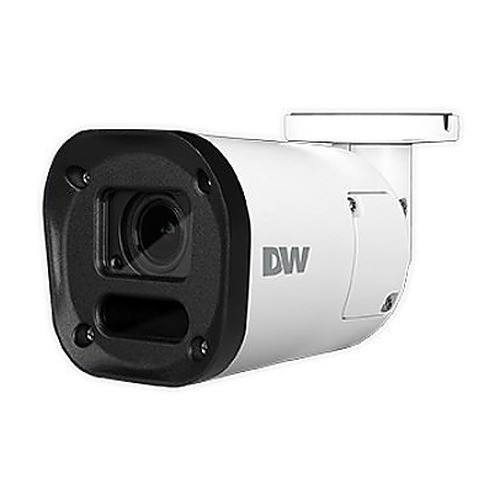
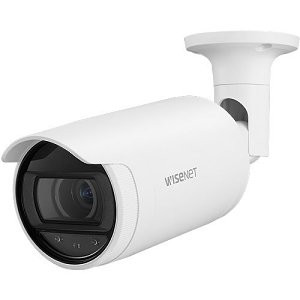
Both the Digital Watchdog DWC-XSBE05Mi and the Hanwha XNO-8080R are 5MP outdoor fixed bullet IP cameras designed for perimeter and exterior surveillance. They occupy the same resolution class, share a motorized varifocal lens, PoE power delivery, IK10 vandal resistance, and IP67 weatherproofing. This comparison examines how their sensor characteristics, lens range, IR performance, installation requirements, and analytics capabilities differ to help integrators and IT buyers determine the better fit for a given deployment.
In This Guide
How do the imaging specs compare?
The DWC-XSBE05Mi uses a 1/2.8" 5MP CMOS sensor with an active pixel array of 2592×1944, while the XNO-8080R uses a larger 1/1.8" 6MP CMOS sensor downsampled to a 5MP output. The larger physical sensor in the XNO-8080R collects more light per pixel, which is reflected in its rated minimum color illumination of 0.07 lux versus 0.04 lux (color) for the DWC-XSBE05Mi. Both cameras reach 0 lux in IR mode. WDR performance is rated identically at 120dB on both models. The XNO-8080R adds a maximum aperture of F1.2, a spec not provided for the DWC-XSBE05Mi.
On the lens side, the DWC-XSBE05Mi offers a wider motorized varifocal range of 2.7–13.5mm (5x optical zoom) with a horizontal field of view spanning 98.3°–31.6°. The XNO-8080R covers a narrower 3.7–9.4mm range (2.5x optical zoom) with an HFOV of 100.2° at the wide end. IR range is 120ft (approx. 36.6m) for the DWC-XSBE05Mi versus 50m (164ft) for the XNO-8080R—the Hanwha unit reaches farther in darkness. Both support auto day/night switching; the XNO-8080R specifies an ICR (IR Cut Filter) mechanism, the DWC-XSBE05Mi specifies auto day/night without explicitly naming ICR.
What about installation and environment?
Both cameras are IP67-rated for dust and water ingress and carry an IK10 impact resistance rating. The XNO-8080R additionally holds an IP66 and NEMA 4X certification, providing a higher-grade seal against water jets and corrosive environments—a meaningful distinction for washdown or coastal deployments. Both are aluminum-housed bullet cameras. The DWC-XSBE05Mi weighs 2.13 lbs (0.97 kg) with dimensions of 197.5×86mm, while the XNO-8080R is significantly heavier at 4.81 lbs (2.18 kg) and larger at Ø91×368.6mm—relevant for junction box selection and bracket load ratings.
On power, the DWC-XSBE05Mi draws a maximum of 8.8W and is classified as PoE Class 1, making it compatible with virtually any 802.3af switch port. The XNO-8080R draws up to 12.95W as a PoE Class 3 device, requiring a switch port budgeted for that load. Both also accept 12V DC; the XNO-8080R additionally supports 24VAC. The DWC-XSBE05Mi is rated for –20°C to +50°C (–4°F to +122°F). The XNO-8080R operates across a significantly wider range of –40°C to +55°C (–40°F to +131°F), making it the clear choice for extreme-cold or high-heat environments.
Which fits your VMS and analytics better?
Both cameras are ONVIF-conformant. The DWC-XSBE05Mi is validated with DW Spectrum IPVMS and any ONVIF-compliant CMS. The XNO-8080R supports ONVIF Profile S/G/T plus Hanwha's SUNAPI (HTTP API) and the Wisenet open platform, providing deeper integration hooks for Hanwha-ecosystem VMS deployments. The XNO-8080R also supports up to 10 simultaneous streaming profiles and unicast to 20 users; the DWC-XSBE05Mi supports triple streaming (third stream MJPEG only). The XNO-8080R includes WiseStream II smart codec for bandwidth optimization; no equivalent is specified for the DWC-XSBE05Mi.
On edge analytics, the DWC-XSBE05Mi offers deep learning object tracking with filters for zones, lines, intrusion, counting, dwell, and tailgating. The XNO-8080R lists a broader catalog of analytics including defocus detection, fog detection, face detection, digital auto tracking, appear/disappear, enter/exit, loitering, tampering, virtual line, audio detection, and sound classification—without specifying a deep learning engine. For on-board storage, both support microSD/SDHC/SDXC; the XNO-8080R provides two card slots with a combined maximum of 512GB versus the DWC-XSBE05Mi's single slot supporting up to 1TB. Both provide one audio input and one audio output. The XNO-8080R supports G.711 and G.726 audio compression; the DWC-XSBE05Mi supports G.711 only.
Which should you choose: the DWC-XSBE05Mi or the XNO-8080R?
Our take: The DWC-XSBE05Mi is the stronger choice when flexible framing range and lower PoE power budget are the priority: its 2.7–13.5mm lens (5x vs 2.5x) covers a wider zoom span, and its 8.8W Class 1 draw places less demand on switch infrastructure than the XNO-8080R's 12.95W Class 3 requirement. The XNO-8080R counters with a larger 1/1.8" sensor, an F1.2 aperture, 50m IR versus 120ft, a wider operating temperature range (–40°C to +55°C vs –20°C to +50°C), additional NEMA 4X and IP66 certifications, dual SD card slots, a richer analytics library, and ONVIF Profile T plus SUNAPI for deeper VMS integration. Choose the DWC-XSBE05Mi for Digital Watchdog Spectrum environments needing wide zoom flexibility on constrained PoE budgets; choose the XNO-8080R for Hanwha/Wisenet ecosystems, extreme-temperature sites, washdown-rated enclosures, or deployments requiring extended IR range.
Side-by-Side Comparison
Spec-for-spec, from manufacturer data.
| Specification | Digital Watchdog DWC-XSBE05Mi | Hanwha XNO-8080R |
|---|---|---|
| Resolution | 5MP (2592×1944) | 5MP (sensor: 6MP 1/1.8" CMOS) |
| Image Sensor | 1/2.8" 5MP CMOS | 1/1.8" 6MP CMOS |
| Lens / Focal Length | Motorized varifocal 2.7–13.5mm (5x) | Motorized varifocal 3.7–9.4mm (2.5x) |
| Max Aperture | — | F1.2 |
| Horizontal FOV | 98.3°–31.6° | 100.2° (wide end) |
| Min. Illumination (Color / IR) | 0.04 lux color / 0 lux IR | 0.07 lux color / 0 lux IR |
| IR Range | 120ft (~36.6m) | 50m (164ft) |
| Wide Dynamic Range | 120dB True WDR | 120dB WDR |
| Max Frame Rate | 30fps at all resolutions | 30fps |
| Video Compression | H.265, H.264, MJPEG | H.265, H.264, MJPEG |
| IP Rating | IP67 | IP67 / IP66 / NEMA 4X |
| IK / Impact Rating | IK10 | IK10 |
| Operating Temperature | –20°C to +50°C (–4°F to +122°F) | –40°C to +55°C (–40°F to +131°F) |
| Power Input / PoE Class | 12V DC / PoE Class 1 (max 8.8W) | 12V DC, 24VAC / PoE Class 3 (max 12.95W) |
| Edge Storage | 1× microSD/SDHC/SDXC up to 1TB | 2× microSD/SDHC/SDXC up to 512GB total |
| Audio | 1 in / 1 out; G.711 | 1 in / 1 out; G.711, G.726 |
| Alarm I/O | 1 input / 1 output | 1 input / 1 output |
| Analytics | Deep learning: intrusion, line crossing, counting, dwell, tailgating | Defocus, fog, face, loitering, appear/disappear, enter/exit, virtual line, audio detection, sound classification |
| ONVIF Profile | ONVIF conformant | ONVIF Profile S/G/T |
| Dimensions | 197.5×86mm (7.77"×3.38") | Ø91×368.6mm (Ø3.58"×14.51") |
| Weight | 0.97 kg (2.13 lbs) | 2.18 kg (4.81 lbs) |
| Warranty | 5 years | 3 years |
Frequently Asked Questions
Which should you choose: the DWC-XSBE05Mi or the XNO-8080R?
The DWC-XSBE05Mi is the stronger choice when flexible framing range and lower PoE power budget are the priority: its 2.7–13.5mm lens (5x vs 2.5x) covers a wider zoom span, and its 8.8W Class 1 draw places less demand on switch infrastructure than the XNO-8080R's 12.95W Class 3 requirement. The XNO-8080R counters with a larger 1/1.8" sensor, an F1.2 aperture, 50m IR versus 120ft, a wider operating temperature range (–40°C to +55°C vs –20°C to +50°C), additional NEMA 4X and IP66 certifications, dual SD card slots, a richer analytics library, and ONVIF Profile T plus SUNAPI for deeper VMS integration. Choose the DWC-XSBE05Mi for Digital Watchdog Spectrum environments needing wide zoom flexibility on constrained PoE budgets; choose the XNO-8080R for Hanwha/Wisenet ecosystems, extreme-temperature sites, washdown-rated enclosures, or deployments requiring extended IR range.
Is the DWC-XSBE05Mi or XNO-8080R better for low-light performance?
Both reach 0 lux in IR mode. In color/ambient light, the DWC-XSBE05Mi is rated at 0.04 lux versus the XNO-8080R's 0.07 lux, suggesting a slight edge for the Digital Watchdog unit in near-darkness color mode. However, the XNO-8080R has a larger 1/1.8" sensor (vs 1/2.8") and a specified F1.2 maximum aperture—specs not provided for the DWC-XSBE05Mi—which typically improve passive light gathering. The XNO-8080R also offers a longer IR range of 50m versus approximately 36.6m (120ft) for the DWC-XSBE05Mi.
Which camera is easier to install on a standard PoE switch?
The DWC-XSBE05Mi is easier to deploy on a standard switch: it is PoE Class 1 with a maximum draw of 8.8W, which fits within the 15.4W budget of any 802.3af port. The XNO-8080R is PoE Class 3, drawing up to 12.95W, which still fits within 802.3af but consumes most of the port's available budget. On a switch with tight per-port power allocations or a limited total PoE budget, the DWC-XSBE05Mi places less strain on the power plant.
Which camera is better suited for extreme outdoor temperatures?
The XNO-8080R is the clear choice for extreme temperatures. Its operating range is –40°C to +55°C (–40°F to +131°F), covering arctic-cold and high-heat deployments. The DWC-XSBE05Mi is rated for –20°C to +50°C (–4°F to +122°F), which excludes the coldest climates. For applications in northern regions with sustained sub-freezing temperatures, or in high-heat industrial environments above 50°C, the XNO-8080R's wider thermal envelope is a decisive advantage.
Get a Second Opinion on Your Camera Choice
Share your site layout, coverage goals, and budget. Our team will validate the camera selection, flag anything we would change, and recommend products that match the use case.