
Digital Watchdog DWC-XSBE05Mi vs Hanwha QNO-8080R: Specification Comparison
Both the Digital Watchdog DWC-XSBE05Mi and the Hanwha QNO-8080R are 5MP outdoor fixed bullet IP cameras aimed at perimeter and parking surveillance applications. They share the same resolution class (2592×1944), the same camera form factor, and both support PoE and ONVIF. Installers and IT buyers comparing these two will find meaningful differences in lens zoom range, low-light performance, deep-learning analytics depth, operating temperature range, IP weatherproof rating, and warranty length—all of which can tip a project decision depending on site requirements.
In This Guide
How do the imaging specs compare?
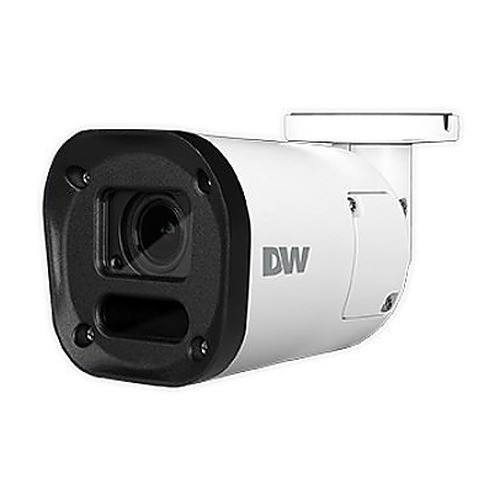
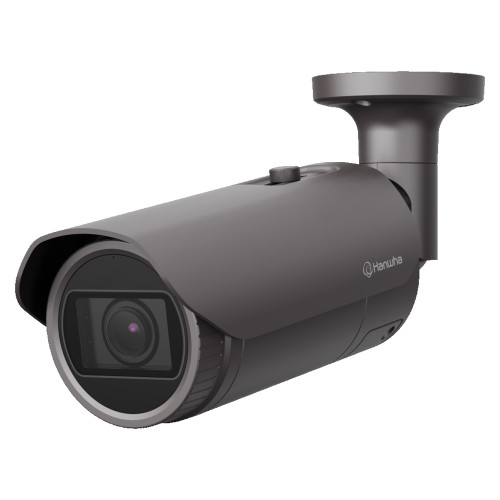
Both cameras use a 1/2.8" CMOS sensor at 5MP (2592×1944) and deliver 30fps at full resolution. The DWC-XSBE05Mi offers a motorized varifocal lens spanning 2.7–13.5mm, yielding a 5x optical zoom ratio and a horizontal field of view of 98.3° (wide) to 31.6° (tele). The QNO-8080R carries a narrower motorized varifocal at 3.2–10mm, providing a 3.1x optical zoom ratio and a horizontal field of view of 101° (wide) to an implied narrower tele end. For sites needing greater stand-off distance or a tighter tele view, the DWC-XSBE05Mi's 5x zoom range is the broader tool.
On low light, the QNO-8080R specifies 0.15 lux in color and 0 lux with IR active, whereas the DWC-XSBE05Mi specifies 0.04 lux in color and 0.0 lux in B/W—indicating a slightly more sensitive color mode on the Digital Watchdog unit. Both cameras claim 0 lux IR performance. IR illumination range is essentially equivalent: the DWC-XSBE05Mi lists 120 ft (≈36.6m) Smart IR; the QNO-8080R lists 30m (98.42 ft). Both feature 120dB True WDR, making that spec a draw. The DWC-XSBE05Mi adds a De-fog function and P-iris lens control, neither of which is listed in the QNO-8080R specifications.
What about installation and environment?
The DWC-XSBE05Mi is rated IP67 and IK10, meaning it is dust-tight and withstands temporary immersion up to 1m depth, while the QNO-8080R is rated IP66 and IK10—dust-tight but rated only against powerful water jets, not immersion. Both carry IK10 vandal resistance. Operating temperature is a significant differentiator: the QNO-8080R is rated −30°C to +55°C (−22°F to +131°F), giving it a considerably wider cold-weather envelope than the DWC-XSBE05Mi's −20°C to +50°C (−4°F to +122°F). Installers in harsh northern climates should weigh the Hanwha's 10°C cold-side advantage.
Power requirements differ by PoE class: the DWC-XSBE05Mi draws a maximum of 8.8W and is classified PoE Class 1, while the QNO-8080R draws a maximum of 9.5W (typical 7.3W) and is classified PoE Class 3. Both use a standard RJ-45 10/100Base-T interface. The DWC-XSBE05Mi weighs 0.97 kg (2.13 lb) and measures 197.5×86mm; the QNO-8080R weighs 1.19 kg (2.62 lb) and measures ø91×322.9mm. Mounting accessories are sold separately for the DWC-XSBE05Mi; the QNO-8080R lists a compatible backbox (SBO-126B). Both housings are aluminum die-cast construction.
Which fits your VMS and analytics better?
Both cameras are ONVIF-conformant. The QNO-8080R specifies ONVIF Profile S, G, and T, adds SUNAPI (Hanwha's HTTP API), and supports the Wisenet open platform—useful for deep integration with Hanwha Wave VMS or third-party systems that support SUNAPI. The DWC-XSBE05Mi is compatible with any ONVIF-conformant CMS and natively with DW Spectrum IPVMS; its ONVIF profile levels are not enumerated in the provided specifications. On analytics, the DWC-XSBE05Mi explicitly lists deep learning object tracking and filters including intrusion, virtual line crossing, counting, dwell time, and tailgating. The QNO-8080R lists motion detection, tampering, defocus detection, virtual area (intrusion/enter/exit), and virtual line (crossing/direction) analytics; deep learning is not stated in the provided specifications.
Audio support is present on the DWC-XSBE05Mi (1 audio in at 1.0Vms/3KΩ, 1 audio out, G.711 compression) and is not listed in the QNO-8080R provided specifications. Both cameras provide one alarm input and one alarm output. Edge storage reaches up to 1TB microSD/SDHC/SDXC on the DWC-XSBE05Mi versus up to 128GB on the QNO-8080R. The QNO-8080R documents a richer security posture in its specifications: SRTP, WSS, SD card partition encryption, device certificate (Hanwha Private Root CA), firmware encryption, and user access/system/event audit logs, none of which are listed for the DWC-XSBE05Mi. Protocol coverage is broader on the QNO-8080R (IPv6, IGMP, QoS, UPnP, Bonjour, LLDP listed versus IPv4 only on the DWC-XSBE05Mi).
Which should you choose: the DWC-XSBE05Mi or the QNO-8080R?
Our take: The DWC-XSBE05Mi is the stronger choice when flexible framing, deep-learning analytics, audio capture, and maximum on-board storage capacity are the priority. Its 5x optical zoom (2.7–13.5mm) versus the QNO-8080R's 3.1x (3.2–10mm) provides meaningfully greater stand-off coverage adjustment, and its explicit deep learning object tracking with dwell, counting, and tailgating filters goes beyond what the QNO-8080R's provided specifications describe. Its microSD support up to 1TB also doubles the Hanwha's 128GB limit for standalone edge recording. The QNO-8080R counters with a 10°C wider cold-weather operating range (−30°C vs −20°C lower limit), a more extensively documented cybersecurity stack (SRTP, firmware encryption, SD partition encryption, device certificate), native IPv6 and SUNAPI integration, and a broader ONVIF profile set (S/G/T). Choose the DWC-XSBE05Mi for analytics-intensive, audio-enabled, high-storage deployments on DW Spectrum; choose the QNO-8080R for cold-climate sites, Hanwha Wave VMS environments, or installations with strict cybersecurity compliance requirements.
Side-by-Side Comparison
Spec-for-spec, from manufacturer data.
| Specification | Digital Watchdog DWC-XSBE05Mi | Hanwha QNO-8080R |
|---|---|---|
| Resolution | 5MP (2592×1944) | 5MP (2592×1944) |
| Image Sensor | 1/2.8" CMOS | 1/2.8" CMOS |
| Lens / Focal Length | Motorized varifocal 2.7–13.5mm (5x optical zoom) | Motorized varifocal 3.2–10mm (3.1x optical zoom) |
| Horizontal Field of View | 98.3° (wide) – 31.6° (tele) | 101° (wide) – not specified (tele) |
| Min. Illumination (Color / IR) | 0.04 lux color / 0.0 lux B&W | 0.15 lux color / 0 lux IR |
| IR Range | 120 ft (≈36.6m) Smart IR | 30m (98.42 ft), 850nm LED |
| Wide Dynamic Range | 120dB True WDR | 120dB WDR |
| Max Frame Rate | 30fps at all resolutions | 30fps @ 5MP |
| Video Compression | H.265, H.264, MJPEG | H.265, H.264, MJPEG |
| IP Rating | IP67 | IP66 |
| IK / Impact Rating | IK10 | IK10 |
| Operating Temperature | −20°C to +50°C (−4°F to +122°F) | −30°C to +55°C (−22°F to +131°F) |
| Power Input / PoE Class | PoE, Class 1, max 8.8W | PoE 802.3af, Class 3, max 9.5W / typical 7.3W |
| Edge Storage | microSD/SDHC/SDXC up to 1TB | microSD/SDHC/SDXC up to 128GB |
| Audio | 1 in / 1 out, G.711 | — |
| Alarm I/O | 1 input / 1 output | 1 input / 1 output |
| Analytics | Deep learning: object tracking, intrusion, line crossing, counting, dwell, tailgating | Motion detection, tampering, defocus, virtual area/line (intrusion, enter/exit, crossing, direction) |
| ONVIF | ONVIF conformant (profile levels not specified) | ONVIF Profile S, G, T |
| Weight | 0.97 kg (2.13 lb) | 1.19 kg (2.62 lb) |
| Warranty | 5 years | 3 years |
Frequently Asked Questions
Which should you choose: the DWC-XSBE05Mi or the QNO-8080R?
The DWC-XSBE05Mi is the stronger choice when flexible framing, deep-learning analytics, audio capture, and maximum on-board storage capacity are the priority. Its 5x optical zoom (2.7–13.5mm) versus the QNO-8080R's 3.1x (3.2–10mm) provides meaningfully greater stand-off coverage adjustment, and its explicit deep learning object tracking with dwell, counting, and tailgating filters goes beyond what the QNO-8080R's provided specifications describe. Its microSD support up to 1TB also doubles the Hanwha's 128GB limit for standalone edge recording. The QNO-8080R counters with a 10°C wider cold-weather operating range (−30°C vs −20°C lower limit), a more extensively documented cybersecurity stack (SRTP, firmware encryption, SD partition encryption, device certificate), native IPv6 and SUNAPI integration, and a broader ONVIF profile set (S/G/T). Choose the DWC-XSBE05Mi for analytics-intensive, audio-enabled, high-storage deployments on DW Spectrum; choose the QNO-8080R for cold-climate sites, Hanwha Wave VMS environments, or installations with strict cybersecurity compliance requirements.
Is the DWC-XSBE05Mi or QNO-8080R better for low-light color performance?
Based on the provided specifications, the DWC-XSBE05Mi lists a color minimum illumination of 0.04 lux versus the QNO-8080R's 0.15 lux, indicating the Digital Watchdog camera is more sensitive in color mode. Both cameras reach 0 lux with IR active. Both also specify 120dB WDR for high-contrast scenes. If color-mode sensitivity in dim ambient light is the deciding factor, the DWC-XSBE05Mi holds a numerical advantage per the published specs.
Which camera is better suited for very cold outdoor environments?
The Hanwha QNO-8080R is rated for operation down to −30°C (−22°F), while the Digital Watchdog DWC-XSBE05Mi is rated to −20°C (−4°F). For installations in northern climates or unheated enclosures where temperatures can drop below −20°C, the QNO-8080R's extended cold-temperature rating provides a 10°C margin of additional protection per the provided specifications.
Does either camera support audio, and which has more on-board storage?
The DWC-XSBE05Mi includes one audio input and one audio output with G.711 compression per its specifications; audio capability is not listed in the QNO-8080R's provided specifications. For edge storage, the DWC-XSBE05Mi supports microSD/SDHC/SDXC cards up to 1TB, while the QNO-8080R supports up to 128GB. If audio recording or large local video buffers are required, the DWC-XSBE05Mi holds a clear advantage on both counts.
Get a Second Opinion on Your Camera Choice
Share your site layout, coverage goals, and budget. Our team will validate the camera selection, flag anything we would change, and recommend products that match the use case.