
Digital Watchdog DWC-XSBE05Mi vs Hanwha QNO-8010R: Specification Comparison
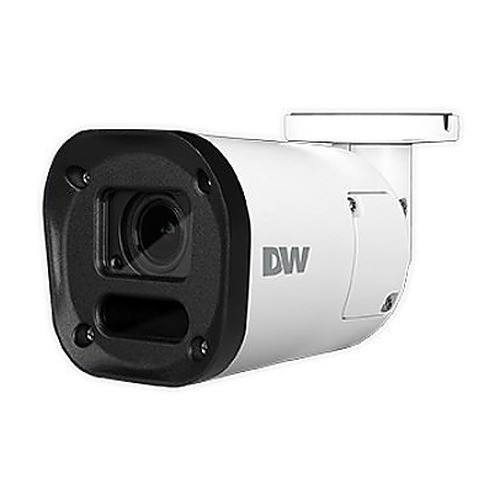
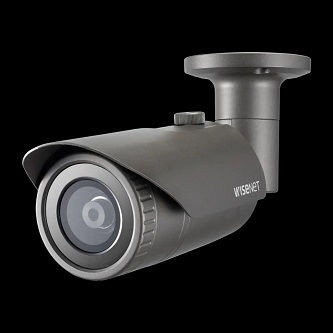
Both the Digital Watchdog DWC-XSBE05Mi and the Hanwha QNO-8010R are 5MP outdoor bullet IP cameras aimed at perimeter and general-purpose surveillance installations. They share the same resolution class (2592×1944), the same fixed-camera form factor, and both target PoE-powered wired deployments. A buyer evaluating either would be choosing between Digital Watchdog's motorized varifocal lens with deep-learning analytics and Hanwha's fixed wide-angle lens with a stronger cold-weather rating and more mature cybersecurity feature set.
In This Guide
How do the imaging specs compare?
Both cameras use a 1/2.8" CMOS sensor delivering 2592×1944 (5MP) at 30fps with 120dB Wide Dynamic Range. The DWC-XSBE05Mi offers a motorized varifocal lens spanning 2.7–13.5mm (5× optical zoom) with auto-focus and P-iris, giving the installer flexible field-of-view adjustment post-mount — HFOV ranging from 98.3° down to 31.6°. The QNO-8010R uses a fixed 2.8mm lens at F2.0, providing a wide 105° HFOV with no optical zoom; focus is set at the factory and cannot be adjusted in the field.
On low-light performance, the DWC-XSBE05Mi reaches 0.04 lux in color and 0.0 lux in IR mode with a stated IR range of 120ft (36.6m). The QNO-8010R specifies 0.15 lux in color and 0 lux in IR mode, with an 850nm IR LED rated to 20m (65.6ft). The DWC-XSBE05Mi therefore offers nearly double the IR throw distance per spec. Hanwha publishes explicit DORI distances — Detect at 40m, Observe at 16m, Recognize at 8m, Identify at 4m — giving integrators a concrete coverage planning baseline; Digital Watchdog does not publish equivalent DORI figures.
What about installation and environment?
The DWC-XSBE05Mi is rated IP67 and IK10, meaning it is dust-tight and withstands temporary immersion as well as 20-joule impacts. The QNO-8010R is rated IP66 and IK10 — also fully dust-tight but rated only against powerful water jets, not immersion. Both carry equivalent vandal resistance. The DWC-XSBE05Mi operates from -20°C to +50°C (-4°F to +122°F); the QNO-8010R operates from -30°C to +55°C (-22°F to +131°F), giving it a meaningful 10°C cold-weather advantage relevant to northern-climate outdoor deployments.
Power draw differs: the DWC-XSBE05Mi draws up to 8.8W and is specified as PoE Class 1 (max 3.84W budgeted by the switch), which appears inconsistent with its 8.8W max — installers should verify switch port budgeting before deployment. The QNO-8010R draws a max of 7.5W (typical 6.1W) and is specified as PoE Class 3 (max 15.4W budgeted), which comfortably covers its actual draw. The DWC-XSBE05Mi weighs 0.97kg (2.13 lbs) and measures 197.5×86mm; the QNO-8010R is lighter at 680g (1.50 lbs) with a ø70×246mm profile. Mounting accessories are sold separately for the DWC-XSBE05Mi; Hanwha lists the SBO-100B1 back-box as an available accessory.
Which fits your VMS and analytics better?
Both cameras support ONVIF and H.265/H.264/MJPEG compression with CBR/VBR control and triple-stream output. The DWC-XSBE05Mi is additionally compatible with DW Spectrum IPVMS and any ONVIF-conformant CMS. The QNO-8010R supports ONVIF Profile S/G/T, Hanwha's SUNAPI (HTTP API), and the Wisenet open platform, providing a broader API surface for Hanwha VMS ecosystems. The QNO-8010R also includes WiseStream II smart codec, which can reduce bandwidth consumption dynamically; no equivalent adaptive codec is listed for the DWC-XSBE05Mi.
On analytics, the DWC-XSBE05Mi specifies deep learning object tracking with zone, line, intrusion, counting, dwell, and tailgating filters — a richer on-camera analytics set per the published spec. The QNO-8010R lists motion detection, tampering, defocus detection, virtual area (intrusion/enter/exit), and virtual line (crossing/direction) without specifying deep learning. Both provide 1-in/1-out alarm I/O and audio I/O; the DWC-XSBE05Mi lists G.711 audio compression explicitly while the QNO-8010R's audio spec is not detailed in the provided data. Edge storage is microSD up to 1TB on the DWC-XSBE05Mi and microSD up to 128GB on the QNO-8010R. Cybersecurity features are more extensively documented on the QNO-8010R: AES encryption, SDcard partition encryption, firmware encryption, device certificate (Hanwha Private Root CA), brute-force attack prevention, and full audit logging — details not enumerated in the DWC-XSBE05Mi spec sheet.
Which should you choose: the DWC-XSBE05Mi or the QNO-8010R?
Our take: The DWC-XSBE05Mi is the stronger choice when the installation requires flexible field-of-view adjustment after mounting, greater IR throw distance, or deep-learning analytics without a Hanwha VMS. Its motorized 2.7–13.5mm varifocal lens (5× optical zoom, HFOV 98.3°–31.6°) eliminates the need to swap lenses at height, and its 120ft IR range nearly doubles the QNO-8010R's 65.6ft. It also supports up to 1TB edge storage versus the QNO-8010R's 128GB cap and carries a 5-year warranty versus Hanwha's 3-year. Conversely, the QNO-8010R is the stronger choice for cold-climate sites (rated to -30°C vs -20°C), Hanwha/Wisenet VMS environments (SUNAPI, ONVIF Profile S/G/T, WiseStream II), and deployments where documented cybersecurity compliance matters — the QNO-8010R's AES encryption, firmware encryption, device certificates, and audit logging are explicitly specified; the DWC-XSBE05Mi's equivalent features are not. Installers should also note the DWC-XSBE05Mi's PoE Class 1 designation against its 8.8W draw and verify switch compatibility before deployment.
Side-by-Side Comparison
Spec-for-spec, from manufacturer data.
| Specification | Digital Watchdog DWC-XSBE05Mi | Hanwha QNO-8010R |
|---|---|---|
| Resolution | 5MP (2592×1944) | 5MP (2592×1944) |
| Image Sensor | 1/2.8" CMOS | 1/2.8" CMOS |
| Max Frame Rate | 30fps at all resolutions | 30fps @ 5MP |
| Lens / Focal Length | Motorized varifocal 2.7–13.5mm (5× optical zoom) | Fixed 2.8mm, F2.0 |
| Horizontal Field of View | 98.3°–31.6° (zoom range) | 105° |
| Min. Illumination (Color / IR) | 0.04 lux color / 0.0 lux IR | 0.15 lux color / 0 lux IR |
| IR Range | 120ft (36.6m) Smart IR | 20m (65.6ft), 850nm LED |
| Wide Dynamic Range | 120dB True WDR | 120dB WDR (BLC, SSDR also listed) |
| Video Compression | H.265, H.264, MJPEG | H.265, H.264, MJPEG |
| IP Rating | IP67 | IP66 |
| IK / Impact Rating | IK10 | IK10 |
| Operating Temperature | -20°C to +50°C (-4°F to +122°F) | -30°C to +55°C (-22°F to +131°F) |
| Power Input / PoE Class | PoE, Class 1 (max draw 8.8W — verify switch budget) | PoE IEEE 802.3af, Class 3 (max 7.5W / typical 6.1W) |
| Edge Storage | microSD/SDHC/SDXC up to 1TB | microSD/SDHC/SDXC up to 128GB |
| Audio I/O | 1 in / 1 out (G.711) | 1 in / 1 out (compression not specified in provided data) |
| Alarm I/O | 1 in / 1 out | 1 in / 1 out |
| Analytics | Deep learning object tracking; intrusion, line, counting, dwell, tailgating | Motion detection, tampering, defocus, virtual area/line (no deep learning specified) |
| ONVIF | ONVIF conformant | ONVIF Profile S/G/T |
| Weight | 0.97kg (2.13 lbs) | 680g (1.50 lbs) |
| Dimensions | 197.5×86mm (7.77"×3.38") | ø70×246mm (ø2.76"×9.69") |
| Housing Material | Aluminum die-cast, white | Aluminum, dark grey |
| Warranty | 5 years | 3 years |
Frequently Asked Questions
Which should you choose: the DWC-XSBE05Mi or the QNO-8010R?
The DWC-XSBE05Mi is the stronger choice when the installation requires flexible field-of-view adjustment after mounting, greater IR throw distance, or deep-learning analytics without a Hanwha VMS. Its motorized 2.7–13.5mm varifocal lens (5× optical zoom, HFOV 98.3°–31.6°) eliminates the need to swap lenses at height, and its 120ft IR range nearly doubles the QNO-8010R's 65.6ft. It also supports up to 1TB edge storage versus the QNO-8010R's 128GB cap and carries a 5-year warranty versus Hanwha's 3-year. Conversely, the QNO-8010R is the stronger choice for cold-climate sites (rated to -30°C vs -20°C), Hanwha/Wisenet VMS environments (SUNAPI, ONVIF Profile S/G/T, WiseStream II), and deployments where documented cybersecurity compliance matters — the QNO-8010R's AES encryption, firmware encryption, device certificates, and audit logging are explicitly specified; the DWC-XSBE05Mi's equivalent features are not. Installers should also note the DWC-XSBE05Mi's PoE Class 1 designation against its 8.8W draw and verify switch compatibility before deployment.
Is the DWC-XSBE05Mi or QNO-8010R better for low-light performance?
Both cameras reach 0 lux in IR (B&W) mode. In color mode the DWC-XSBE05Mi specifies 0.04 lux versus the QNO-8010R's 0.15 lux, giving Digital Watchdog an edge in low-light color imaging per spec. More practically, the DWC-XSBE05Mi's IR illuminator is rated to 120ft (36.6m) compared to the QNO-8010R's 20m (65.6ft), making it the better option for longer IR coverage of driveways, parking lots, or perimeter fencing. Hanwha does publish explicit DORI distance figures (Detect 40m, Observe 16m, Recognize 8m, Identify 4m) which Digital Watchdog does not, so real-world coverage planning for the QNO-8010R is more straightforward.
Which camera handles colder outdoor temperatures better?
The QNO-8010R is rated to operate down to -30°C (-22°F), whereas the DWC-XSBE05Mi's lower limit is -20°C (-4°F). For installations in northern climates where ambient temperatures regularly drop below -20°C — outdoor parking structures, cold-storage facility perimeters, northern-state or Canadian sites — the QNO-8010R provides a 10°C cold-weather buffer that the DWC-XSBE05Mi does not.
Can either camera work without a proprietary VMS?
Yes — both cameras support ONVIF, which means either will integrate with any ONVIF-conformant Video Management System. The DWC-XSBE05Mi also lists native compatibility with DW Spectrum IPVMS. The QNO-8010R supports ONVIF Profile S/G/T and Hanwha's SUNAPI HTTP API, giving it deeper integration with Wisenet/Hanwha VMS platforms and a broader API surface for custom integrations. Neither camera requires a proprietary NVR to function, but each will deliver the richest feature set when paired with its manufacturer's recommended VMS.
Get a Second Opinion on Your Camera Choice
Share your site layout, coverage goals, and budget. Our team will validate the camera selection, flag anything we would change, and recommend products that match the use case.