
Digital Watchdog DWC-VSTB04Bi vs Speco Technologies O4LT2: Specification Comparison
Both the Digital Watchdog DWC-VSTB04Bi and the Speco Technologies O4LT2 are 4MP fixed turret IP cameras designed for outdoor perimeter and entrance monitoring. They occupy the same resolution class and share a broadly similar form factor, PoE power delivery, and IP67 environmental rating, making them direct cross-shop candidates for installers evaluating mid-tier surveillance hardware. The comparison below is driven entirely by published specifications for each model, covering imaging performance, installation requirements, and integration capabilities.
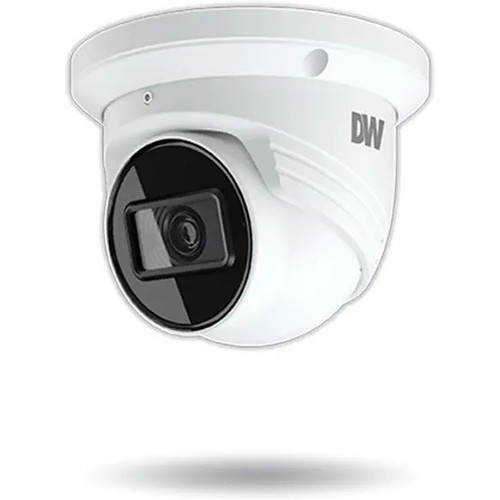
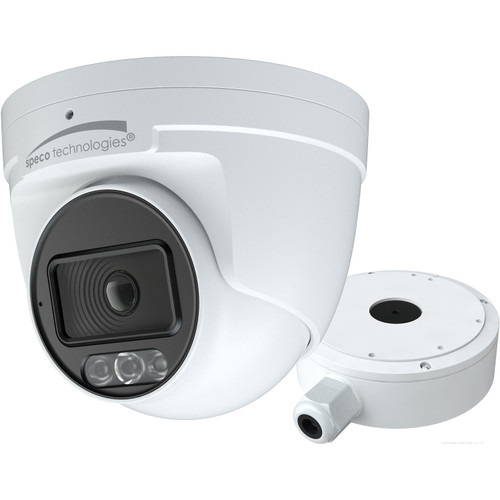
In This Guide
How do the imaging specs compare?
The DWC-VSTB04Bi uses a 1/3" CMOS sensor at 2560×1440 (4MP), while the O4LT2 uses a larger 1/1.79" CMOS sensor at 2688×1520 (4MP). The O4LT2's larger sensor format is physically bigger, which generally correlates with improved light collection per pixel, though neither datasheet specifies a minimum illumination figure for the O4LT2. The DWC-VSTB04Bi lists 0.005 lux in color mode and 0.0 lux in B/W with IR active. Both cameras ship with a fixed 2.8mm lens; the DWC-VSTB04Bi specifies a 94° HFOV, while the O4LT2 datasheet entry indicates approximately 110° HFOV—a meaningfully wider field of view if confirmed by the full datasheet.
For WDR, the DWC-VSTB04Bi specifies True WDR at 120dB, a concrete figure useful for high-contrast scenes such as doorways with backlit conditions. The O4LT2 lists WDR as a feature but does not specify a dB rating in the provided specs. Night vision approaches differ: the DWC-VSTB04Bi uses a 100-foot Smart IR illuminator for B/W night imaging at 0.0 lux, while the O4LT2 employs white light intensifier technology—meaning it produces color images at night rather than monochrome IR, a meaningful operational distinction for identification use cases. IR distance is not specified for the O4LT2.
What about installation and environment?
Both cameras carry an IP67 ingress protection rating, confirming resistance to dust and temporary water immersion. The DWC-VSTB04Bi adds an IK10 vandal resistance rating, indicating it meets the standard for resistance to 20-joule impacts—the O4LT2 does not list an IK rating in the provided specifications. Housing material for the DWC-VSTB04Bi is specified as aluminum die-casting; the O4LT2's housing material is not stated.
On operating temperature, the O4LT2 has a broader rated range of -40°F to 140°F (-40°C to 60°C), versus -22°F to 140°F (-30°C to 60°C) for the DWC-VSTB04Bi—a 18°F advantage in cold-climate installations. Both are powered via PoE; the DWC-VSTB04Bi draws a maximum of 5W and is compatible with 802.3af, while the O4LT2 lists a maximum power consumption of 5.5W. DC 12V is also listed as a power option for the O4LT2; the DWC-VSTB04Bi lists DC 12V as well (max 5W). Both cameras are described as turret form factor for wall or ceiling mounting; mounting accessories for the DWC-VSTB04Bi are sold separately. The O4LT2 datasheet notes wall/soffit mountability but does not enumerate accessory part numbers.
Which fits your VMS and analytics better?
The DWC-VSTB04Bi is ONVIF conformant and is also listed as compatible with DW Spectrum IPVMS, as well as any ONVIF-compliant CMS. The O4LT2 specifies ONVIF Profile G compliance, which adds on-board recording and playback interoperability beyond basic ONVIF streaming—a meaningful distinction for VMS integrations that leverage edge storage. Edge analytics on the DWC-VSTB04Bi include Line Crossing, Perimeter Intrusion, and Tampering Detection. The O4LT2's listed analytics are Motion Detection, Line Crossing, and Vehicle Detection—offering a vehicle classification capability not listed for the DWC-VSTB04Bi, while lacking a listed tampering detection function.
For audio, the DWC-VSTB04Bi provides 1 audio input, 1 audio output, a built-in microphone, and G.711A/U compression—supporting two-way audio with a connected external speaker. The O4LT2 lists Two-Way Audio support, though microphone and speaker integration details are not elaborated in the provided specs. On-board storage via Micro SD/SDHC/SDXC up to 1TB is specified for the DWC-VSTB04Bi; no edge storage specification is listed for the O4LT2 in the provided data. The DWC-VSTB04Bi supports dual-stream at variable rates across multiple resolutions including 4MP, 3MP, 2.1MP, 1080P, 720P, D1, and CIF; the O4LT2's streaming resolution options are not enumerated in the provided specs.
Which should you choose: the DWC-VSTB04Bi or the O4LT2?
Our take: The DWC-VSTB04Bi is the stronger choice when vandal resistance, on-board storage, and a proven low-light IR specification are primary requirements. Its IK10 aluminum housing, confirmed 1TB microSD slot, and documented 0.005 lux color / 0.0 lux B/W sensitivity with 100-foot Smart IR give installers concrete numbers to commit to in a bid. Its 120dB True WDR rating is also explicitly quantified, whereas the O4LT2 lists WDR without a dB figure. The O4LT2 counters with a larger 1/1.79" sensor, a wider approximate HFOV (~110° vs 94°), a colder minimum operating temperature (-40°F vs -22°F), ONVIF Profile G for edge-recording interoperability, and white-light color night vision—advantages for cold-climate deployments or sites where full-color after-dark footage is operationally required. Vehicle detection analytics on the O4LT2 add a classification layer not listed for the DWC-VSTB04Bi. Choose the DWC-VSTB04Bi for vandal-exposed indoor/outdoor sites needing IR night vision and local storage; choose the O4LT2 for cold-climate perimeter work or color-at-night identification requirements.
Side-by-Side Comparison
Spec-for-spec, from manufacturer data.
| Specification | Digital Watchdog DWC-VSTB04Bi | Speco Technologies O4LT2 |
|---|---|---|
| Resolution | 4MP (2560×1440) | 4MP (2688×1520) |
| Image Sensor | 1/3" CMOS | 1/1.79" CMOS |
| Lens / Focal Length | 2.8mm Fixed | 2.8mm Fixed |
| Horizontal FOV | 94° | ~110° (approx.) |
| Min. Illumination (Color) | 0.005 lux | — |
| Min. Illumination (B/W) | 0.0 lux (IR on) | — |
| Night Vision Technology | Smart IR (100 ft / ~30 m) | White light intensifier |
| WDR | True WDR 120dB | WDR (dB not specified) |
| Max Frame Rate | 30fps at all resolutions | 30fps |
| Video Compression | H.264, H.265, MJPEG | H.264, H.265, MJPEG |
| IP Rating | IP67 | IP67 |
| IK / Impact Rating | IK10 | — |
| Operating Temperature | -22°F to 140°F (-30°C to 60°C) | -40°F to 140°F (-40°C to 60°C) |
| Power Input | PoE (802.3af), DC 12V; max 5W | PoE, DC 12V; max 5.5W |
| Edge Storage | MicroSD/SDHC/SDXC up to 1TB | — |
| Audio | 1-in / 1-out, built-in mic, G.711A/U | Two-way audio |
| Edge Analytics | Line Crossing, Perimeter Intrusion, Tampering | Motion Detection, Line Crossing, Vehicle Detection |
| ONVIF | ONVIF conformant | ONVIF Profile G |
| Housing Material | Aluminum die-casting | — |
| Weight | 1.01 lbs (0.46 kg) | 1.0 lb |
| Warranty | 5 years | 3 years |
Frequently Asked Questions
Which should you choose: the DWC-VSTB04Bi or the O4LT2?
The DWC-VSTB04Bi is the stronger choice when vandal resistance, on-board storage, and a proven low-light IR specification are primary requirements. Its IK10 aluminum housing, confirmed 1TB microSD slot, and documented 0.005 lux color / 0.0 lux B/W sensitivity with 100-foot Smart IR give installers concrete numbers to commit to in a bid. Its 120dB True WDR rating is also explicitly quantified, whereas the O4LT2 lists WDR without a dB figure. The O4LT2 counters with a larger 1/1.79" sensor, a wider approximate HFOV (~110° vs 94°), a colder minimum operating temperature (-40°F vs -22°F), ONVIF Profile G for edge-recording interoperability, and white-light color night vision—advantages for cold-climate deployments or sites where full-color after-dark footage is operationally required. Vehicle detection analytics on the O4LT2 add a classification layer not listed for the DWC-VSTB04Bi. Choose the DWC-VSTB04Bi for vandal-exposed indoor/outdoor sites needing IR night vision and local storage; choose the O4LT2 for cold-climate perimeter work or color-at-night identification requirements.
Is the DWC-VSTB04Bi or O4LT2 better for low-light performance?
Based on provided specifications, the DWC-VSTB04Bi lists a minimum illumination of 0.005 lux in color mode and 0.0 lux in B/W with its 100-foot Smart IR active. The O4LT2 does not include a minimum illumination (lux) figure in the provided specs. The O4LT2 uses white-light intensifier technology for color night imaging rather than IR, which produces color footage after dark but requires active visible illumination. If IR-based B/W night vision at a documented lux threshold is required, the DWC-VSTB04Bi provides those figures; if color identification at night is the priority, the O4LT2's white-light approach is relevant.
Does either camera support local microSD recording?
Yes—the DWC-VSTB04Bi explicitly supports Micro SD/SDHC/SDXC cards up to 1TB for on-board edge storage. The O4LT2's provided specifications do not list an edge storage or microSD slot. If local recording redundancy or VMS-independent buffering is a project requirement, the DWC-VSTB04Bi has a confirmed specification for this; the O4LT2's capability in this area cannot be confirmed from the available data.
Which camera is better suited for extreme cold-weather installations?
The O4LT2 carries a rated operating temperature range of -40°F to 140°F (-40°C to 60°C), which is 18°F lower than the DWC-VSTB04Bi's rated minimum of -22°F (-30°C). For installations in northern climates, unheated outdoor enclosures, or regions regularly reaching below -22°F, the O4LT2's wider cold-side rating is the differentiating factor based on published specifications.
More IP Camera Comparisons
Get a Second Opinion on Your Camera Choice
Share your site layout, coverage goals, and budget. Our team will validate the camera selection, flag anything we would change, and recommend products that match the use case.